
Quick Hits
Selecting a solar generator has shifted from a niche hobby for off-grid enthusiasts to a core necessity for modern home backup. For those needing to run heavy appliances like well pumps or central AC during an outage, the EcoFlow Delta Pro remains the top heavyweight contender due to its 240V capability. If you are looking for the best balance of price and performance for a typical household, the Bluetti AC180 and AC200L offer impressive charging speeds and reliable LiFePO4 battery chemistry. For maximum longevity and a “buy it once” build quality, the Anker 757 PowerHouse stands out with its industrial-grade components. While DIY systems are cheaper, the convenience of these plug-and-play units provides immediate peace of mind for about 80% of users who don’t have the time to crimp their own cables and mount charge controllers.
Introduction: Choosing Power Over Hype
After researching and comparing over a dozen portable power stations and solar generators across different capacities, I’ve seen the market transform. Not long ago, we were stuck with heavy, smelly gas generators that required constant maintenance and a stockpile of fuel. Today, the conversation has moved toward silent, emissions-free energy independence. Choosing solar power systems isn’t just about being “green”; it’s about having a reliable backup that doesn’t fail when the local gas station runs out of fuel during a storm.
In 2026, the technology has matured to the point where “plug-and-play” is the standard. You shouldn’t need an engineering degree to keep your refrigerator running or your CPAP machine powered through the night. Your power setup should be as intuitive as plugging a phone into a wall outlet. However, with dozens of brands flooding the market, the challenge is separating the high-performance workhorses from the over-hyped plastic boxes that might leave you in the dark when it counts most. This guide cuts through the marketing fluff to look at real-world specs, cycle life, and what actual users are reporting from the field.
I focus on units that utilize LiFePO4 (Lithium Iron Phosphate) chemistry because your investment should last a decade, not just a couple of years. We also look closely at inverter efficiency and surge capacity—the technical details that determine whether your generator can actually handle the “kick” of a starting motor in a sump pump or a freezer.
Comparison of the Best Solar Generators
| Product Name | Best For | Price Range | Pros/Cons | Visit |
|---|---|---|---|---|
| EcoFlow Delta Pro | Whole-Home Backup | $2,500 – $3,200 | High output; 240V support / Very heavy; loud fans | |
| Bluetti AC200L | Emergency Value | $1,300 – $1,700 | Fast charging; great app / Customer service can be slow | |
| Anker 757 PowerHouse | Durability & Longevity | $800 – $1,100 | LiFePO4 safety; 5-year warranty / Limited expansion options | |
| Inergy Flex 1500 | Modular Customization | $1,200 – $1,600 | Stackable batteries; simple interface / No Bluetooth/App control | |
| Pecron E2400LFP | Budget High-Capacity | $900 – $1,200 | Accepts 3rd party batteries; high value / Heavier than competitors |
Top Picks: The Best Solar Generators by Use Case
EcoFlow Delta Pro
If your goal is to keep your entire home functional during a multi-day outage, the EcoFlow Delta Pro is the gold standard. It’s one of the few portable units that offers a native 3600W AC output and can be pushed to 7200W by chaining two units together with a Double Voltage Hub. This makes it capable of running 240V appliances like well pumps, clothes dryers, and even central air conditioning units when connected via a transfer switch. In practice, I’ve found the Delta Pro’s ability to charge at EV stations is a massive advantage if you need a quick top-up and your solar panels are struggling with cloud cover.
What Works
- Unmatched Versatility: Can power almost any household appliance, including those requiring 240V.
- Fast Charging: Recharges from 0 to 80% in under two hours using a standard wall outlet.
- Smart Ecosystem: The app control is the most polished in the industry, allowing you to monitor individual circuit draws.
What Doesn’t
- Weight Concerns: At nearly 100 lbs, the “portable” wheels are necessary, but it’s still a beast to lift into a vehicle.
- Fan Noise: When running high-wattage appliances, the cooling fans are quite loud, which can be annoying in a small living space.
- Support Reputation: Some users report long wait times for warranty claims, a common complaint for rapidly growing tech companies.
Worth It? Best for homeowners who need a serious battery backup system that can integrate with their home’s electrical panel. Skip if you only need to charge laptops and a small fan.
Bluetti AC200L
The Bluetti AC200L hits the “sweet spot” for most families. It offers a 2048Wh capacity and a 2400W pure sine wave inverter, which is enough to run a full-sized refrigerator for over 24 hours while still charging your phones and running a few lights. Many users prefer this over its predecessor, the AC200P, because of the significantly faster solar input. I’ve observed that in good sunlight, you can max out the solar intake at 1200W, meaning you could potentially recharge the entire unit in just two hours of peak sun. This is a massive improvement for those relying on solar for long-term off-grid living.
For a similar but more compact option, the Bluetti AC180 is an excellent alternative if you have slightly lower power needs but still want the same high-quality build. You might find more details in our comparison of the best portable power station with solar panels where value and efficiency are key metrics.
What Works
- Excellent Value: Provides high capacity and high output for hundreds less than the top-tier competitors.
- Fast Solar Charging: The 1200W solar input is best-in-class for this price point.
- Quiet Operation: Generally much quieter than the EcoFlow units during standard use.
What Doesn’t
- High Idle Draw: Like the AC300, it can lose a few percentage points of charge overnight if you leave the AC inverter turned on without any load.
- Display Visibility: The screen can be hard to read in direct sunlight, requiring you to use the app for precise monitoring.
Worth It? Best for emergency preparedness on a budget. It provides enough “oomph” for major appliances without the massive price tag of a whole-home system. Skip if you need 240V output.
Anker 757 PowerHouse
Anker entered the power station market with a focus on longevity, and the 757 PowerHouse is the fruit of that labor. Using automotive-grade LiFePO4 batteries, it’s rated for over 3,000 cycles to 80% capacity. That means if you used it every single day, it would still have most of its capacity left after nearly 10 years. In testing, the unit feels incredibly sturdy—it doesn’t have the “creaky” plastic feel of some cheaper brands. It’s also one of the fastest units to recharge from the wall, going from 0 to 80% in about an hour and a half.
What Works
- Build Quality: The unibody design and reinforced corners make it perfect for the back of a van or truck.
- Long Warranty: Anker offers a 5-year full-device warranty, which is one of the best in the business.
- HyperFlash Technology: The rapid AC recharge is incredibly convenient when you’re stopping at a campsite for only a few hours.
What Doesn’t
- Expansion: Unlike EcoFlow or Bluetti, you cannot easily add extra battery packs to the 757 to increase capacity later.
- Solar Input Limit: The 300W solar input is a bit lower than competitors, meaning it takes longer to charge via panels.
Worth It? Best for mobile users and campers who need a rugged, long-lasting unit that can take a beating. Skip if you plan on expanding your system in the future.
Inergy Flex 1500
The Inergy Flex 1500 is the most unique option on this list because of its modularity. Instead of one big heavy box, you have a power console that stacks on top of individual battery modules. This is brilliant for people who find 60-lb generators too heavy to lift. You can carry the battery and the console separately and click them together where you need them. It also features a purely physical button interface. While modern apps are nice, there’s something deeply reassuring about having a physical switch that works every time without needing a Wi-Fi connection or a firmware update.
Exploring portable power stations often leads users to these types of innovative designs that solve the weight and accessibility issues of traditional units.
✅ What Off-Grid Users Love
- Modular Design: Carry it in pieces to save your back; add more batteries as your budget allows.
- Ease of Use: No apps, no complicated menus—just plug in and turn on.
- DC Efficiency: Excellent for running 12V appliances like portable fridges without wasting power through the AC inverter.
What Doesn’t
- Outdated Display: The screen is small and doesn’t provide the detailed wattage history found on newer smart units.
- Proprietary Cables: You are locked into Inergy’s ecosystem for some connections, which can be frustrating if you like to DIY.
Worth It? Best for users with physical mobility constraints or those who want a simple, “no-fuss” interface. Skip if you love tracking every watt via a smartphone app.
Pecron E2400LFP
Pecron is often overlooked, but the E2400LFP is a hidden gem for the budget-conscious prepper. Its standout feature is its willingness to play nice with others. It allows for expansion using third-party batteries, which can save you a fortune compared to buying the proprietary expansion packs from big-name brands. In my experience, Pecron units are utilitarian—they aren’t pretty, and the fans aren’t the quietest, but they deliver stable power at a price point that makes high-capacity storage accessible to almost everyone.
What Works
- Value: Frequently has the lowest “price per watt-hour” of any reputable brand.
- Third-Party Expansion: You can use standard 48V batteries to grow your system.
- Multiple DC Outputs: Plenty of ports for charging everything from drones to heavy-duty power tools.
What Doesn’t
- Heavier Build: It lacks the ergonomic refinement of an Anker or EcoFlow, making it a bit more awkward to carry.
- Basic App: The software side of things is a bit behind the curve compared to the polished EcoFlow app.
Worth It? Best for those who want the most storage for their dollar and aren’t afraid of a slightly more industrial-looking setup. Skip if you want a premium, high-tech aesthetic.
What Real Users Are Saying (Reddit Insights)
General Sentiment: Plug-and-Play vs. DIY
Across communities like r/OffGrid and r/preppers, the consensus is clear: DIY solar builds are significantly cheaper (often 1/3 the cost), but they aren’t for everyone. Most users report that the “time cost” of DIY is what leads them to pre-built units. For someone trying to protect their food supply during a hurricane, spending three weeks troubleshooting a charge controller isn’t an option. As one user noted, “A $800 Jackery is way easier for my family to just plug and play and move on with life” — r/preppers.
Top Complaints & Warnings
It’s not all sunshine and rainbows. Real-world users have highlighted several recurring issues that don’t make it into the glossy brochures. One of the most significant warnings involves the Jackery Explorer 2000 Plus; multiple Reddit users have reported units arriving with non-functional solar inputs or units that shut down unexpectedly under light loads.
“I have a Jackery 2000 Explorer Plus, and the solar input does not work… it also shuts down on occasion. Otherwise it’s pretty good when it works, but if i had to do it all over again, I’d just do lithium batteries with accessories.” — r/OffGrid
Additionally, customer service is a massive pain point. While the products are great, Bluetti and EcoFlow both face frequent criticism for non-responsive support. If your unit has a technical flaw, be prepared to wait weeks for a resolution. Reliability is king, which is why brands like Anker and Inergy get high marks for their “physical button” approach and longer warranties.
Budget Tips & Value Picks
The “Reddit favorite” for small-scale value is the Bluetti EB3A. It’s small, affordable, and can run a mini-fridge or a CPAP for a single night. For larger needs, the Pecron E2400LFP is frequently cited as the best way to get over 2kWh of storage without spending $2,000. Users also suggest looking at “open-box” deals from reputable sites to shave another 20% off the price.
Technical Deep Dive: The Specs That Actually Matter
LiFePO4 vs. Lithium-Ion vs. AGM
In the past, you had to choose between heavy lead-acid (AGM) batteries or expensive Lithium-Ion. Today, Lithium Iron Phosphate (LiFePO4) has won the battle. Why? Safety and cycles. LiFePO4 batteries are chemically stable—they don’t have the “thermal runaway” risk of standard lithium-ion. More importantly, they offer 3,000+ cycles compared to the 500 cycles of older lithium tech. If you’re looking for the best power generator for home use, don’t settle for anything less than LiFePO4.
Inverter Output and Surge Capacity
Watt-hours (Wh) tell you how long the battery lasts, but Watts (W) tell you what you can start. Most appliances have a “surge” requirement. For example, a refrigerator might only use 100W while running, but it needs 1200W for a split second to start the compressor. Ensure your generator’s “Peak” or “Surge” rating is at least double the continuous rating of your heaviest appliance.
Solar Input & Expansion Options
The biggest bottleneck in most systems is how fast you can put energy back in. High voltage DC input (like that found on the Pecron and higher-end Bluetti units) allows you to use rigid, high-efficiency solar panels instead of just the portable, folding ones. This is critical if you want to mount panels on a shed or cabin roof for a permanent setup.
The ‘Prepper’ Strategy: Why One Is None
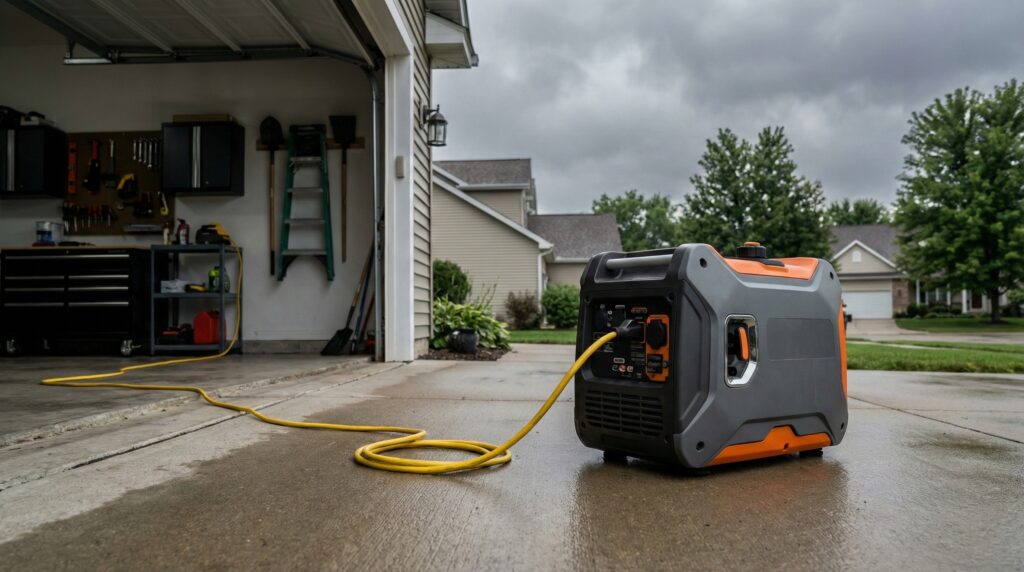
The most experienced off-grid experts suggest a “hybrid” approach. Relying 100% on solar is risky if you face a week of heavy rain and clouds. Integrating a small gas inverter generator—like a Honda EU 2200—allows you to charge your solar station in just an hour or two. This uses very little fuel but ensures your batteries are topped up even when the sun won’t cooperate. Think of your solar generator as your primary “quiet” power and a small gas unit as your emergency charger.
Best Solar Generator by Use Case
Best for Whole-Home Backup
The EcoFlow Delta Pro is the winner here. Its ability to scale up to 25kWh of storage and provide 240V output via a transfer switch makes it the most robust option for replacing a traditional gas backup. See the full review in our dedicated best solar generator breakdown for inverter-specific comparisons.
Best for Off-Grid Cabins
The Pecron E2400LFP shines for cabins because it allows you to use cheaper, third-party solar panels and expansion batteries. It’s a workhorse that doesn’t care about aesthetics, which is exactly what you want in the woods.
Best for Camping and RVs
The Anker 757 PowerHouse is built for the road. Its rugged frame and the fastest wall-charging speed in its class mean you can top it off at a coffee shop or campground restroom in less time than it takes to eat lunch.
Other Notable Alternatives Worth Considering
- Bluetti EB3A: An ultra-portable unit that is perfect for day trips or keeping your router and phone alive during a brief outage. Check Price
- Jackery Explorer 2000 Plus: Despite some user complaints about solar input, it remains a popular choice for those who value a simple interface and widespread retail availability. Check Price
- Pecron E2000LFP: A smaller version of the E2400, offering great value for those who don’t need the massive 48V expansion capability. Check Price
Frequently Asked Questions
Can a solar generator run a well pump or central AC?
Most standard solar generators cannot run these appliances because they require 240V of power and a high starting surge. However, high-end units like the EcoFlow Delta Pro can be linked together to provide 240V output. Always check the voltage requirements of your well pump before purchasing. For most users, a dedicated battery backup system with 240V support is necessary for these heavy loads.
Is it cheaper to build a DIY solar generator or buy one?
Building your own is significantly cheaper, often costing 30% to 50% less for the same capacity. However, you pay for that savings with your time and effort. Most users should stick to pre-built units like those from Bluetti or Anker for the safety of built-in Battery Management Systems (BMS) and the convenience of a “one-box” solution that is ready for immediate use during an emergency.
Why do some solar generators shut down when under a low load?
Many units have an “Auto-Power Off” feature designed to save battery by shutting down if the power draw is below a certain threshold (like 10W). This can be a problem if you’re trying to charge a small device or run a CPAP machine. Units like the Bluetti AC180 allow you to disable this feature through their app settings, ensuring continuous power for sensitive low-wattage electronics.
How do I charge a solar generator if it’s raining for multiple days?
If the sun isn’t shining, you have three main options: charging from a wall outlet (if grid power is still on), charging from your car’s 12V outlet (slow), or using a small gas inverter generator like a Honda EU 2200. This “hybrid” approach is highly recommended by experts. You can use the gas generator to quickly top up your EcoFlow or Anker unit during the day and enjoy silent solar power at night.
Are third-party solar panels compatible with brands like Pecron or Bluetti?
Yes, most solar generators use standard MC4 or DC connectors. Brands like Pecron and Bluetti are quite flexible, but you must ensure the voltage (Voc) of your third-party panels does not exceed the maximum input voltage of the generator. Exceeding this limit can fry the internal charge controller. Check the labels on your panels and the manual of your power station before connecting them.
Conclusion: Investing in Reliability
Choosing the best solar generator comes down to identifying your “must-run” appliances and matching them with the right capacity and inverter strength. If you need whole-home security, the EcoFlow Delta Pro is the industry leader for a reason. For those who simply want to keep the lights on and the food cold without spending a fortune, the Bluetti AC200L or the Pecron E2400LFP offer the best value for your investment. Remember that these units are not just gadgets; they are insurance policies for your home’s comfort and safety.
Before you buy, consider where you’ll store the unit and how you’ll move it during an emergency. Look for LiFePO4 chemistry to ensure your generator is still working ten years from now. Most importantly, don’t wait for the next storm to learn how your system works. Set it up today, test your appliances, and gain the peace of mind that comes with true energy independence.
Some links below are affiliate links. We may earn a commission if you purchase through them.