
TL;DR
A 1000W-class portable power station makes sense when you need a practical middle ground: enough AC output for electronics, small appliances, and backup essentials, but still portable enough to move around. For most buyers, the sweet spot is not just 1000W output, but roughly 1kWh of battery capacity, solid surge handling, fast recharge options, and a port mix that fits the devices you actually use.
If you are shopping this class now, the Bluetti Elite 100 V2 stands out as a strong fit because it lands close to that 1kWh target while staying in a price range that is realistic for many camping, road-trip, and outage-backup buyers.
What Portable Power Station 1000W Actually Is
When shoppers search for a portable power station in the 1000W range, the biggest point of confusion is usually this: 1000W almost always refers to the inverter’s continuous AC output, not the battery size. In plain terms, that number tells you about how much power the unit can deliver at one time, not how long it can keep doing it.
That distinction matters because watts and watt-hours are not the same thing. Watts are about instant power draw. Watt-hours measure stored energy, which is what determines runtime. So a station with roughly 1000W of output could still have a relatively small battery and run your gear for a shorter time than you expect. On the flip side, a unit with around 1kWh of capacity may be much more useful in real life, especially for overnight backup, day trips, or repeated charging of small devices.
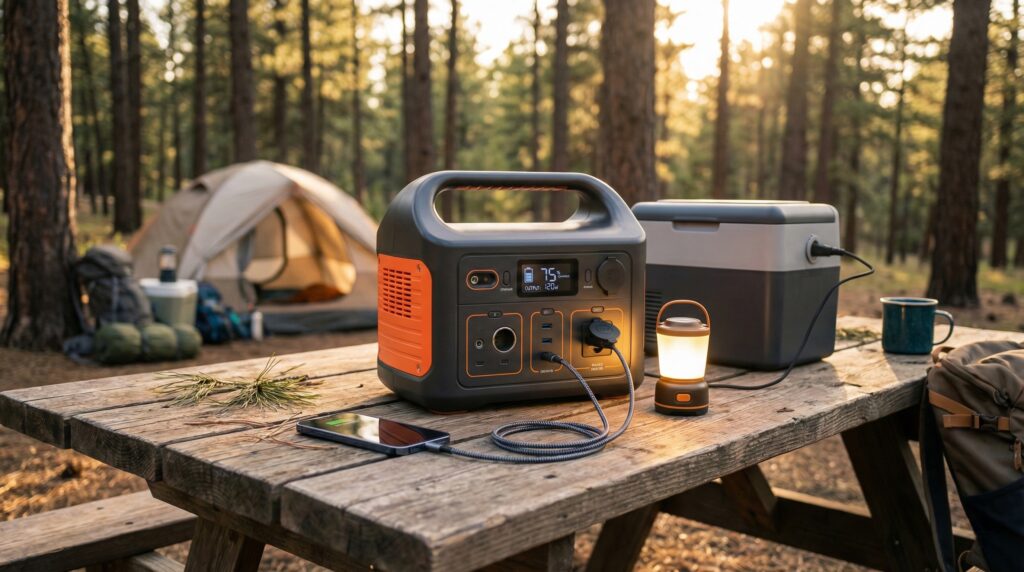
This size category is usually best thought of as the “light appliance and essential gear” class. It can work well for laptops, routers, lights, phones, CPAP machines, camera batteries, drones, small coolers, and in some cases a compact fridge if the running load and startup surge stay within the inverter’s limits. It is not the right class for sustained high-draw heating loads like space heaters, electric kettles, hair dryers, or many microwaves.
The formula for buying well in this category is simple: match continuous output to your actual load, make sure startup spikes fit inside the surge rating, then choose enough battery capacity for the runtime you need. After that, recharge speed, port variety, handling, and safety become the deciding factors. Evidence from technical guidance and consumer testing points in the same direction: runtime and usability matter more than the headline watt number alone.
Safety also deserves attention. A portable power station used indoors should have recognized safety certification where possible, good ventilation, and clear operating limits. Guidance from NFPA lithium-ion battery safety is a useful reminder not to block vents, not to charge damaged battery products, and not to ignore unusual heat or odors. If solar charging matters to you, DOE solar PV basics offers a good grounding in what panels can realistically do in the field.
In short, a 1000W portable power station is best understood as a balanced power class, not a promise of long runtime or all-appliance compatibility.
Who Portable Power Station 1000W Fits Best
This category fits buyers who want a meaningful jump over a small battery bank without stepping into the size, weight, and cost of a much larger backup unit. If you need to power several small devices together, run a laptop and monitor, keep a router and modem online during outages, or support campsite and road-trip electronics, a 1000W-class station is often the most practical step up.
It is also a strong match for people who value flexibility more than brute force. For example, a remote worker may need to keep a laptop, hotspot, phone, and desk light running for hours. A camper may want AC outlets plus USB-C charging for cameras and drones. A family building a short-duration outage kit may just need to keep communications, lights, and small medical gear available without dealing with fuel, fumes, or engine noise. Indoors, that last point matters, especially compared with fuel-burning generators. If someone is considering a gas generator as an alternative for enclosed or semi-enclosed spaces, CDC carbon monoxide safety is worth reading.
The buyers who get the most value from this class usually have loads that stay comfortably below the advertised maximum. In practice, that means using the 1000W number as a ceiling, not a target. Leaving headroom reduces overload shutdowns and gives you more stable operation with startup spikes from small motors, fans, and compact refrigeration.
This size also suits buyers who will actually move the unit. Once you get into higher-capacity stations, portability can drop off fast. If you expect to carry the unit from a closet to a car, from a vehicle to a campsite, or up apartment stairs during an outage, the lighter end of the 1000W class makes more sense than a bigger unit you hesitate to lift.
On today’s market, the Bluetti Elite 100 V2 is a good example of what this buyer profile should look for. Its near-1kWh capacity aligns well with the real-world needs of shoppers searching this power range, and its listed price range of $410 to $480 puts it in a zone that can make sense for mixed-use buyers who want backup and recreation value from one purchase.
Who Should Skip Portable Power Station 1000W
You should skip this category if your must-run devices regularly push high wattage or have unpredictable startup surges. A lot of buyers run into trouble when they shop by the 1000W headline and assume that means “runs anything in the house.” It does not. If your list includes a space heater, hot plate, kettle, toaster oven, hair dryer, or full-size microwave, this power class is usually too small for reliable use.
It is also the wrong fit if your main goal is long runtime for overnight refrigeration, extended CPAP use without recharge opportunities, or repeated all-day use on cloudy solar input. In those cases, battery capacity matters more than inverter output, so moving up to a larger energy reserve often makes more sense than staying in the 1000W class.
Another group that should think twice is buyers who need heavy-duty jobsite support. Some power tools, compressors, pumps, and chargers can surge well above their running numbers. If your equipment sits near the limit on paper, real-world startup behavior may still trip the inverter. That is why licensed electricians and off-grid solar installers often recommend building in headroom instead of sizing right to the label.
You may also want to skip this category if you expect easy airline transport. Portable power stations with large lithium batteries face strict travel limits, and many units in this class are not realistically flyable. Before planning air travel with any large battery device, check FAA lithium battery transport rules.
Finally, if your main use case is solar-first off-grid living, some buyers in this range will outgrow the solar input ceiling. A station can have a useful inverter and decent battery size but still recharge too slowly from panels for daily off-grid recovery. In that case, more solar input capacity may matter as much as battery size.
Price and Value
In this category, value is less about finding the cheapest box with “1000W” printed on it and more about buying the right balance of output, capacity, charging speed, and usability. Two stations can look similar in search results yet deliver very different ownership experiences if one has limited battery capacity, slower wall charging, weaker solar acceptance, or a less useful port layout.
That is why we prefer to frame value around use case. If you only need occasional backup for phones, lights, and a router, paying extra for a near-1kWh unit may be more than you need. But if you want a single station that can cover camping, remote work, and short outages, a larger battery in this class often feels like money well spent because it reduces recharge stress and broadens what the unit can realistically handle.
Based on the available pricing here, the Bluetti Elite 100 V2 at roughly $410 to $480 looks competitive for shoppers who want to stay close to the 1kWh target. That range is notable because many buyers searching “1000W” are actually trying to solve for both moderate output and useful runtime. A near-1kWh model can answer both needs better than a cheaper low-capacity unit that only wins on its inverter headline.
Good value in this class usually includes:
- Battery capacity near the 1kWh mark if you need meaningful runtime
- Fast enough AC recharging that the unit is practical between uses
- Solar and car charging options if you want flexibility away from home
- USB-C PD and enough AC outlets for your real device mix
- A weight and handle design you can live with
Weak value usually shows up when one spec is overemphasized. A station with 1000W output but limited battery capacity can disappoint on runtime. A station with good capacity but poor charging speed may be frustrating during multi-day outages or back-to-back field use. And a low-priced unit without credible safety pedigree is not a bargain. Safety certification, thermal management, and proper use matter as much as performance, especially for indoor emergency backup.
If solar is part of your plan, value also depends on whether the unit can realistically recover in a day. The NREL PVWatts solar calculator and broader NREL renewable energy research can help set expectations about real-world production by location and season. That matters because a station that looks solar-ready on paper may still recharge slowly under ordinary conditions.
Common Mistakes When Trying Portable Power Station 1000W
The most common mistake is confusing wattage with battery capacity. Buyers see 1000W and assume it means long runtime, when it really describes how much load the inverter can support at once. If runtime is your priority, watt-hours should be one of the first specs you compare.
The second mistake is sizing too close to the edge. Even if your device list appears to total under 1000W, real-life startup surges can push some appliances or tools beyond what the inverter can tolerate. Small fridges, fans, pumps, e-bike chargers, and power tools are common examples. Giving yourself buffer room is one of the simplest ways to avoid overload shutdowns.
Another mistake is ignoring recharge speed. A station that takes a long time to refill from the wall can become annoying fast if you use it frequently. The same goes for weak solar input: a model may technically support solar charging but still recover too slowly for regular off-grid use. If your plan includes daily cycling, recharge performance is not a bonus feature. It is core functionality.
Buyers also underestimate portability. Weight differences in this class can change how often you actually use the unit. A station that is easy to carry from the garage to the car or from the closet to the living room is more likely to be useful than one that feels awkward every time you move it.
Finally, some buyers overlook basic safety and setup habits. Keep vents clear, follow the specified charging input range, and stop using the unit if you notice swelling, unusual heat, or repeated faulting. If you want a system that integrates with home circuits, transfer equipment, or larger solar setups, it is smart to consult a licensed electrician or off-grid solar installer rather than improvising adapters.
FAQ
Can a 1000W portable power station run a refrigerator?
Sometimes, yes. The key is not just the fridge’s running wattage but also its startup surge. A compact fridge may work if both numbers fit inside the station’s continuous and surge ratings, but many full-size refrigerators are less predictable. Check the appliance label, the manufacturer specs, and leave headroom rather than planning to run right at the inverter limit.
Is 1000W enough for camping or emergency backup?
For many people, yes. This class is well suited to lights, phones, laptops, routers, CPAP machines, camera gear, and some small appliances. It is a good fit when you want quiet indoor-safe backup without fuel storage, but it is not the right choice for sustained high-heat appliances or whole-home coverage.
How much battery capacity should I buy with a 1000W inverter?
Buy enough capacity for your runtime needs, not just enough output for your load. For mixed-use buyers, around the 1kWh class is often a practical target because it balances decent runtime with manageable size. If your devices are low wattage but run for many hours, prioritize more watt-hours over a bigger inverter.
Should I choose faster charging or a bigger battery first?
Start with enough battery capacity to cover your actual use. After that, prioritize faster charging if you expect frequent reuse, outage cycling, or solar recovery between sessions. A unit that is big enough but too slow to recharge can still feel limiting in everyday ownership.
What is the biggest mistake buyers make with 1000W power stations?
The biggest mistake is treating the 1000W label like an all-purpose performance number. It only tells part of the story. Buyers often overlook runtime, surge capability, port selection, and recharge speed, then end up with a station that technically turns on but does not fit how they actually use power.
Can I charge a 1000W portable power station with solar panels?
Usually yes, but solar performance depends on the station’s input limits, connector type, and local conditions. You need to match panel voltage and current to the manufacturer’s allowed range. For a basic technical primer, see DOE solar PV basics. To estimate likely output in your area, the NREL PVWatts solar calculator is useful.
Are 1000W portable power stations safe to use indoors?
Portable battery power stations are generally intended for indoor-capable use, unlike fuel generators, but you still need to use them correctly. Choose a model with credible safety certification when possible, keep it ventilated, avoid hot enclosed spaces, and stop using it if it shows swelling, burning odor, or repeated faults. For battery handling basics, review NFPA lithium-ion battery safety.
What should I look for besides the 1000W label?
Look at battery capacity in Wh, surge rating, AC recharge time, solar input limits, AC outlet count, USB-C PD support, total weight, and overall ergonomics. Those details often matter more in daily use than the headline watt number. A well-balanced near-1kWh station is usually a better buy than a poorly equipped unit that happens to advertise 1000W.
Looking for these on Amazon? Browse portable power station 1000w on Amazon →
Bottom Line
A 1000W portable power station is a smart buy when your real-world loads are modest, your runtime needs are realistic, and portability still matters. For most shoppers, the best version of this category is a near-1kWh unit with solid surge handling, useful ports, and charging options that fit home, car, and solar use.
Among the options reflected here, the Bluetti Elite 100 V2 makes the most sense as a lead recommendation because it tracks closely with what buyers in this power class usually need: practical output, better runtime potential, and a price that stays within reach for camping, travel, and short backup use.
Affiliate disclosure: Some of the links in this article are affiliate links. We may earn a commission if you purchase through them.