
TL;DR
A good camping power bank is less about the biggest mAh number and more about having the right ports (especially USB-C Power Delivery) and enough real-world usable energy for your trip length. For most campers, a 10,000–20,000mAh bank with USB-C PD (roughly 20–30W) plus at least one USB-A port is the sweet spot; go bigger (20,000–30,000mAh) if you’re out 3+ days or charging multiple devices.
If you need AC outlets for higher-draw gear (some laptops without USB-C charging, small appliances, or certain CPAP setups), skip “power banks” entirely and look at a small portable power station instead.
What Camping Power Banks Actually Are
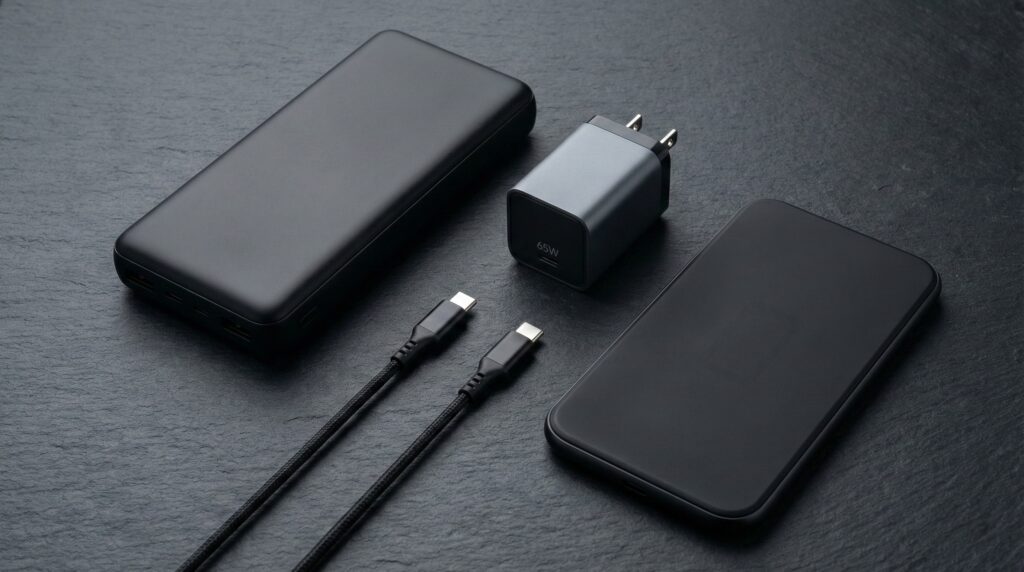
A camping power bank is a handheld battery pack designed to store energy and deliver it back out through DC ports — usually USB-A and USB-C — to recharge devices like phones, headlamps, GPS watches, earbuds, and small cameras when you’re away from wall outlets. In plain terms, it’s a “battery reservoir” you fill up at home (or from a car/solar) so you can top off your electronics at camp.
The most confusing part is the rating on the box. Power banks are commonly labeled in milliamp-hours (mAh), but that mAh figure is typically based on the internal battery cell voltage (around 3.7V). Your phone doesn’t charge at 3.7V; it charges at higher voltages depending on the charging mode (5V for basic USB, and often 9V/12V/15V/20V with USB-C Power Delivery). Converting that internal battery energy into usable USB output creates losses — so you won’t get the full “labeled capacity” delivered to your phone. In real use, it’s normal to plan for meaningful conversion loss, plus additional loss in cables and heat.
That’s why “ports and wattage” matter as much as capacity for camping. A modern USB-C Power Delivery (PD) port can charge many phones far faster than a basic 5V/2A USB-A port. PD also usually allows the power bank itself to recharge faster (assuming the USB-C port is bidirectional — usable as both output and input). If you’re pairing a bank with a small solar panel or relying on short car-charging windows, recharge speed becomes a big deal.
Finally, camping adds stressors you don’t feel at home: cold temperatures reduce usable energy and can make lithium batteries sluggish, and moisture/drops can shorten a bank’s life. A “camping power bank,” ideally, is simply a power bank chosen with outdoors reality in mind: enough usable energy, the right outputs, durable build, and a plan to keep it warm and dry.
Who Camping Power Banks Fit Best
Camping power banks are a great fit when your main goal is keeping USB-charged devices alive — phones (photos, maps, emergency calls), headlamps, satellite messengers, GPS watches, and earbuds — without carrying the size and cost of a full power station.
- Weekend campers (1–2 nights) who want 1–3 phone charges plus headlamp top-offs — often well served by a 10,000–20,000mAh class bank with USB-C PD.
- Multi-device couples or small groups who want to charge two phones plus a watch, headlamp, or camera battery — usually better with ~20,000mAh (or two smaller banks for redundancy).
- Hikers and backpackers who care about weight but still need reliable navigation power — often pick a lighter 20,000mAh-ish bank with USB-C PD and a simple port layout.
- Campers who plan to recharge from a car between trailheads or on road trips — benefit from banks that accept fast USB-C input so short drives actually replenish meaningful capacity.
- Anyone who wants an “electronics buffer” for emergencies—a charged power bank plus a short, reliable cable is one of the simplest preparedness upgrades.
Buyer reports also show that people often buy into a brand ecosystem (cables, plugs, power banks) for consistency. For example: “I have bought power banks, cables, plugs and more all the products are great quality. I also love how the cables are braided so they last longer and are better quality” — customer review, 5 stars.
If you fly to your camping destination, it’s also worth noting that lithium battery transport has rules and limits — check FAA lithium battery transport rules before you pack a high-capacity bank in your luggage.
Who Should Skip Camping Power Banks
A camping power bank is the wrong tool when your trip involves AC power needs, sustained high wattage, or lots of daily energy demand. In those cases, you’ll be happier (and often safer) with a portable power station or a different plan altogether.
- You need AC outlets for devices that can’t charge from USB-C (or require a specialized AC brick). A power bank won’t run a kettle, toaster, or most “appliance” loads.
- You’re running medical gear that’s sensitive or high draw (or requires AC). Talk to your device provider and, ideally, a licensed electrician or off-grid solar installer about a proper backup approach.
- You’re camping in real winter conditions and expect to recharge in freezing temps. Lithium packs can refuse charging when cold, and usable capacity drops — your strategy matters as much as the bank.
- You want a “set-and-forget” device but don’t want to think about cables, charging modes, and recharge time. Outdoor charging is a system; a weak cable can ruin “fast charging” even with a great bank.
Also, not every brand experience is smooth — especially around stock and support. One critical customer review illustrates that risk: “I ordered the Anker Prime 250W Power Bank and the charging base. After taking my money, they started a scripted loop of excuses, claiming the product is “out of stock.” The” — customer review, 1 stars.
Finally, if your priority is maximum safety confidence, look for reputable brands and indications of safety testing (commonly referenced standards include UL-related battery/power supply safety). For general handling and fire-risk awareness, it’s worth skimming NFPA lithium-ion battery safety before your trip — especially if you charge batteries in a tent, vehicle, or enclosed space.
Price and Value
Camping power bank pricing is mostly driven by three things: (1) how much energy it stores (capacity), (2) how fast it can output and input (USB-C PD wattage and bidirectional USB-C), and (3) brand reputation/build quality.
In general:
- 10,000–20,000mAh USB-C PD banks often land in the “reasonable, high-value” zone for most campers because they’re big enough for a weekend without being a brick.
- 20,000–30,000mAh premium banks can cost more, but they can also reduce anxiety if you’re running maps, taking lots of photos/video, or charging multiple devices.
- Portable power stations (not power banks) cost more and weigh more, but they buy you AC power, higher wattage, and often more usable watt-hours for longer base-camp setups.
From the products covered here, the only explicit price range available is for a small power station: the Goal Zero Yeti 300 Portable Power Station (297Wh) is listed around $250–$300. That’s a different class than a pocket power bank, but it helps frame the value jump: you’re paying for AC output, higher sustained wattage, and a much larger energy reserve.
When you’re weighing value, don’t ignore “hidden” trip costs: a better bank with faster USB-C input can mean you actually refill it from a car charger between trailheads, instead of arriving at camp with a half-charged brick that takes all night to recover.
Common Mistakes When Trying Camping Power Banks
Most camping power bank disappointment comes from planning mistakes rather than a single “bad product.” Here are the big ones we see in user feedback and in how people actually use these in the field.
- Taking the labeled mAh too literally. Because of voltage conversion losses, cable losses, and heat, you should expect fewer real phone charges than the label implies — then reduce expectations further in cold weather.
- Buying capacity but not speed. A huge bank with only basic USB-A output can be painfully slow for modern phones; similarly, a huge bank that recharges slowly is frustrating if you’re trying to refill from a car or solar.
- Not confirming USB-C is bidirectional. Some banks have USB-C output but recharge slowly over a different port; for camping, it’s usually best when the USB-C port can both charge devices and accept fast input.
- Using the wrong cable. A worn cable (or a cable that can’t handle higher wattage) can prevent fast charging and can even get warm at higher loads. If plugs get hot, stop charging and swap cables.
- Charging/using batteries in unsafe conditions. Don’t charge a power bank buried in bedding or a sleeping bag where heat can build up; don’t keep it baking in direct sun on a dashboard; and don’t keep using a pack that’s swollen or damaged.
- Letting the power bank get cold-soaked. In winter camping, the simplest fix is often behavioral: sleep with the bank in an inner pocket of your sleeping bag, then charge devices when the bank is warm.
Support and fulfillment can also be a “practical mistake” if you’re buying right before a trip. This user feedback is a reminder to buy early enough to troubleshoot shipping or availability: “I ordered the Anker Prime 250W Power Bank and the charging base. After taking my money, they started a scripted loop of excuses, claiming the product is “out of stock.” The” — customer review, 1 stars.
If you’re planning to recharge from solar, remember that small panels are weather-dependent and angle-dependent. Tools like the NREL PVWatts solar calculator can help set expectations for solar production in your location, but real-world output in the woods can be much lower due to shade and suboptimal panel positioning.
FAQ
How many times will a 10,000mAh or 20,000mAh camping power bank charge my phone?
Use watt-hours (Wh) to estimate. Power banks are typically rated at 3.7V internally, so:
- 10,000mAh ≈ 10Ah × 3.7V ≈ 37Wh
- 20,000mAh ≈ 20Ah × 3.7V ≈ 74Wh
Then subtract conversion losses. Many campers find real-world usable output is meaningfully lower than the label. If your phone battery is ~12–15Wh, a 10,000mAh bank might net roughly 2-ish full charges in practice, while a 20,000mAh bank might net roughly 4-ish — then reduce expectations in cold weather or if you’re charging while actively using the phone (maps/photos).
Is USB-C Power Delivery worth it for camping?
Yes for most modern phones and tablets. USB-C PD (often 20W, 30W, or higher depending on the bank) can cut charging time dramatically compared with basic USB-A. It also tends to simplify your kit: one USB-C cable can handle both charging the bank and charging your phone — assuming the bank’s USB-C port supports input and output.
Can I recharge a camping power bank with a solar panel?
Usually yes, but it works best when (1) the bank accepts stable USB input and (2) it can recharge fast enough to take advantage of peak sun. A common approach is to charge the power bank during the day (when sun is available) and charge phones/headlamps from the bank at night.
For a basic primer on how solar PV works (and why conditions matter), see DOE solar PV basics.
What’s the difference between a camping power bank and a portable power station?
A power bank is a handheld USB battery meant for charging small electronics via DC ports (USB-A/USB-C). A portable power station is much larger (typically measured in watt-hours), often includes AC outlets, and can run higher-wattage loads for longer. If you need AC power at camp, or you need to power gear beyond USB charging, you’re generally in “power station” territory.
How do I keep a power bank working in cold weather?
Keep it warm and avoid charging it when it’s very cold. Store it in an inner jacket pocket while hiking, and at night keep it in your sleeping bag (inside a small pouch to protect it). Expect reduced usable capacity in the cold, so bring extra capacity margin for winter trips.
Are there safety rules for flying with a camping power bank?
Yes. Airlines and regulators limit lithium batteries, and large-capacity power banks may have restrictions (and generally should be carried in your carry-on, not checked). Always check the latest guidance in FAA lithium battery transport rules before you fly.
How should I charge and store a power bank safely at camp?
Charge it on a hard, non-flammable surface when possible, don’t cover it with clothing/bedding, and keep it out of direct sun and hot vehicles. Stop using a bank that’s swollen, punctured, or showing signs of damage. For general lithium battery fire-safety awareness, review NFPA lithium-ion battery safety.
Looking for these on Amazon? Browse camping power bank on Amazon →
Bottom Line
The best camping power bank is the one that matches your trip length and devices: enough real-world usable energy, USB-C PD fast charging, and a port mix that fits your cables. For most campers, that means a 10,000–20,000mAh USB-C PD bank; for 3+ days or multi-device use, size up and prioritize fast USB-C input so you can realistically refill it between opportunities.
If your camping plan includes AC power or higher-draw loads, skip power banks and step up to a small portable power station instead.
Affiliate disclosure: Some of the links in this article are affiliate links. We may earn a commission if you purchase through them.