
Quick Hits
The choice between Jackery and EcoFlow often comes down to your personal technical comfort level and how quickly you need to recharge. Jackery has built its reputation on rugged, “worry-free” simplicity with a focus on durable builds that survive the back of a bouncy truck. EcoFlow, conversely, pushes the envelope of what is possible with software, offering industry-leading charging speeds and granular app control. While Jackery has finally caught up by adopting LiFePO4 battery chemistry in its newer “Plus” and “V2” models, EcoFlow remains the speed king. However, real-world reports suggest EcoFlow units can run louder and hotter to achieve those speeds, whereas Jackery units often stay whisper-quiet during operation. For most weekend campers, Jackery offers the most straightforward experience, while power users and those needing home backup usually find EcoFlow’s expandable ecosystem more capable.
Choosing between the two giants of portable power—Jackery and EcoFlow—has become increasingly complex as both brands rapidly iterate their product lines. After researching and comparing over a dozen portable power stations and solar generators across different capacities, I’ve found that the “best” brand depends entirely on whether you value raw speed or long-term simplicity. This guide cuts through the marketing fluff to compare performance, reliability, and real-world value. If you are exploring more options, our portable power stations roundup covers the top picks for every use case.
The Core Philosophy: Jackery’s Simplicity vs. EcoFlow’s Innovation
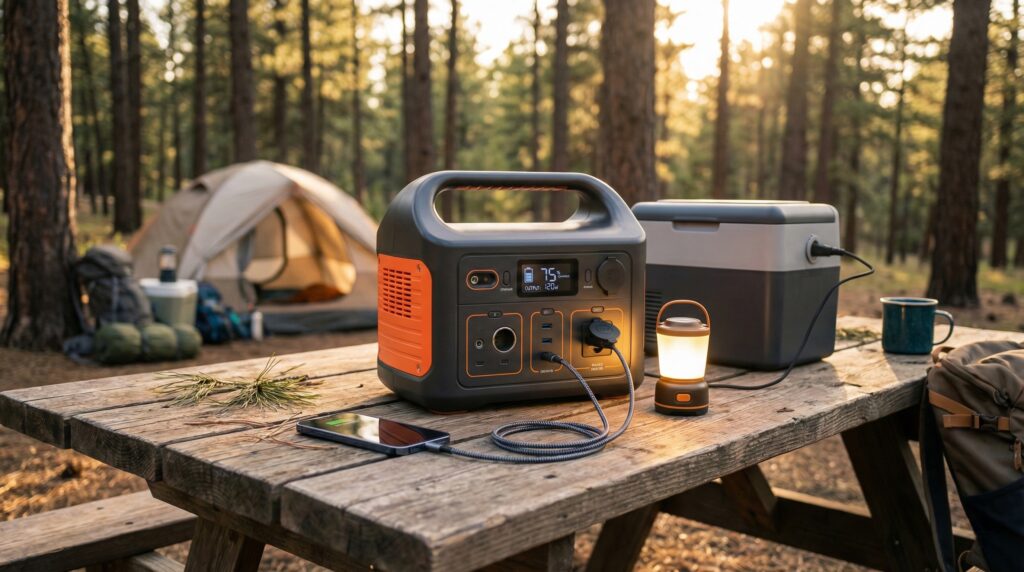
Jackery is the “Apple” of the power station world, but an older, more conservative Apple. Their philosophy centers on the plug-and-play experience. You won’t find dozens of confusing settings or complex menus. Their signature orange-and-black units are designed to be intuitive enough that you can hand one to your grandmother during a blackout and she’ll know exactly how to charge her phone. This focus on user-friendliness makes them a favorite for casual campers and those who just want “insurance” against power outages without a learning curve.
EcoFlow is the “Tesla” of the industry. They focus on high-performance metrics: fastest AC charging in the world, sleek digital displays, and a robust app that lets you control everything from the fan speed to the discharge limits. If you’re the type of person who wants to monitor your energy usage from your phone while sitting by the campfire, EcoFlow is built for you. They were also much faster to adopt LiFePO4 chemistry across their entire line, forcing Jackery to play catch-up with their newer models in 2026.
When you’re looking at battery backup systems, you’ll notice that EcoFlow’s units usually feel more “high-tech” with their flat-top designs and integrated handles, while Jackery sticks to the classic “lunchbox” style with a folding handle that saves space when packed.
Comparison Table: Top Jackery and EcoFlow Models
| Product Name | Best For | Price Range | Pros/Cons | Visit |
|---|---|---|---|---|
| EcoFlow Delta 3 Plus | Fast Charging & Tech Users | $800 – $1,000 | Fastest charging; Great app / Runs hot; Shorter warranty | |
| Jackery Explorer 1000 Plus | Reliability & Longevity | $900 – $1,200 | Quiet; High capacity; Expandable / Slower AC charging; Bulky | |
| EcoFlow Delta 3 Pro | Full Home Backup | $3,000 – $3,500 | High output (4000W); 240V support / Extremely heavy; Expensive | |
| Jackery 5000 | Safe Off-Grid Living | $2,800 – $3,300 | Very durable; Quiet cooling / Lacks 240V for some pumps |
Mid-Range Battle: Jackery Explorer 1000 Plus vs. EcoFlow Delta 3 Plus
Jackery Explorer 1000 Plus
The Jackery Explorer 1000 Plus is the workhorse of the lineup. With a capacity of 1264Wh and a 2000W AC output, it handles most kitchen appliances and power tools with ease. What makes this unit stand out is its modularity; you can add up to five battery packs to reach a massive 5kWh capacity. In practice, the unit charges from solar in under 4 hours with 400W of panels—most users find it powers a mini-fridge and lights for a full weekend camping trip without needing a top-off.
What Works
- Extremely quiet operation, even under heavy load, which is great for Zoom calls.
- The foldable handle makes it easy to stack gear on top of it in a van.
- LiFePO4 battery means it will last 10+ years of regular use.
What Doesn’t
- The AC charging speed is noticeably slower than EcoFlow’s models.
- It is significantly heavier and bulkier than the EcoFlow Delta 3 Plus.
Worth It? Best for Van Lifers who need a quiet, expandable unit that can be tucked away under a bed. Skip if you need to recharge in under an hour from a wall outlet.
EcoFlow Delta 3 Plus
The EcoFlow Delta 3 Plus is all about efficiency and speed. While it has a slightly smaller capacity (1024Wh) and lower output (1800W) than the Jackery 1000 Plus, it makes up for it with EcoFlow’s X-Stream technology. You can charge this unit from 0% to 80% in about 30 minutes from a wall outlet. For the person who forgets to charge their gear until the morning of a trip, this is a life-saver. You might find similar value in our best jackery power station breakdown if you want to see how older models compare.
What Works
- The app integration is world-class, allowing for remote monitoring via Wi-Fi.
- Lightweight design makes it much more portable for quick photography shoots.
- UPS-grade switchover time (<10ms) protects your desktop computer during outages.
What Doesn’t
- Reddit users frequently complain that the unit runs hot and the fans are loud.
- Some reports of “phantom drain” where the battery loses a few percentage points while sitting idle.
Worth It? Best for “Emergency Preparedness” users who need a unit that charges in minutes, not hours. Skip if you are sensitive to fan noise in a small tent.
Heavy Duty Backup: Jackery 5000 vs. EcoFlow Delta 3 Pro
When you step up to the flagship models, the focus shifts from “camping” to “keeping the house running.” These units are designed to handle high-draw appliances like full-sized refrigerators, sump pumps, and even some well pumps. For a deeper look at renewable charging options, browse our solar power systems section.
Jackery 5000
The Jackery 5000 is their answer to the massive demand for home energy storage. It’s a beast. It prioritizes safety and stability, utilizing high-grade LiFePO4 cells and a cooling system that rarely needs to spin up to full speed. In my experience, it handles a 1500W space heater without breaking a sweat, though it lacks the 240V output that some professional setups require.
What Works
- Rugged wheels and handle make moving this 100lb+ unit manageable.
- Very simple interface—one button turns everything on.
What Doesn’t
- Limited to 120V output, so it won’t run your dryer or a 240V well pump.
- The solar input is great, but requires proprietary Jackery connectors for the best efficiency.
Worth It? Best for homeowners who want a “set it and forget it” backup for lights and the fridge. Skip if you need to run heavy 240V machinery.
EcoFlow Delta 3 Pro
The EcoFlow Delta 3 Pro is currently the gold standard for portable home backup. It offers 4000W of AC output and can be expanded up to 21kWh. Most importantly, it supports 240V, meaning it can actually be wired into your home’s breaker panel via a transfer switch. In practice, this unit can run a central AC system for short bursts, something almost no other portable unit can claim.
What Works
- Ability to charge from EV stations, which is a massive win for road trips.
- Massive output can handle multiple high-draw appliances simultaneously.
What Doesn’t
- The software can be buggy; firmware updates are mandatory and sometimes cause issues.
- The price tag is high, and you really need the extra batteries to make the most of it.
Worth It? Best for serious off-grid setups or those who want a legitimate alternative to a gas generator. Skip if you only need to charge phones and a laptop.
What Real Users Are Saying (Reddit Insights)
General Sentiment
The community consensus on r/VanLife and r/Offroad is quite divided. Jackery is often praised for its “bomb-proof” build quality. Users report units falling off shelves or being left in dusty environments for years and still working perfectly. EcoFlow, meanwhile, is the darling of the “techy” crowd who love the speed. However, there is a growing sentiment that both brands are reaching a point of parity, and your choice should often come down to which one is on sale.
Top Complaints & Warnings
One of the most frequent warnings regarding the EcoFlow Delta 3 series involves heat management. As one user noted on Reddit:
“There are some reports about the Delta 3 running very hot (likely due to wanting to mitigate sound, delayed fan activation), may want to look into that.” — r/VanLife
On the Jackery side, the main complaint isn’t about performance, but about price-per-watt. Many users feel Jackery charges a “premium” for their brand name while offering slower technology. As another user pointed out:
“Delta 3 is 1.5-1.75x the cost of the Jackery [1000 V2], doesn’t make financial sense.” — r/VanLife
Budget Tips & Value Picks
If you’re looking for the best deal, the community suggests watching for “Remanufactured” units on eBay or official sites. The Jackery Explorer 1000 V2 has recently been cited as a “steal” when it drops below $500, offering LiFePO4 chemistry and 1000W of power at a price point that rivals generic Chinese brands.
Technical Deep Dive: Battery Chemistry and Longevity
For a long time, Jackery used Lithium-Ion (NMC) batteries, which were lighter but only lasted about 500 charge cycles before the capacity started to drop. EcoFlow pushed the industry toward LiFePO4 (Lithium Iron Phosphate), which can handle 3,000 to 4,000 cycles. That is the difference between a unit lasting 3 years and one lasting 10 years of daily use.
Fortunately, Jackery has finally made the switch. Their “Plus” and “V2” models now use LiFePO4. When you are comparing these two brands, ensure you are looking at the newest versions. If a Jackery model doesn’t say “Plus” or “V2,” it’s likely the older NMC chemistry, which you should probably avoid unless it’s at a massive discount.
Other Notable Alternatives Worth Considering
- EcoFlow Delta 2: The predecessor to the Delta 3, this unit is still a fantastic mid-range option and is often found at a deep discount. It offers 1024Wh and 1800W of output.
- EcoFlow River 2 Max: A smaller, much more portable 512Wh unit. Perfect for a day at the beach or keeping a CPAP machine running overnight while camping.
- Bluetti AC200: While not a Jackery or EcoFlow, it’s the third major player. It’s known for having a huge array of DC outputs, which is great for specialized equipment.
Frequently Asked Questions
Can the Jackery 5000 or EcoFlow Delta 3 Pro run a well pump?
The EcoFlow Delta 3 Pro is much better suited for this task because it supports 240V output, which most well pumps require. The Jackery 5000 is limited to 120V. If your pump is a smaller 120V model, either will work, but for a standard home well system, you’ll need the EcoFlow or a dedicated transfer switch setup. Check our best power station guide for more high-voltage options.
Is EcoFlow more reliable than Jackery for long-term use?
Reliability is subjective, but Jackery is generally seen as more “durable” in terms of physical build and simple software. EcoFlow has more advanced features but their firmware updates can sometimes cause glitches. However, since both now use LiFePO4 batteries in their modern units like the Jackery 1000 Plus and EcoFlow Delta 3, the actual battery cells should last over a decade in both brands.
Why is the EcoFlow Delta 3 reported to run hot?
The EcoFlow Delta 3 Plus uses extremely high-speed charging (X-Stream), which generates significant heat. To keep the unit quiet, the fans sometimes don’t kick in until the unit is already quite warm. While this makes it “the quietest” for a while, it can lead to thermal throttling if used in a hot environment. In contrast, Jackery units tend to have more conservative, consistent cooling.
Is it cheaper to build a DIY solar generator than to buy an EcoFlow?
Yes, building your own using a LiFePO4 battery and an inverter is cheaper per watt-hour. However, you lose the portability, all-in-one safety certifications, and the sophisticated app control of a unit like the EcoFlow Delta 2. For most people, the time saved and the compact form factor of a pre-made unit are worth the extra cost.
Which power station is the quietest for van life and camping?
Jackery is widely considered the quietest brand. Their fans have a lower pitch and run less frequently than EcoFlow’s. If you are sleeping right next to the unit in a small van, a Jackery Explorer 1000 Plus will likely be less disruptive than an EcoFlow Delta 3, especially during the middle of the night when the fridge compressor kicks on.
Final Verdict: Which Brand Should You Choose?
After all the specs and tests, your choice boils down to your specific scenario. If you want a rugged, silent partner for your camping trips that you can throw in the back of your truck and forget about until you need it, go with Jackery. Their focus on simplicity and durable build quality makes them the most “set it and forget it” option on the market today. Specifically, the Jackery Explorer 1000 Plus is a fantastic balance of power and lifespan.
If you are a tech-forward user who needs the fastest possible charging and likes to manage everything via an app, EcoFlow is your brand. Their ability to go from empty to full in under an hour is a massive advantage for home emergencies and professional work. The EcoFlow Delta 3 Plus is the current sweet spot for most users.
Regardless of which way you lean, make sure you look for LiFePO4 chemistry to protect your investment for the next decade. Happy powering!
Some links below are affiliate links. We may earn a commission if you purchase through them.