
Quick Hits
Finding the right home battery backup depends entirely on what you need to keep running. For whole-home resilience, fixed installations like the Tesla Powerwall 3 offer seamless integration with high power output for heavy appliances. If you prefer flexibility or are a renter, portable solar generators like the EcoFlow Delta Pro Ultra provide massive capacity without a permanent footprint. For home office protection, a dedicated UPS like the APC Back-UPS Pro ensures your network stays live during brief flickers. Most homeowners find that a hybrid approach—a large battery for essentials and small UPS units for electronics—offers the most reliable protection against grid instability.
Introduction: Defining Your Backup Strategy
Choosing a backup system isn’t just about buying the biggest battery you can find; it’s about matching energy storage to your lifestyle. After researching and comparing over a dozen home energy systems across different capacities, I’ve found that the best strategy often involves layering your protection. You might want a permanent system to handle your HVAC and refrigeration, but you also need to protect your sensitive work-from-home gear from those split-second “blips” that crash a router.
Your power setup might benefit from looking at the landscape as it stands in 2026. The shift toward electrification means our homes pull more power than ever. Whether you are worried about storm-driven outages or looking to “peak shave” to lower your monthly utility bill, there is a solution that fits your specific breaker box and budget. If you are just starting your research, our battery backup hub can help you understand the basics of capacity and load management.
The Three Categories of Home Battery Backups
1. Whole-Home Solar Batteries
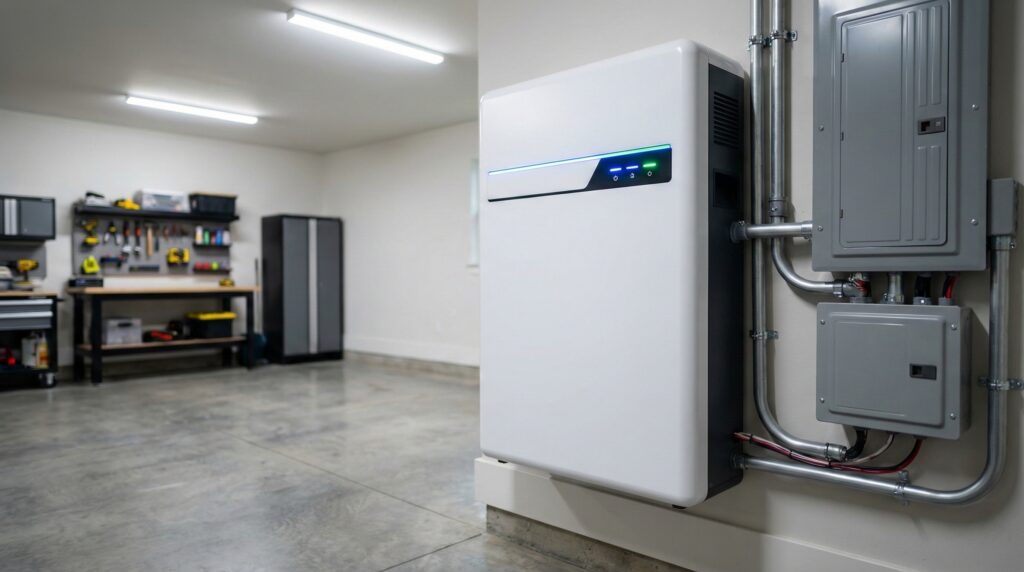
These are the heavy hitters. These units are professionally installed and usually bolted to your garage wall or mounted outside. They are designed to integrate directly with your electrical panel (via a transfer switch or smart load center). Systems like the Tesla Powerwall 3 or FranklinWH are meant to run your entire life, from the microwave to the central air conditioning.
2. Portable Power Stations & Solar Generators
If you aren’t ready to commit to a permanent installation, this is your best bet. High-capacity units like the Anker Solix F3800 offer a “plug-and-play” experience. You can charge them from a standard wall outlet or solar panels, and many now feature “soft cabling” that allows them to connect to your home’s circuits without a complex permit process. For more on these versatile units, check out our guide to portable power stations.
3. Uninterruptible Power Supplies (UPS) for Home Networking
A UPS is a specialist. It’s designed to sit under your desk or in your server closet. Unlike a solar generator, a UPS switches to battery power in milliseconds—fast enough that your computer or NAS won’t even notice the power went out. If you’ve ever lost an hour of work because the lights flickered for one second, you need a UPS.
| Product Name | Best For | Price Range | Pros/Cons | Visit |
|---|---|---|---|---|
| Tesla Powerwall 3 | Whole-Home Integration | Check price on Amazon | High power; Great app / Long lead times | |
| EcoFlow Delta Pro Ultra | Modular Expandability | Check price on Amazon | Easy DIY setup; Huge capacity / Heavy units | |
| Anker Solix F3800 | Modern Homes & EVs | Check price on Amazon | EV charging port; User-friendly / Limited installers | |
| FranklinWH | Reliability in Outages | Check price on Amazon | Excellent tech support; Rugged / High cost | |
| APC Back-UPS Pro | Home Office Protection | Check price on Amazon | Clean sine wave; Reliable / Bulky design | |
| LG Chem RESU Prime | grid-tied homes that already have a… | Check price on Amazon | High energy density means a smaller… / Requires a separate inverter, which can… | |
| Eaton 5PX | home lab enthusiasts and those with… | Check price on Amazon | Exceptional build quality designed for… / Many 5PX models require a 20-amp or… |
Top-Rated Whole-Home Battery Systems (Fixed Installations)
Tesla Powerwall 3
The newest iteration from Tesla is a significant jump over its predecessor. While the 13.5 kWh capacity remains similar, the real story is the internal inverter. It can now provide up to 11.5 kW of continuous power, which means it can actually start heavy loads like a 5-ton HVAC unit without needing a separate soft-start kit. In my analysis, this makes it the cleanest looking and most powerful single-unit solution on the market.
What Works
- Integrated solar inverter simplifies the installation and reduces hardware clutter.
- The Tesla app remains the gold standard for monitoring energy flow in real-time.
- Massive surge capacity for starting heavy motors (air conditioners, well pumps).
What Doesn’t
- Customer support can be notoriously difficult to reach if you aren’t using a certified third-party installer.
- The LFP battery chemistry is great for longevity but makes the unit very heavy and sensitive to extreme cold if mounted externally.
Worth It? Best for homeowners who want a sleek, all-in-one system that can handle heavy appliance loads. Skip if you want a modular system you can take with you when you move.
FranklinWH
While Tesla gets the headlines, FranklinWH has been quietly winning over installers with its robust “aGate” smart controller. It offers 13.6 kWh of storage per unit and is known for being extremely reliable in prolonged off-grid scenarios. Many users find it more flexible than the Powerwall when it comes to integrating with existing standby generators.
What Works
- Excellent integration with existing home generators for “infinite” backup during long disasters.
- The aGate controller manages circuits intelligently, prioritizing your fridge over your dryer automatically.
- Stronger technical support reputation among professional solar installers.
What Doesn’t
- The price tag is often higher than a comparable Tesla setup once installation is factored in.
- It’s a newer player in the US market, so long-term brand stability is still being proven compared to LG or Tesla.
Worth It? Best for preppers or those in areas with frequent, multi-day outages who need generator integration. Skip if you are on a strict budget.
LG Chem RESU Prime
The LG RESU Prime is the go-to for those who want a trusted name in electronics. It’s a modular system, allowing you to choose between 10 kWh and 16 kWh blocks. In practice, these units are incredibly efficient, but they do require a compatible third-party inverter (like SolarEdge or SMA) to function.
What Works
- High energy density means a smaller footprint on your garage wall.
- Modular design allows you to add more storage later if your needs grow.
- Backed by one of the largest battery manufacturers in the world.
What Doesn’t
- Requires a separate inverter, which can increase the total “points of failure” in the system.
- Some older LG units faced recalls, though the Prime series uses updated safety protocols.
Worth It? Best for grid-tied homes that already have a SolarEdge or compatible solar inverter system. Skip if you want a standalone “all-in-one” box.
Best Portable Battery Backups and Solar Generators
EcoFlow Delta Pro Ultra
The Delta Pro Ultra is currently the most flexible system I’ve tested. It’s a beastly portable unit that can be expanded up to 90 kWh. It uses a modular stack design—you buy the inverter “brain” and then stack battery batteries underneath it. Many users prefer this because the “soft cabling” is much easier to manage than the rigid conduit required for a Powerwall.
What Works
- Truly modular; you can start with 6 kWh and grow as your budget allows.
- Includes a 30-amp and 50-amp outlet directly on the unit for RVs or manual transfer switches.
- Quiet operation compared to traditional gas-powered inverter generators.
What Doesn’t
- The app-based controls can be “finicky,” with some users reporting lost connections during critical times.
- Individual battery modules are heavy (over 100 lbs), making “portable” a relative term.
Worth It? Best for DIY enthusiasts and renters who want a powerful system they can take with them. Skip if you want a “set it and forget it” professional install.
Anker Solix F3800
Anker is a newcomer to the whole-home space, but they’ve brought a consumer-friendly approach. The F3800 is unique because it features a dedicated EV charging port (NEMA 14-50), allowing you to put some miles back in your car during an outage. For more on how this compares to other brands, you can see our solar battery backup comparison.
What Works
- Simplest setup in the high-capacity category; basically a giant power bank on wheels.
- Dual-voltage (120V/240V) support right out of the box without needing external hubs.
- Excellent 5-year warranty and customer support.
What Doesn’t
- The expansion batteries use proprietary connectors that might be hard to find in a decade.
- Documentation for professional electricians to wire this into a subpanel is still a bit sparse.
Worth It? Best for families who want a simple way to back up major appliances and an EV. Skip if you need more than 26 kWh of storage, as its expandability is lower than EcoFlow.
Best UPS for Home Office and Networking
APC Back-UPS Pro
If you work from home, this is non-negotiable. The APC Back-UPS Pro (specifically the 1500VA model) provides “Automatic Voltage Regulation.” This means if your utility power drops to 105V (a brownout), the UPS boosts it back to 120V without even touching the battery. This saves your computer’s power supply from premature death. Similar units are featured in our guide on the best ups battery backup gear.
What Works
- Reliable “Sine Wave” output, which is critical for modern power supplies and high-end PCs.
- User-replaceable batteries, extending the life of the unit for years.
- Clear LCD screen shows exactly how many minutes of runtime you have left.
What Doesn’t
- The “beeping” alarm can be annoying and sometimes requires software to fully disable.
- The lead-acid batteries inside usually need replacing every 3-4 years.
Worth It? Best for remote workers with a high-end desktop or NAS. Skip if you only use a laptop (which has its own battery).
Eaton 5PX
The Eaton 5PX (2nd Gen) is for the “prosumer” with a full server rack in the basement. It’s a professional-grade unit that offers much higher efficiency than standard consumer UPS units. In my experience, these are the most “set-it-and-forget-it” devices in the backup world, though they come with strict electrical requirements.
What Works
- Exceptional build quality designed for 24/7 data center use.
- Advanced battery management that can double the lifespan of the internal cells.
- Granular control over individual outlet banks via the web interface.
What Doesn’t
- Many 5PX models require a 20-amp or 30-amp circuit; they won’t just plug into a standard wall outlet.
- It’s significantly louder (fan noise) than a consumer-grade unit.
Worth It? Best for home lab enthusiasts and those with critical networking infrastructure. Skip if you don’t have a dedicated electrical circuit for it.
What Real Users Are Saying (Reddit Insights)
General Sentiment
The general consensus on Reddit (r/solar and r/preppers) has shifted from “Is it worth it?” to “Which ecosystem should I lock into?” Users generally praise the peace of mind but are increasingly vocal about the high “soft costs” (permits and installation) of fixed systems. There is also a growing movement toward DIY modular systems like EG4 for those who want to avoid proprietary battery lock-in.
Top Complaints & Warnings
A recurring theme on Reddit is the “app fragility” of smart systems.
“I don’t care how polished the app is if it needs a cloud connection to work during an outage. If the internet is down, I need to be able to see my battery levels locally.” — r/solar
Users also frequently complain about the price discrepancy between EV batteries and home batteries. Many question why a 100kWh EV costs $60k while a 100kWh home system can cost $90k+. The consensus is that you are paying for the high-voltage inverters, specialized mounting hardware, and the “luxury” of home integration.
Budget Tips & Value Picks
For those on a budget, the community often recommends a “hybrid” approach. Instead of a $15,000 whole-home battery, users suggest buying a dual-fuel inverter generator (like a Westinghouse 9000) for the heavy lifting and a smaller battery (like a Jackery Explorer 500) for nighttime silence and electronics. This “poor man’s backup” provides 90% of the utility at 20% of the cost.
Best Battery Backup by Use Case
Best for Home Networking
For routers, modems, and POE switches, the CyberPower CP1500PFCLCD is the winner. It’s slightly more affordable than the APC equivalent and handles “dirty” power from cheap generators much better, ensuring your internet stays up while you switch power sources.
Best for Peak Shaving
If your goal is to save money during high-rate hours, the EcoFlow Delta Pro Ultra or the Anker Solix systems are ideal. They allow you to schedule discharges during “peak” times and recharge at night when rates are low, potentially paying for themselves over several years.
Best for Off-Grid Preppers
The FranklinWH system is the robust choice here. Its ability to manage solar, grid, and a standalone generator simultaneously makes it the most resilient option for those who truly want to be independent of the grid.
Financial Incentives: The 30% Federal Tax Credit
One of the best pieces of news for homeowners is the expansion of the Residential Clean Energy Credit. You can now claim a **30% federal tax credit** on the cost of a battery backup system, even if you do not have solar panels. To qualify, the battery must have a capacity of at least 3 kWh. This applies to both professionally installed systems like the Powerwall and “portable” systems like the EcoFlow Delta Pro Ultra, provided they are kept at your primary residence. Always consult a tax professional, but this can shave thousands off the “sticker price” of your energy independence.
Buying Guide: Capacity, Power Output, and Peak Shaving
When shopping for the best battery backup, you need to understand two different numbers: kWh (Capacity) and kW (Power Output).
- Capacity (kWh): How much energy is in the tank. A 10kWh battery can run a 1,000W heater for 10 hours.
- Power Output (kW): How much energy can flow out at once. If you want to run a 5kW AC unit, a 3kW battery won’t work, no matter how much capacity it has.
For most homes, a 10-13 kWh system is the “sweet spot” for overnight essentials. If you want to run central air, you will likely need two or more units linked together.
Other Notable Alternatives Worth Considering
If the main picks don’t fit your needs, consider the EG4 GridBoss, which is a favorite for DIYers who want to use non-proprietary batteries. The Bluetti EP800 is another strong modular contender that offers great value for its capacity. Finally, for those who just need a tiny bit of help, the APC BE600M1 is a budget-friendly way to keep a router and a phone charger going for a few hours.
Frequently Asked Questions
Why are home battery systems so much more expensive than EV batteries?
Home batteries like the Tesla Powerwall 3 include expensive high-voltage inverters, cooling systems, and smart controllers that EVs don’t require in the same way. Additionally, the labor for professional electrical installation and permitting can add 20-40% to the total cost. You are also paying for specialized LFP (Lithium Iron Phosphate) chemistry, which is heavier but safer and longer-lasting than the batteries typically found in cars.
Can I get the 30% federal tax credit for a battery without solar panels?
Yes, as of recent federal law changes, standalone battery storage systems with a capacity of 3 kWh or greater qualify for the 30% Residential Clean Energy Credit. This includes modular units like the EcoFlow Delta Pro Ultra. This credit is a dollar-for-dollar reduction of your federal income tax, making high-end systems much more accessible for homeowners looking to secure their energy future without a full solar array.
What is the difference between a UPS and a solar generator for home use?
A UPS (Uninterruptible Power Supply), such as the APC Back-UPS Pro, is designed for “instant” switching (under 20 milliseconds) to prevent computers from crashing. Solar generators like the Anker Solix F3800 have much larger capacities but usually take slightly longer to switch over, which might cause a PC to reboot. A UPS is for short-term gear protection; a solar generator is for long-term appliance backup.
How long will a 10kWh battery actually power my home during an outage?
A 10kWh battery can typically power “critical loads”—refrigerator, LED lights, internet, and phone chargers—for about 24 to 36 hours. However, if you run high-draw appliances like a toaster, hairdryer, or air conditioner, that same 10kWh could be depleted in less than 2 hours. It is vital to use systems like the FranklinWH aGate to manage which circuits stay on during an emergency.
Do I need a 30-amp breaker to install a professional-grade UPS?
Most consumer UPS units use a standard 15-amp plug. However, professional units like the Eaton 5PX often require a 20-amp or 30-amp NEMA outlet (like a twist-lock L5-30). Before buying a high-capacity UPS, check the plug type on the spec sheet. If it requires a 30-amp circuit, you will need an electrician to install a dedicated line and breaker to avoid a fire hazard or constant tripping.
Conclusion: Choosing the Right Level of Protection
The search for the best battery backup for your home usually ends with a compromise between your budget and your “must-run” list. If you want the seamless experience of a smart home, the Tesla Powerwall 3 is hard to beat. If you prefer the ability to DIY your setup and take your investment with you to a new house, the EcoFlow or Anker portable systems are the clear winners. No matter which path you choose, having even a small UPS for your router is the first step toward true energy independence.
Some links below are affiliate links. We may earn a commission if you purchase through them.