
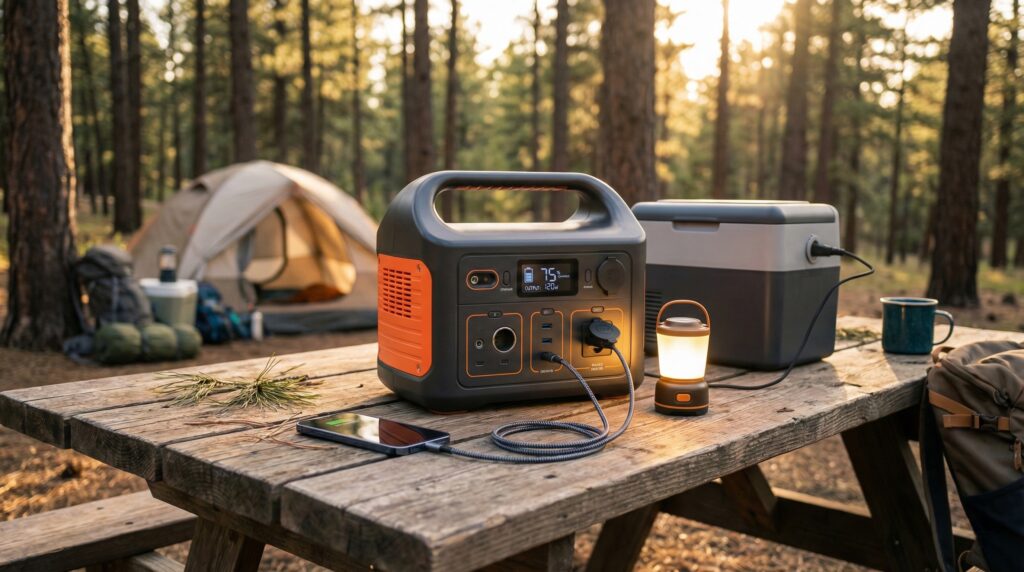
TL;DR
Jackery is a solid choice if you want a simple, beginner-friendly power station for camping, road trips, and charging small devices. But it is not automatically the best for every buyer, because competing brands can offer faster recharging, longer-life battery chemistry, and better value if you need more than light-duty portable power.
Top Recommended Picks
| Product | Best For | Price | Pros/Cons | Visit |
|---|---|---|---|---|
| Jackery Portable Power Station Explorer 300, 293Wh Backup | Simple camping and small devices | $179.00as of Oct 17, 10:30 GMT+0000 | Compact and easy to use; limited capacity for serious backup | Visit Amazon |
| AC180 | More output and better value | $410 – $480 | Stronger alternative for heavier use; costs more than a small Jackery | Visit Bluetti |
Top Pick: Best Overall
Jackery Portable Power Station Explorer 300, 293Wh Backup
Best for: weekend camping, a go-bag, or keeping phones, lights, camera batteries, and a laptop topped up during a short outage or a 2-night road trip.
The Good
- Compact size makes it easy to carry and stash in a car, tent setup, or small apartment.
- 293Wh capacity per brand spec is a practical fit for phones, tablets, cameras, lights, and occasional laptop charging.
- Beginner-friendly design appeals to buyers who want a straightforward all-in-one unit without a steep learning curve.
- User feedback is especially strong for camping and light backup use where convenience matters more than max specs.
- Jackery remains widely available, which can make support, accessories, and replacement shopping simpler.
The Bad
- Capacity is limited for home backup, higher-watt appliances, or long runtimes.
- Older small-station design can look less competitive next to rivals with faster charging or LiFePO4 chemistry.
- This listing may confuse some shoppers because the refurb status has been a point of complaint in buyer reports.
4.6/5 across 637 Amazon reviews
“This was an excellent find as a like new, refurbished model. It even had the protector on the small LED screen. The only thing that was missing was a pretty box. This has worked great on recently camping trips to recharge small devices like lamps, camera batteries and cell phones, as well as larger items like a laptop. One night I even left my laptop lugged…” — Verified Amazon buyer (5 stars)
“I didn’t realize I was buying a refurbished item. I don’t recall that being clear in the description. Its possible I overlooked it somehow but it certainly wasn’t clear if it was mentioned.” — Verified Amazon buyer (4 stars)
“I think the explorer 240/300 is a great choice for camping, long road trips, a go bag, and the occasional power outage” — r/preppers discussion
“This has worked great on recently camping trips to recharge small devices like lamps, camera batteries and cell phones, as well as larger items like a laptop.” — verified buyer, 5 stars
Our Take: For buyers who keep asking whether Jackery is the best, this is the clearest case where the answer can be yes: if your needs are basic, your loads are small, and you value easy ownership over chasing the strongest spec sheet.
Jackery earns its reputation mostly on ease of use, not on dominating every category. That matters. A lot of buyers do not need to run a fridge, power tools, or a full RV setup. They need something that works, charges common gear, and does not feel intimidating the first time they use it.
That is where the Explorer 300 makes sense. It sits in the sweet spot for lighter-duty buyers who want enough battery for overnight device charging, camp lighting, and occasional laptop use, but do not want the size and cost jump that comes with bigger stations. If your normal use looks like phones, tablets, drone batteries, USB accessories, and a few hours of laptop charging, this style of Jackery can be a very good match.
It is also important to be realistic about what a unit this size cannot do. A compact power station is not a whole-home backup plan, and it is not the right tool for heaters, kettles, hair dryers, or most microwaves. Before you buy, list your devices and estimate both running watts and total watt-hours. Research from NREL renewable energy research and sizing best practices generally point to the same lesson: buying based on brand name alone is how people end up with too little battery or too little inverter power.
Battery safety matters too. Portable power stations store a lot of energy in a small box, so keep vents clear, avoid extreme heat, and use properly rated cables and chargers. For general storage and charging precautions, the NFPA lithium-ion battery safety guidance is worth reviewing before you leave one in a hot vehicle or packed tightly in a gear bin.
AC180
Best for: buyers stepping up from basic weekend camping to heavier use, such as powering more demanding gear during a 24-hour outage, car camping with appliances, or wanting stronger value than a small Jackery offers.
The Good
- Well-known Jackery alternative that is frequently cross-shopped by value-focused buyers.
- Better fit for shoppers who want more capability than a compact entry-level station can provide.
- Appeals to buyers prioritizing stronger output, broader use cases, or more features for the money.
- Useful benchmark when asking whether Jackery is truly the best or simply the easiest brand to find.
The Bad
- Costs more than the small Jackery option featured here.
- May be more power than casual phone-and-light users actually need.
- A larger, more capable station can also mean more weight and less grab-and-go convenience.
Our Take: If your idea of “best” means stronger real-world value, more headroom, and a better fit for larger loads, the AC180 is the kind of rival that makes Jackery harder to crown as the default winner.
The Bluetti AC180 is the smarter direction for many shoppers once the conversation shifts from simple gadget charging to practical backup power. If you want to run more than just electronics — think a cooler, more substantial AC loads, or a longer-duration emergency kit — a stronger alternative often makes more sense than staying loyal to a familiar brand.
This is the key point in the whole Jackery debate: there is a difference between “good” and “best.” Jackery is often good. It is polished, easy to understand, and easy to buy. But buyers comparing output, battery chemistry, charging speed, app features, and solar flexibility often end up looking at brands like Bluetti, EcoFlow, and Anker because those brands can deliver more capability per dollar.
That does not automatically make every rival the right choice. A higher-spec model is only better if it still fits your actual use. If the station is too heavy for your camping style, too noisy for your setup, or too complex for your comfort level, then the raw numbers may not matter as much. For some households, simplicity really is part of the value equation.
Solar compatibility is another place where shoppers should slow down and compare details. Buyer reports often point out that some Jackery setups rely on proprietary 7mm or 8mm style solar connections, which can add friction if you already own panels or want to shop broadly. If you are pairing a power station with existing solar gear, compare connector type, voltage range, and input limits carefully. A connector that physically fits is not enough — the electrical match has to be right too. The DOE solar PV basics page is a helpful plain-English starting point, and the NREL PVWatts solar calculator can help set more realistic expectations for panel production.
When Jackery Makes the Most Sense
Jackery is easiest to recommend in a few specific scenarios:
- Weekend camping: You need dependable charging for phones, lanterns, cameras, GPS units, and maybe a laptop.
- Road trips: You want a compact unit that is easy to move between the car, cabin, and campsite.
- Emergency basics: You are covering communication devices, small lights, and modest electronics during short outages.
- First-time buyers: You would rather have a familiar, polished product than maximize every technical spec.
In those roles, the Explorer 300 is a practical example of why Jackery remains popular. Buyer reports repeatedly describe small Explorer models as easy to live with. The brand’s main appeal is not that it crushes competitors in every metric. It is that it often removes friction for people who want portable power without a lot of homework.
When Another Brand Is the Smarter Buy
You should strongly cross-shop if any of these apply to you:
- You need to power higher-wattage appliances, not just gadgets.
- You care about faster AC recharging for travel or outage prep.
- You want app-based monitoring and more modern feature sets.
- You plan to use third-party solar panels and want less connector hassle.
- You care about long battery life and are specifically shopping for LiFePO4-based models.
For these buyers, a Bluetti, EcoFlow, or Anker model may be the better answer. That is especially true if you are comparing total ownership value instead of just the sticker price. Longer cycle life, easier charging, and more flexible solar input can matter more than saving a little money up front.
If your goal is home backup, also remember that battery size is only part of the equation. Continuous wattage, surge handling, recharge time, and outlet selection all matter. If you are planning around medical equipment, refrigeration, or outage resilience, it can be smart to talk with a licensed electrician or off-grid solar installer before buying. For indoor backup planning, portable battery stations avoid the carbon monoxide risks tied to fuel-burning generators, but households should still understand general emergency power safety. The CDC carbon monoxide safety guidance is especially relevant if you are comparing batteries against gas generators for outage use.
Battery Chemistry, Charging Speed, and Solar Flexibility Matter More Than Brand Hype
If you are trying to decide whether Jackery is the best, these are the specs we think deserve more attention than logo recognition:
- Battery chemistry: Many older or smaller Jackery units are associated with NMC-style lithium setups, while many newer rivals emphasize LiFePO4 for longer service life.
- Continuous AC output: This determines what you can actually run, not just how much energy is stored.
- Recharge speed: Fast recharge can matter as much as capacity on road trips or during back-to-back outages.
- Solar input flexibility: Third-party panel compatibility can save money and reduce setup headaches.
- Portability: The best power station on paper is a poor fit if you hate moving it.
That last point gets overlooked. A compact, easy-to-carry station often gets used more than a larger, more capable unit that stays in the garage because it is inconvenient. So when people ask, “Is Jackery the best?” we think the more useful question is, “Best for what?”
Other Notable Alternatives Worth Considering
- Jackery Portable Power Station Explorer 290, 290Wh Backup — This appears to be listed in the same general category and may appeal to buyers wanting a similarly compact Jackery option. It is listed in this category based on retailer data; we haven’t independently verified specific performance.
FAQ
Is Jackery the best portable power station brand for camping, home backup, or solar use?
No single brand is the best for every job. Jackery is often a strong fit for camping, travel, and light device charging because it is simple to use and easy to find, but buyers who want stronger output, faster recharge, or easier third-party solar pairing should compare it directly against Bluetti, EcoFlow, and Anker.
What kinds of devices can a small Jackery realistically run?
A compact unit like the Explorer 300 is generally best for phones, tablets, cameras, lights, drones, Wi-Fi gear, and some laptop charging. It is usually not the right choice for heaters, kettles, hair dryers, most microwaves, or sustained heavy appliance use, so add up your devices before buying.
Why do some buyers choose Bluetti, EcoFlow, or Anker instead?
Many shoppers move to those brands because they want more features or better value at a similar spend level. Common reasons include faster AC charging, longer-life battery chemistry, app control, stronger inverter output, or easier solar compatibility with standard panels and adapters.
Does Jackery make third-party solar panels harder to use?
It can, depending on the model and the connector setup. Buyer reports often mention proprietary 7mm or 8mm style solar connections as a hassle compared with more standard inputs, so check voltage, current, and connector compatibility carefully before connecting existing panels or adapter cables.
How should I compare watt-hours and AC output before buying?
Think of watt-hours as your fuel tank and continuous AC output as what the station can actually power at one time. You need enough stored energy for the runtime you want, but you also need enough inverter power for the appliance to start and run properly, especially with motors, compressors, or anything with a surge draw.
Is LiFePO4 better than NMC for portable power stations?
For many buyers, LiFePO4 is attractive because it is commonly associated with longer cycle life and better long-term durability. NMC can still be perfectly fine for lighter-duty users who care more about compact size and convenience, but if you expect frequent charging cycles, battery chemistry deserves a closer look.
Can I use a portable power station safely indoors during an outage?
Yes, battery power stations are designed for indoor use when used as directed, unlike fuel-burning generators. You should still follow basic charging and storage precautions, keep vents clear, avoid extreme heat, and review recognized safety guidance such as NFPA lithium-ion battery safety.
How do I estimate the right size for camping or backup use?
List every device you want to run, note its watt draw, and estimate how many hours you need it. If you are adding solar, use tools like the NREL PVWatts solar calculator to get a more realistic picture of panel output instead of assuming ideal conditions all day.
Bottom Line
Jackery is a good brand, but it is not automatically the best once you compare charging speed, battery chemistry, solar flexibility, and value. For simple camping and light device charging, the Jackery Portable Power Station Explorer 300, 293Wh Backup is still our top pick because it matches what many casual buyers actually need without adding complexity. If your loads are bigger or your priorities are more advanced, cross-shop before you buy and choose based on your real power needs, not the logo on the box.
Affiliate disclosure: Some of the links in this article are affiliate links. We may earn a commission if you purchase through them.
Product prices and availability are accurate as of the date/time indicated and are subject to change. Any price and availability information displayed on Amazon.com at the time of purchase will apply to the purchase of this product. Certain content that appears on this site comes from Amazon. This content is provided “as is” and is subject to change or removal at any time.