
TL;DR
If you’re shopping for an emergency generator for home backup, focus first on (1) your biggest starting/surge loads (often a well/sump pump or fridge compressor) and (2) how you’ll connect it (ideally a transfer switch or panel interlock installed by a licensed electrician). For most households running “critical circuits” (fridge/freezer, furnace blower, a few lights/outlets), a 240V generator with roughly 7,500–12,500 starting watts is the practical sweet spot — then choose inverter vs conventional based on noise, fuel use, and power quality.
What an Emergency Generator for Home Actually Is
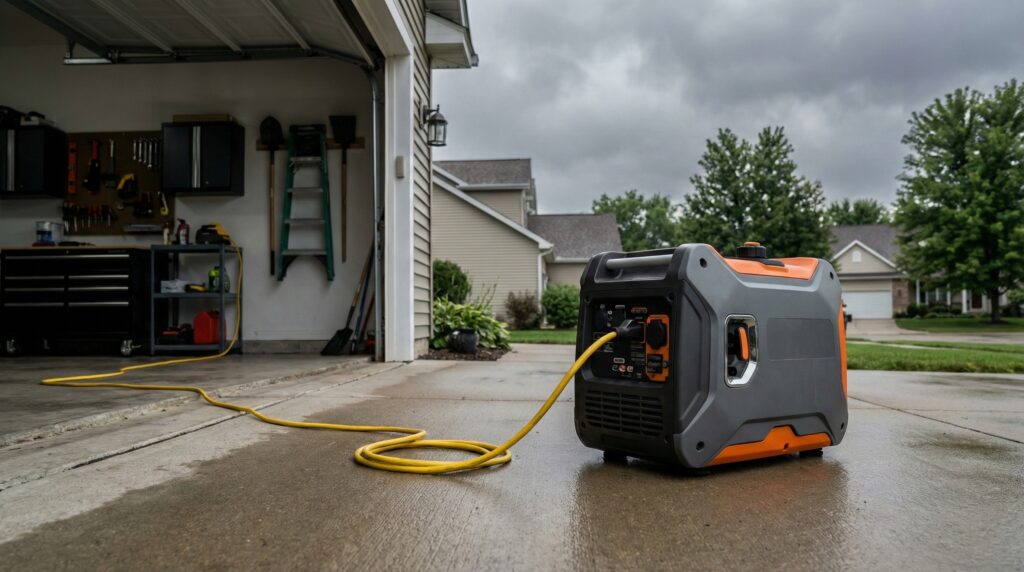
An “emergency generator for home” usually means a portable generator you roll out during an outage to power the most important things in your house — without paying (or committing) to a permanently installed standby generator. In the inverter-generator category, the big idea is that the generator makes DC power first and then “inverts” it to a stable AC output, which is typically cleaner power for sensitive electronics and more efficient at partial load (because many inverter models can throttle down).
The practical formula we use for buying the right class of home backup generator looks like this:
- Your critical-load list (what you truly need during an outage) +
- Starting watts (surge) for your single biggest motor load (well pump, sump pump, fridge/freezer, furnace blower) +
- Connection method (extension cords vs transfer switch/interlock + inlet box) +
- Fuel plan you can actually maintain (gas, propane, dual-fuel) +
- Safety basics (CO shutoff/alert, outdoor placement, refueling practices).
This matters because the label “X running watts” doesn’t tell the whole story. A generator might handle steady loads (running watts) fine, but struggle when a compressor or pump kicks on (starting watts). Evidence and real-world user experience both point to surge capacity as the common point of failure when people try to run refrigeration, water pumps, or HVAC blowers during an outage.
Also, don’t treat “home backup” like it automatically means “whole-home.” With a portable unit — even a large one — you’re often aiming for critical circuits: refrigeration, heat circulation (furnace blower), communications, some kitchen convenience, possibly sump/well, and medical devices. You can get there either by running a few heavy-duty extension cords to individual appliances, or (more safely and conveniently) by using a transfer switch or panel interlock with an outdoor inlet. Backfeeding through an outlet is dangerous and can put utility workers at risk.
Finally: safety is not optional. Carbon monoxide (CO) from generators can be deadly. Keep the unit outdoors and away from doors, windows, and vents, and treat CO shutoff features as a helpful layer — not a permission slip to put the generator “closer.” For official guidance, see CDC generator safety guidance and general safety reminders from NFPA.
Who an Emergency Generator for Home Fits Best
This category is a strong fit if you want meaningful outage capability without the cost and permanence of a standby system. In practice, it fits best for:
- Homes that need to keep food from spoiling (fridge/freezer) and power basics like lights, chargers, Wi‑Fi, and a microwave — especially for outages lasting hours to a few days.
- Cold-weather households that mainly need a furnace blower (for gas/oil/propane furnaces) rather than powering electric resistance heat.
- Homes with water concerns (well pump or sump pump) where you’re willing to size up to 240V and plan a proper connection method.
- People who care about neighborhood noise and fuel efficiency—often a reason to pick inverter designs for overnight running at lighter loads.
- Anyone who wants a safer, cleaner setup than “cord spaghetti” by installing an inlet + interlock/transfer switch (a licensed electrician can confirm neutral/ground bonding needs and local code details).
Owner sentiment often comes down to peace of mind when the grid is unreliable: “Works great for power outages, runs my fridge and some lights easily.”
— buyer report, 5 stars.
If that’s your goal, plan your “critical loads list” before you buy. A right-sized generator plus a realistic fuel plan is usually more satisfying than an oversized machine you can’t store fuel for — or an undersized machine that trips every time the fridge cycles.
Who Should Skip an Emergency Generator for Home
Portable inverter generators are not the best answer for everyone. You should consider skipping (or changing approach) if:
- You want true whole-home backup (central AC, electric oven/dryer, multiple large loads at once) with automatic switchover. That’s generally standby-generator territory, or a more complex hybrid system.
- You can’t commit to safe outdoor operation (space constraints, apartment/condo rules, inability to place it well away from openings). CO risk is serious and non-negotiable.
- You don’t want ongoing maintenance (oil changes, test runs, fuel rotation, carburetor care for gasoline units). A generator you never test is a generator that may not start when you need it.
- You’re not willing to invest in the connection method. Running lots of extension cords is possible, but it’s inconvenient and can encourage unsafe shortcuts. If you want to energize home circuits, budget for an electrician-installed interlock/transfer setup.
User feedback also commonly flags frustration when expectations don’t match reality: “It’s louder than I expected and heavier than the videos made it look.”
— buyer report, 2 stars.
If noise, weight, and manual setup sound like deal-breakers, you may be happier with a permanently installed standby generator, or a battery-based backup for lighter loads (noting that large batteries get expensive fast when you add long runtimes and high-watt appliances).
Price and Value
Because “emergency generator for home” spans a wide range of sizes, price is less about brand and more about output class + features + fuel type. As a rule of thumb:
- Small inverter generators (2,000–4,000 starting watts) are typically the lowest-cost option, but they’re often best for fridge + a few devices via cords — not pumps or 240V circuits.
- Mid/large inverter generators (roughly 4,500–9,000+ starting watts) cost more, but are more realistic for “home critical circuits,” especially if you want 240V output and a transfer setup.
- Dual-fuel capability often adds cost, but can improve real outage reliability because propane stores long-term without going stale. The tradeoff is reduced power on propane on many models.
- CO shutoff/alert features are increasingly common and worth prioritizing. Treat this as a value feature, not just a checkbox.
Also budget beyond the generator itself. Many buyers underestimate the “complete system” cost:
- Transfer switch or panel interlock + inlet box (often the biggest add-on; hire a licensed electrician).
- Generator cord sized correctly for amperage and length.
- Fuel storage (approved cans, stabilizer for gasoline, or propane cylinders/tank access).
- Maintenance supplies (oil, funnels, spare spark plug/air filter depending on model).
Value comes from buying the smallest generator that reliably starts your biggest loads while still being manageable (noise, weight, fuel consumption) for the way you’ll actually use it.
Common Mistakes When Trying an Emergency Generator for Home
Most “generator disappointment” isn’t about a defective unit — it’s about planning gaps. Here are the pitfalls we see most often in customer reviews and owner reports:
- Shopping by running watts only. A fridge or pump that runs at a modest wattage can demand a much larger surge at startup. If the generator can’t supply that momentary surge, you’ll see bogging, tripping, or cycling failures.
- Buying 120V-only when you actually need 240V. If you have a well pump, certain sump setups, or you want easier “panel-level” backup, 240V output and the right receptacle type matter.
- No plan for connection method. Extension cords work for a couple appliances. Once you try to run a household, cords become messy fast — and can lead to unsafe shortcuts. A transfer switch/interlock is typically the cleaner solution.
- Ignoring fuel reality. Gasoline availability can be constrained during regional outages, and stored gas can go stale. Propane stores well, but you need a realistic refill plan and correct cylinder sizing.
- Skipping test runs. Generators should be exercised periodically (and under some load) so you’re not discovering issues during an actual emergency.
A common theme in user feedback is “it worked great… once we changed how we used it”: “Once I stopped trying to run everything at once, it ran perfectly.”
— buyer report, 4 stars.
Two safety-related mistakes are worth calling out explicitly:
- Unsafe placement: Never run a generator in a garage, basement, or enclosed space — even with doors open. CO can build up quickly. Follow CDC generator placement guidance and keep battery CO alarms active inside your home.
- Backfeeding: Never plug a generator into a wall outlet. Use a properly installed transfer switch or interlock to prevent energizing utility lines. If you’re unsure about neutral/ground bonding or inlet wiring, consult a licensed electrician.
FAQ
How many watts do I need for an emergency generator for home backup?
Start with your “critical loads” list and size for starting (surge) watts, not just running watts. Many homes targeting fridge/freezer, furnace blower, and basic lighting/outlets land in the 7,500–12,500 starting-watt range if they want a 240V unit capable of handling motor starts more comfortably. The exact number depends on whether you’re adding a well pump, sump pump, or other high-surge loads.
Is an inverter generator worth it for emergencies at home?
Often, yes — especially if you expect to run the generator for long stretches at partial load (overnight, between pump cycles, etc.). Inverter designs typically throttle down, which can reduce fuel use and noise, and they generally produce cleaner power for electronics. Conventional generators can be cheaper per watt, but may be louder and less efficient when lightly loaded.
What’s the safest way to connect a portable generator to my house?
The safest, most practical approach for home backup is a properly installed transfer switch or panel interlock with an inlet box, matched to the generator’s voltage (often 240V) and amperage (commonly 30A or 50A). This helps prevent backfeed and makes it easier to power selected circuits. For safety reminders, review guidance from NFPA, and have a licensed electrician verify your setup and local code requirements.
Do CO shutoff generators eliminate carbon monoxide risk?
No. CO shutoff/alert features can help, but they do not eliminate the need for strict outdoor placement and good distance from openings. CO can kill quickly, and it can drift into a home through doors, windows, soffit vents, and other openings. Follow CDC carbon monoxide generator guidance and use working CO alarms inside the home.
How should I store fuel for a home emergency generator?
Gasoline is common but needs a plan: store it in approved containers, consider a stabilizer, and rotate it so it doesn’t sit too long. Propane stores long-term more easily, but you need enough cylinder capacity (or a larger tank) and a realistic refill plan during outages. Always shut down and allow the generator to cool before refueling, and follow general safety practices referenced by NFPA.
Do I need a 240V generator for home backup?
You don’t always need 240V if you’re only running a few 120V appliances via extension cords. But if you have any 240V loads (like many well pumps) or you want to connect through a transfer switch/interlock to power a broader set of circuits more conveniently, a 240V-capable generator is typically the better fit.
Should I look for UL certification on a portable generator?
Looking for recognized safety certification can be a good idea because it signals the product was evaluated against specific safety standards. You can learn more about certifications and product safety programs via UL Solutions. (Certification alone doesn’t replace safe operation, but it’s one useful quality/safety filter when comparing options.)
Looking for these on Amazon? Browse emergency generator for home on Amazon →
Bottom Line
The best emergency generator for home backup is the one that can reliably handle your biggest starting-watt load, connects safely through a transfer switch/interlock when needed, and runs on a fuel plan you can maintain during a real outage. For many households, that means shopping 240V units in the roughly 7,500–12,500 starting-watt class, prioritizing CO shutoff/alert features and safe outdoor placement.
Affiliate disclosure: Some of the links in this article are affiliate links. We may earn a commission if you purchase through them.