
Quick Hits
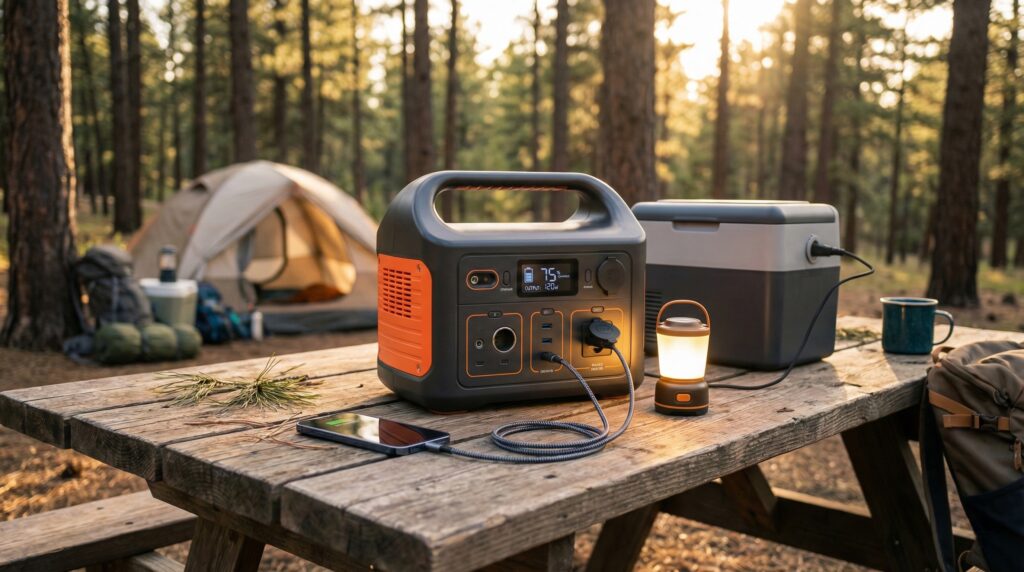
Finding the right portable power station for your refrigerator depends entirely on your specific scenario. For full-size home refrigerators during a multi-day outage, a high-capacity unit like the EcoFlow Delta Pro or Anker Solix F3800 is necessary to handle the initial compressor surge and provide at least 24–48 hours of runtime. If you are overlanding with a compact 12V cooler, a smaller, more portable unit like the Bluetti EB70S or the AC70 is often the more practical choice. The critical factor is “surge power”—your station must be able to handle roughly 1,500W for a split second to start a home fridge, even if the fridge only draws 150W while running. For apartment dwellers with limited space, specialized slim units like the BioLite Backup offer a way to keep food safe without a massive footprint.
Why You Need a Dedicated Power Station for Your Fridge
When the grid goes down, your refrigerator is the most important appliance in your home. It isn’t just about the cost of spoiled groceries—though a single freezer full of meat can easily exceed $500—it is about food safety and maintaining a sense of normalcy. Unlike gas generators, portable power stations are silent and emit no fumes, making them the only viable choice for apartment dwellers or those who don’t want to wake the entire neighborhood during a blackout.
For those who love the outdoors, the shift from ice chests to 12V portable fridges has been a massive quality-of-life improvement. No more soggy sandwiches or hunting for ice in the middle of nowhere. However, relying on your vehicle’s starter battery to run a fridge is a recipe for a stranded morning. A dedicated power station acts as a buffer, charging while you drive and keeping your food cold while you’re parked at camp. If you’re just starting to build out your mobile energy setup, exploring our portable power stations hub can help you understand the foundational technology before you commit to a specific fridge setup.
The Math of Cold: Calculating Your Power Needs
You might see a power station labeled “1000Wh” and assume it can run a 100W device for 10 hours. In reality, conversion losses (usually around 15-20%) and the way refrigerators consume energy make the math a bit more complex. To choose the right unit, you have to look at two distinct numbers: surge power and total capacity.
Running Watts vs. Surge Power
A modern Energy Star refrigerator might only use 100W to 150W while the compressor is running. However, the moment that compressor kicks on, it requires a massive “kickstart” of electricity. This is known as surge power or starting watts. Most full-size kitchen refrigerators require between 1,200W and 1,500W to start. If your power station’s inverter is rated for 1,000W continuous but doesn’t have a high enough surge rating, it will trip a safety breaker and shut down the moment your fridge tries to turn on.
Wh vs. Ah: How to Estimate Runtime
While many in the overlanding community still talk in Amp-hours (Ah), the industry standard for power stations is Watt-hours (Wh). To estimate how long a station will last, assume a standard kitchen fridge uses about 1.5kWh (1,500Wh) per 24-hour period. A 2,000Wh battery, like the one in a Jackery 2000 Pro, would realistically run that fridge for about 24 to 30 hours once you account for the energy lost by the inverter staying awake. For a smaller 12V travel cooler, the consumption is much lower—often only 400Wh to 600Wh per day—meaning a mid-sized battery can easily last an entire weekend.
Top-Rated Portable Power Stations for Refrigerators
1. EcoFlow Delta Pro: The Gold Standard for Home Backup
The EcoFlow Delta Pro is a heavy-duty solution designed specifically for those who can’t afford to let their home appliances go dark. With a massive 3.6kWh capacity and a 3,600W inverter, it handles full-size refrigerators without breaking a sweat. Its main advantage is expandability; you can chain extra batteries to it to keep your kitchen running for nearly a week.
What Works
- Massive 3,600W AC output handles the heaviest compressor surges easily.
- Can be charged via EV stations or high-wattage solar for rapid recovery.
- LiFePO4 battery chemistry means it will last for thousands of cycles over a decade.
What Doesn’t
- Extremely heavy (nearly 100 lbs); the wheels are helpful, but stairs are a nightmare.
- The cooling fans are quite loud when the unit is under heavy load or fast charging.
💰 Street Price: $3500 – $6000
Worth It? Best for homeowners who need a reliable, high-capacity “insurance policy” for their kitchen. Skip if you need something you can easily carry to a campsite.
2. Anker Solix F3800: High-Capacity Home Solution
The Anker Solix F3800 is a direct competitor to the Delta Pro, offering a slightly higher base capacity of 3.84kWh. It is built like a tank and features a very user-friendly interface. It excels at powering 120V and 240V appliances, making it one of the few portable units that can also handle things like a well pump or a dryer if needed.
What Works
- Seamless integration with home transfer switches for “plug and play” backup.
- High solar input capacity allows for faster recharging during daylight hours.
- The build quality feels premium and rugged compared to some plastic-heavy rivals.
What Doesn’t
- The physical footprint is large, requiring a dedicated spot in your garage or utility room.
- Initial setup and firmware updates via the app can be finicky.
💰 Street Price: $2500 – $4500
Worth It? Best for those who want a “whole-house” feel in a portable package. Skip if you have a very tight budget, as the per-watt cost is premium.
3. Bluetti AC200Max: The Versatile All-Rounder
If you find the top-tier units too bulky, the Bluetti AC200Max offers a fantastic middle ground. It features a 2,200W inverter and 2,048Wh of capacity. In our experience, this is the “sweet spot” for most people. It is powerful enough to run a kitchen fridge for 24+ hours but light enough that two people can move it into a vehicle for a weekend trip.
What Works
- Modular design allows you to add B230 or B300 expansion batteries later.
- The touch-screen interface provides very detailed real-time data on power draw.
- Includes a 30A RV port, which is a massive plus for van-lifers.
What Doesn’t
- The screen can be difficult to read in direct sunlight.
- The power brick for AC charging is external and gets quite hot during use.
💰 Street Price: $800 – $1500
Worth It? Best for the “hybrid” user who wants home backup and occasional camping utility. Skip if you struggle with lifting 60 lbs.
4. Jackery Solar Generator 2000 Pro: Reliable Off-Grid Power
The Jackery Solar Generator 2000 Pro is often the first choice for those who value simplicity. There are no complicated menus or expansion ports to worry about. You plug it in, and it works. When paired with Jackery’s folding solar panels, it creates a very efficient closed-loop system for off-grid living.
What Works
- Extremely fast AC charging—reaches 100% in under 2 hours.
- The handles are ergonomically designed, making it feel lighter than it actually is.
- The display is simple, clear, and focused on the most important metrics.
What Doesn’t
- Unlike some competitors, it does not use LiFePO4 chemistry, meaning it has a shorter overall lifespan (cycles).
- No expansion battery options—the capacity you buy is the capacity you’re stuck with.
💰 Street Price: $500 – $1000
Worth It? Best for users who want a simple, “no-nonsense” setup for emergencies. Skip if you’re looking for a 10-year daily-use battery.
5. EcoFlow Delta 3 Plus: Modern Efficiency
The EcoFlow Delta 3 Plus is the newest entry in the mid-range category. It shines as a UPS (Uninterruptible Power Supply). You can leave it plugged into the wall and plug your fridge into the Delta 3 Plus. If the power flickers, it switches to battery in under 10 milliseconds, preventing the fridge compressor from stalling.
What Works
- Ultra-fast UPS switching speed is safer for sensitive modern appliances.
- Compact size fits easily on top of a chest freezer or under a table.
- Excellent app control for managing power limits and charge speeds.
What Doesn’t
- 1,024Wh capacity is a bit low for full-size fridges; you’ll likely want the expansion battery.
- The “X-Boost” mode can be misleading; it lowers voltage to run high-draw items, which isn’t ideal for motors.
💰 Street Price: $300 – $700
Worth It? Best for those in areas with frequent, short power flickers. Skip if you need to survive a 3-day outage without solar.
6. Bluetti EB70S: Best for Portable 12V Coolers
For the weekend camper using an Iceco VL45 or a similar 12V cooler, the Bluetti EB70S is the gold standard. It’s small, affordable, and uses the long-lasting LiFePO4 chemistry. It won’t run your kitchen fridge for long, but it will keep your camping food cold for 2 days without a charge.
What Works
- Compact enough to tuck behind a car seat.
- Regulated 12V DC output ensures your fridge doesn’t shut off as the battery drops.
- Great price-to-performance ratio for entry-level users.
What Doesn’t
- The DC input is limited to 200W, which can make solar charging slow for high-use scenarios.
- The built-in LED light is a bit of a gimmick and not very bright.
💰 Street Price: $150 – $300
Worth It? Best for car camping and overlanding with small fridges. Skip if you’re trying to power a household appliance.
7. BioLite Backup: The Apartment Dweller’s Choice
Living in an apartment often means you don’t have space for a bulky “crate” style power station. The BioLite Backup solves this with a thin, flat design. It is meant to sit on top of your fridge or slide behind it, staying permanently plugged in as a dedicated emergency reserve. If you’re looking for other ways to keep your mobile devices topped off in small spaces, check out our guide on the best solar power bank for lightweight backup.
What Works
- Unobtrusive design that doesn’t clutter living spaces.
- True “set it and forget it” functionality.
- Magnetic mounting options for sticking it to the side of appliances.
What Doesn’t
- Capacity is limited compared to the “beast” units like the Delta Pro.
- Not really designed for porting around a campsite or rugged outdoor use.
💰 Street Price: $200 – $500
Worth It? Best for urban dwellers who want “invisible” protection. Skip if you need a versatile battery for camping.
Comparison of Top Fridge-Ready Power Stations
| Product Name | Best For | Price Range | Pros/Cons | Visit |
|---|---|---|---|---|
| The Gold Standard for Home Backup | homeowners who need a reliable, high-capacity “insurance policy” for their ki… | $3500 – $6000 | ✅ Massive 3,600W AC output handles the heaviest comp; Can be charged via EV stations or high-wattage sol ❌ Extremely heavy (nearly 100 lbs); the wheels are h; The cooling fans are quite loud when the unit is u |
|
| High-Capacity Home Solution | those who want a “whole-house” feel in a portable package | $2500 – $4500 | ✅ Seamless integration with home transfer switches f; High solar input capacity allows for faster rechar ❌ The physical footprint is large, requiring a dedic; Initial setup and firmware updates via the app can |
|
| The Versatile All-Rounder | the “hybrid” user who wants home backup and occasional camping utility | $800 – $1500 | ✅ Modular design allows you to add B230 or B300 expa; The touch-screen interface provides very detailed ❌ The screen can be difficult to read in direct sunl; The power brick for AC charging is external and ge |
|
| Reliable Off-Grid Power | users who want a simple, “no-nonsense” setup for emergencies | $500 – $1000 | ✅ Extremely fast AC charging—reaches 100% in under 2; The handles are ergonomically designed, making it ❌ Unlike some competitors, it does not use LiFePO4 c; No expansion battery options—the capacity you buy |
|
| Modern Efficiency | those in areas with frequent, short power flickers | $300 – $700 | ✅ Ultra-fast UPS switching speed is safer for sensit; Compact size fits easily on top of a chest freezer ❌ 1,024Wh capacity is a bit low for full-size fridge; The “X-Boost” mode can be misleading; it lowers vo |
|
| Best for Portable 12V Coolers | car camping and overlanding with small fridges | $150 – $300 | ✅ Compact enough to tuck behind a car seat.; Regulated 12V DC output ensures your fridge doesn’ ❌ The DC input is limited to 200W, which can make so; The built-in LED light is a bit of a gimmick and n |
|
| The Apartment Dweller’s Choice | urban dwellers who want “invisible” protection | $200 – $500 | ✅ Unobtrusive design that doesn’t clutter living spa; True “set it and forget it” functionality. ❌ Capacity is limited compared to the “beast” units ; Not really designed for porting around a campsite |
What Real Users Are Saying (Reddit Insights)
General Sentiment
Across the overlanding and prepping subreddits, there is a clear shift toward LiFePO4 (Lithium Iron Phosphate) chemistry. Users who previously relied on lead-acid AGM batteries or standard lithium-ion units are moving to stations like the Bluetti AC200Max because of the “peace of mind” that comes with a 10-year lifespan. Most users find that for a standard kitchen fridge, a 2,000Wh capacity is the absolute baseline for feeling “safe” during a storm.
“I have a Delta 3 Plus on my kitchen fridge, keeps it going for about 24 hours no power. For an extended outage, instead of running a generator with extension cords, I just run solar panels.” — r/solar
Top Complaints & Warnings
The most common frustration among Reddit users is the “Solar Reality Check.” Manufacturers often claim fast solar charging times, but users report that in real-world conditions (clouds, shade, low sun angles), a 200W panel rarely produces 200W. This leads to situations where the fridge consumes energy faster than the panels can replace it.
Another common warning involves the 12V sockets in vehicles. Many overlanders note that a standard vehicle DC port only outputs about 120W (10 amps). If you have a large battery like the AC200Max, it can take over 15 hours of driving to fully recharge it. Users recommend using a DC-to-DC charger or high-wattage solar to avoid this bottleneck.
Budget Tips & Value Picks
The community frequently points out that if you don’t need portability, a dedicated gas inverter generator like the Honda EU2200i is still the king of price-per-watt. However, for those committed to battery power, the “DIY” route is often suggested for those on a budget—buying a standalone LiFePO4 battery and a separate inverter. For a ready-made solution, the Bluetti EB70S is the most frequently recommended “value” pick for small fridge setups.
Buyer’s Guide: Key Features for Refrigeration
- LiFePO4 Battery Chemistry: This is non-negotiable for long-term value. These batteries last 3,000+ cycles, whereas older lithium-ion units (NMC) may drop to 80% capacity after just 500 cycles.
- Pure Sine Wave Inverters: Refrigerators use sensitive AC motors. A Pure Sine Wave inverter ensures the power is as clean as what comes out of your wall, preventing motor damage.
- Pass-through Charging & UPS Mode: Look for a unit that can act as a UPS. This allows you to keep it plugged into the wall and the fridge plugged into the unit, providing instant backup during a flicker. Our battery backup systems overview covers more on how this logic applies to home office gear as well.
- Expandable Battery Ports: Your needs might grow. Buying a system that allows for extra “slave” batteries ensures you don’t have to buy a whole new station if you add a second freezer later.
Setup Scenarios
For Home Power Outages
Prioritize high Watt-hour (Wh) capacity over everything else. In a home outage, you aren’t moving the unit around much, so weight is less of a concern. Aim for at least 2,000Wh to get through a single day comfortably. If you’re also worried about keeping your phone charged during these times, a smaller best power bank for iphone is a great companion to keep in your pocket so you don’t have to hover near the big battery.
For Overlanding & Camping
Focus on the footprint and charging flexibility. A Bluetti AC70 is often enough for a 12V fridge. Make sure your unit has a “Regulated 12V DC” output. Some cheaper units have unregulated ports that drop voltage as the battery drains, which can cause your fridge to throw an “Error” code and stop cooling even if the battery has 40% charge left.
For Apartments (No Balcony)
Since you can’t use a gas generator and might not have a place for solar panels, focus on high-speed AC charging. You want a unit that can recharge from the wall in 2 hours or less, so you can top it off quickly if you get a “grid warning” before a storm. The BioLite Backup is the gold standard for this niche.
Frequently Asked Questions
Can a 500Wh power station run a full-size refrigerator?
Technically, no. While 500Wh might seem like enough for a few hours, most 500Wh stations only have a 500W or 600W inverter. A full-size fridge needs a 1,500W surge to start the compressor. The station will likely trip its overload protection immediately. You would need something larger, like the Bluetti AC200Max, to handle the initial power spike.
How many solar panels do I need to run a fridge indefinitely?
For a standard kitchen fridge using 1.5kWh daily, you generally need about 400W to 600W of solar panels. This accounts for the fact that you only get 4–5 hours of “peak” sun per day and there are energy losses in the system. Check out our solar generators section for more on matching panel wattage to battery size.
What is the difference between starting watts and running watts for a fridge?
Running watts is the power used while the fridge is actively cooling (typically 100-150W). Starting watts (surge) is the massive burst of energy (up to 1,500W) required to physically get the compressor motor spinning. Your power station must be rated to handle this peak surge, or the fridge simply won’t turn on.
Are portable power stations better than gas generators for food storage?
They are better for indoor use, silent operation, and zero maintenance. However, gas generators like the Honda EU2200i are better for long-term outages lasting over a week, as you can simply pour in more fuel. Power stations are limited by how fast you can recharge them via solar or the wall. For many, a hybrid approach works best.
How long will a 2000Wh battery power a standard kitchen fridge?
A 2,000Wh battery like the Jackery 2000 Pro will typically run a modern, efficient kitchen fridge for about 24 to 36 hours. Older fridges from the 90s are much less efficient and might only last 12 to 15 hours on the same battery. Always test your specific fridge before a real emergency happens.
Final Thoughts
Choosing the best portable power station for your refrigerator is an investment in safety and comfort. If you are preparing for home emergencies, don’t skimp on capacity—the EcoFlow Delta Pro or Anker Solix F3800 are the heavy hitters you want in your corner. For those living the mobile life, a mid-sized LiFePO4 unit like the Bluetti AC200Max or a compact EB70S provides the perfect balance of portability and reliability. If you’re still weighing your options between portable batteries and traditional fuel, our guide to inverter generators can help you decide if a gas-powered backup fits your lifestyle better.
Some links below are affiliate links. We may earn a commission if you purchase through them.