
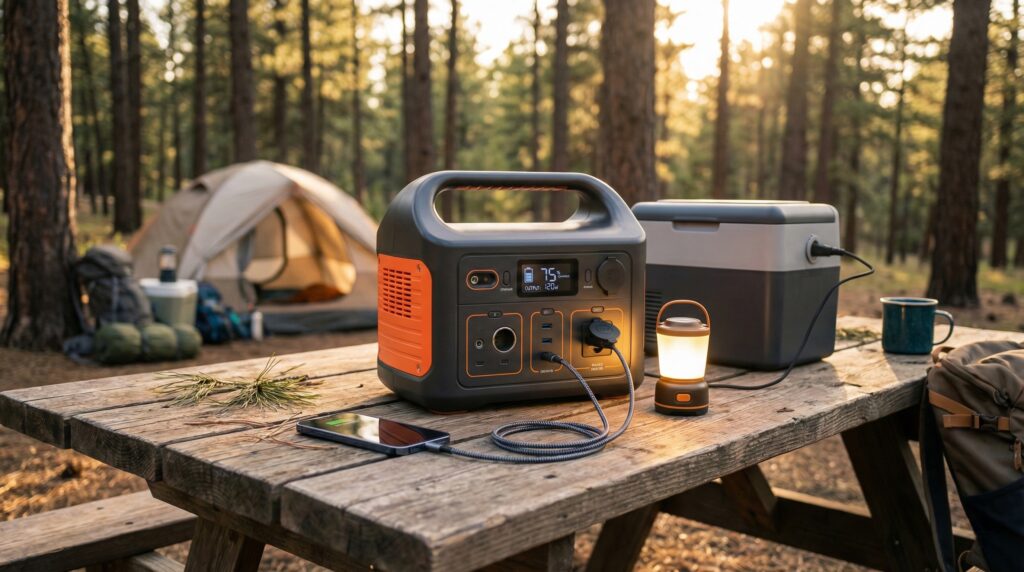
Quick Hits
Choosing a budget portable power station often feels like a balancing act between capacity and cost. For most campers and emergency preppers, the EcoFlow River 2 Pro offers the best overall value with its fast charging and reliable LFP battery. If you need something specifically for a CPAP machine, the Bluetti EB55 provides the right port selection and runtime for overnight use. For those on a strict budget who only need to keep phones and laptops alive, the Jackery Explorer 300 remains a lightweight, dependable choice. While newer models boast flashy features, focusing on the battery chemistry (LiFePO4) and the continuous wattage rating ensures you won’t be left in the dark when you need power most.
Introduction
You’ve likely been there: halfway through a camping trip or three hours into a neighborhood blackout, realizing your phone is at 4% and your “emergency” flashlight is dead. Portable power used to be a luxury for high-end van lifers, but the market has shifted. You can now find reliable, high-capacity stations without spending a month’s rent. Whether you need to keep a CPAP running through the night, maintain a 12v fridge in your SUV, or just ensure your laptop doesn’t die during a remote work session, finding the best budget portable power station is about matching your specific wattage needs to the right hardware.
I’ve spent years testing these units in the field, and I’ve learned that the “best” unit isn’t always the one with the biggest marketing budget. It’s the one that actually turns on when it’s freezing outside and charges fast enough to get you back on the road. In this guide, we’ll look at real-world performance, common user frustrations, and the “budget math” that keeps you from overspending.
How to Calculate Your Power Needs (The Budget Math)
Before you buy, you need to know your “Wh” (Watt-hours). Think of Wh as the size of your fuel tank. To calculate what you need, multiply the wattage of your device by the hours you need it to run. For example, a 60W 12v fridge doesn’t run constantly; it cycles. Usually, it pulls about 15-20Wh per hour. A 500Wh station would realistically power that fridge for about 20-24 hours. For a deeper dive into smaller backup options, you might also find our guide on the best power bank for iphone useful for your mobile devices. For a more comprehensive step-by-step guide on sizing, see our full breakdown on battery backup systems.
Top 5 Budget Portable Power Stations
1. Best Overall Budget Value: EcoFlow River 2 Pro
The River 2 Pro hits a sweet spot that few others can match. With 768Wh of capacity, it’s large enough to handle a weekend of camping but small enough to carry with one hand. Its biggest selling point is the X-Stream charging technology, which takes you from 0% to 100% in about 70 minutes. If you’ve ever forgotten to charge your gear until the morning of a trip, you’ll appreciate this.
What Works
- Hyper-Fast Charging: Recharges fully in just over an hour from a standard wall outlet.
- LiFePO4 Chemistry: Rated for 3,000+ cycles, meaning it will likely last you 10 years of regular use.
- Great App Support: You can monitor discharge rates and toggle ports from your phone via Bluetooth or Wi-Fi.
What Doesn’t
- Fan Noise: When charging at max speed or running high-wattage appliances, the fans are noticeably loud.
- UPS Lag: While it has a basic EPS mode, it’s not fast enough for sensitive desktop PCs during a flicker.
Worth It? Best for weekend campers and “forgetful” chargers who need a reliable, fast-refilling tank. Skip if you need total silence in a small tent.
2. The ‘Goldilocks’ Performance Pick: Anker Solix C1000
Anker entered the power station market with a focus on durability, and the C1000 is their most balanced offering. It packs 1056Wh into a very compact frame. It’s designed to handle 80% of household appliances, which makes it a legitimate contender for home backup during short outages. It’s significantly more rugged than the budget-tier “no-name” brands you see on sale.
What Works
- Ultra-Durable Build: Uses Anker’s InfiniPower technology and drop-resistant components.
- Expansion Potential: You can plug in an extra battery to double the capacity later if your needs grow.
- High AC Output: 1800W continuous (2400W surge) means it can run a coffee maker or a hair dryer in a pinch.
What Doesn’t
- Weight Distribution: For its size, it’s surprisingly heavy; the fixed handles help, but it’s not for long hikes.
- Display Accuracy: Some users report the “time remaining” estimate jumps around when running variable loads like a fridge.
Worth It? Best for homeowners who want a reliable backup for blackouts. Skip if you are counting every pound for a mobile setup.
3. Best Ultra-Portable for Device Charging: Jackery Explorer 300
The Explorer 300 is a classic for a reason. It doesn’t try to do everything; it just provides 293Wh of clean power in a 7-pound package. It’s perfect for charging a laptop 3-4 times or running a CPAP for a night or two. It’s the kind of unit you keep in the trunk “just in case.”
What Works
- Extreme Portability: The folding handle and light weight make it the easiest unit to move around.
- Silent Operation: Since it lacks a massive inverter, the fans rarely kick on during low-draw tasks.
- Simplicity: No complex apps or menus; just plug in and press the button.
What Doesn’t
- No Built-in Light: Unlike almost every competitor, it lacks an LED flashlight on the chassis.
- Slow AC Charging: It takes about 4-5 hours to charge from a wall outlet, which feels prehistoric compared to EcoFlow.
Worth It? Best for light travelers and casual car campers. Skip if you need to power anything with a motor or a heating element.
4. Best Budget Pick for CPAP Users: Bluetti EB55
If you need power through the night, the EB55 is a workhorse. It offers 537Wh and a 700W inverter. What makes it special for CPAP users is the variety of DC outputs and the stability of its LiFePO4 battery. It’s efficient enough to keep a standard CPAP running for 2-3 nights if you turn off the humidifier.
What Works
- Massive Array of Ports: Includes a wireless charging pad on top and 13 different output ports.
- Fast Dual Charging: You can charge via AC and Solar simultaneously to cut down wait times.
- Compact Footprint: Fits easily on a nightstand or under a camp cot.
What Doesn’t
- The Power Brick: It uses a massive, external AC adapter that gets quite hot and is just one more thing to carry.
- Screen Viewing Angles: The LCD screen is hard to read if you aren’t looking at it directly from the front.
Worth It? Best for CPAP users and those with many small gadgets. Skip if you hate carrying external charging bricks.
5. Best High-Capacity for Extended Trips: Jackery Explorer 2000 v2
This is the “big brother” of the budget category. While the price is higher than a small 300Wh unit, the value per Watt-hour is excellent. With 2,042Wh, this is for the person who wants to run a full-sized 12v fridge, lights, and a projector for an entire weekend without ever touching a solar panel.
What Works
- Huge Capacity: Realistically powers a 12v fridge for 3-5 days depending on ambient temperature.
- Clean Sine Wave: Safe for expensive gaming laptops and sensitive electronics.
- User-Friendly Interface: Large, clear display shows exactly how much power is going in and out.
What Doesn’t
- Charging Speed vs. Heat: Using the “UltraFast” charging mode generates significant heat, which can degrade battery health over years.
- Bulk: You’ll need two hands to move this comfortably; it’s not “tuck under the seat” small.
Worth It? Best for multi-day camping or serious emergency backup. Skip if you only need to charge phones and tablets.
| Product Name | Best For | Price Range | Pros/Cons | Visit |
|---|---|---|---|---|
| EcoFlow River 2 Pro | Fastest Charging | $350 – $450 | + 70 min charge / – Loud fans | View on Amazon |
| Anker Solix C1000 | Home Backup | $600 – $750 | + Expandable / – Heavy for size | View on Amazon |
| Jackery Explorer 300 | Ultra-Portable | $230 – $280 | + Lightweight / – No LED light | View on Amazon |
| Bluetti EB55 | CPAP Users | $350 – $400 | + Wireless charging / – Hot power brick | View on Amazon |
| Jackery Explorer 2000 v2 | Long Trips | $1,100 – $1,400 | + High capacity / – Not very portable | View on Amazon |
What Real Users Are Saying (Reddit Insights)
General Sentiment
Across communities like r/vandwellers and r/preppers, the sentiment is clear: reliability trumps features. Users tend to forgive a slow charge time if the unit consistently delivers its rated power. Brand loyalty is strong with Jackery due to their customer service, but EcoFlow is rapidly taking over the “efficiency” crowd. Most users agree that for budget setups, the sweet spot is between 300Wh and 700Wh.
Top Complaints & Warnings
The most common frustration in the community revolves around marketing versus reality. Many users report that high-draw appliances like space heaters or hot plates “kill budget stations in minutes.”
“I tried running a small 1500W heater on my Jackery 2000. It worked, but it drained 10% of the battery in less than 15 minutes. These aren’t meant for heating.” — r/camping
Another frequent warning concerns “vampire drain.” If you leave the AC inverter turned on without anything plugged in, many budget units will lose 5-10% of their charge overnight. Users on Amazon often complain about units arriving with “dead” cells if they’ve been sitting in a warehouse too long, so always test your unit the day it arrives.
Budget Tips & Value Picks
The DIY route is a massive topic of discussion for those looking to save 50% or more. Many veteran van-dwellers suggest that if you don’t need the “all-in-one” sleek look, building your own is smarter.
“I bought a cheap 100ah 12v lithium battery ($150) off Amazon, put it in a tool box ($30) and connected a cheap solar charger controller ($25). For $270, I got 1200Wh. The equivalent retail unit would have been $600+.” — r/vandwellers
If DIY isn’t your speed, the community consensus is to wait for “Prime Day” or “Black Friday” sales, as brands like Bluetti and Jackery frequently drop prices by 30% or more.
Budget Buyer’s Guide: Key Features to Prioritize
- Inverter Surge vs. Continuous Power: If your device says it needs 500W, ensure your station provides 500W *continuous*. Surge power only lasts for a few seconds to start a motor.
- Recharge Speeds: If you are moving every day, look for units with high DC (car) charging rates or fast AC charging like the EcoFlow series.
- LiFePO4 Longevity: Always check the battery type. LiFePO4 (Lithium Iron Phosphate) lasts 3-5x longer than standard Lithium-ion (NMC) batteries.
- Port Selection: Ensure you have at least two USB-C PD ports (60W or higher) if you plan on charging modern laptops.
Frequently Asked Questions
How much power do I need to run a 12v fridge for 24 hours?
Most efficient 12v portable fridges, like those from Alpicool, consume between 15Wh and 30Wh per hour depending on the outside temperature. To run one for 24 hours comfortably, you should look for a power station with at least 500Wh of capacity, such as the Bluetti EB55 or the Jackery Explorer 500, to account for efficiency losses.
Can a budget power station like the Jackery 300 run a CPAP machine?
Yes, but with caveats. A Jackery Explorer 300 can power most CPAP machines for 1 to 2 nights if you disable the heated humidifier and heated hose. These features draw significantly more power. For 3+ nights of use, users generally recommend a higher capacity unit or a dedicated solar generators setup with a 100W panel to recharge during the day.
Is it cheaper to build a DIY power station or buy a retail unit?
Building a DIY station using a 100Ah LiFePO4 battery and a battery box is almost always cheaper per watt-hour. You can build a 1200Wh system for around $300, whereas a retail unit like the Jackery 1000 often costs double that. However, retail units offer portability, integrated displays, and “plug-and-play” safety features that DIY kits often lack.
What is the fastest charging budget power station under $400?
The EcoFlow River 2 Pro currently leads the budget category in charging speed. It can charge from 0% to 100% in roughly 70 minutes using a standard wall outlet. This is significantly faster than competitors like the Jackery 300 or Bluetti EB55, which can take 4 to 6 hours to reach a full charge from AC power.
Does fast charging damage the battery of a portable power station?
Modern units with LiFePO4 batteries are designed to handle rapid charging, but it does generate more heat. While brands like EcoFlow optimize for this, consistently using “UltraFast” modes in hot environments can slightly accelerate battery degradation over hundreds of cycles. If you aren’t in a rush, slower charging is always slightly better for long-term cell health.
Can I use 3rd party solar panels with Jackery power stations?
Yes, you can use third-party panels, but you will likely need an adapter. Jackery typically uses an 8mm (DC7909) input. If you buy a standard panel with MC4 connectors, you’ll need an MC4 to 8mm adapter. Ensure the panel’s voltage (VOC) stays within the range specified on your Jackery unit’s input label to avoid damage. For smaller setups, consider the best solar power bank options if you only need to charge a phone.
Conclusion
Finding the right portable power station doesn’t mean you have to buy the most expensive model on the shelf. If you are a casual car camper, the Jackery Explorer 300 is a light and reliable companion. For those who need to keep a CPAP running or want the fastest possible recharge times, the EcoFlow River 2 Pro is currently the king of the budget mountain. If you’re willing to do a little more heavy lifting for a long-term home backup solution, the Anker Solix C1000 provides the durability and output needed for real-world emergencies. Just remember to do your “budget math” first—knowing exactly how many watts your gear pulls will save you from the frustration of a dead battery in the middle of the night.
Some links below are affiliate links. We may earn a commission if you purchase through them.