
TL;DR
A “solar powered battery” is usually either (1) a small power bank with a tiny built-in panel (slow, emergency-only solar) or (2) a portable power station that can charge from separate solar panels (the realistic option for outages, camping, and appliances). For most people who want dependable solar charging, we recommend a LiFePO4 portable power station sized in watt-hours (Wh) and paired with panels that match its solar input limits — don’t buy based on “solar” marketing alone.
What Solar Powered Battery Actually Is
Most shoppers type “solar powered battery” when they want a battery they can refill from the sun. In practice, there are two very different product classes that get lumped under that phrase:
1) Solar power banks (integrated panel)
These look like chunky phone chargers with a small solar panel built into the face. They can be convenient for hiking bags or emergency kits, but the integrated panel area is so limited that solar charging is usually slow. Think “topping off over a long day (or multiple days) in good sun,” not “recharging quickly.” They’re best treated as a battery first, with solar as a backup trickle.
2) Portable power stations (external solar panels)
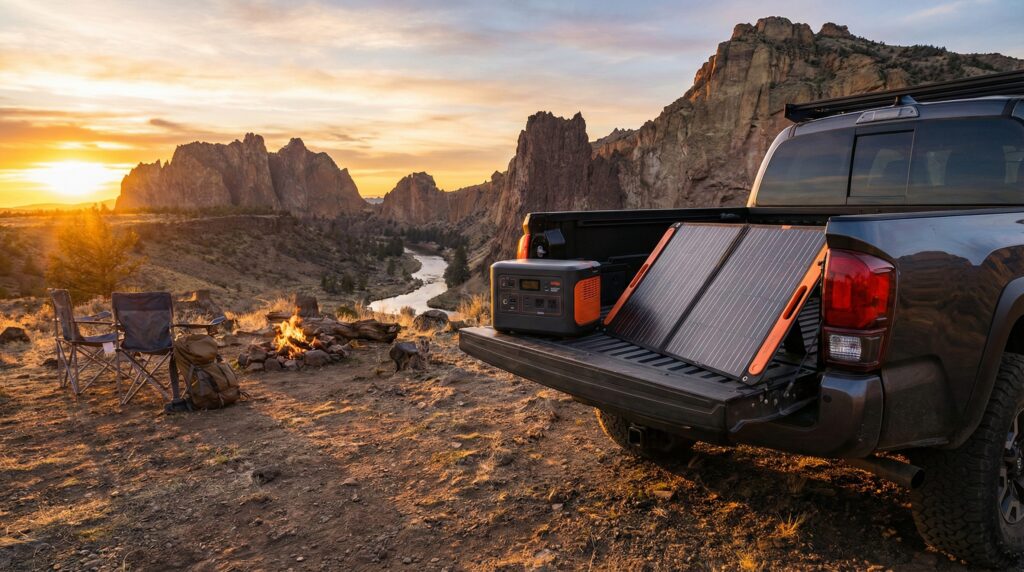
These are larger battery boxes (often 200Wh to 3,000Wh+) that accept solar input from separate panels (commonly 100W–400W each, sometimes more with multiple panels). This is what most people actually need when they want solar to matter: quiet power for camping, CPAP use, tailgating, van life, or keeping essentials going during an outage. The panel is usually sold separately, and the “battery” is the storage part while the solar panel is the generator part.
To shop smart, focus on the simple formula:
Usable energy (Wh) = how long it runs your gear
A battery’s watt-hours (Wh) tells you the size of the “fuel tank.” For planning, estimate:
(Device watts × hours used) + 20–30% overhead
The overhead accounts for inverter losses (when using AC outlets), conversion losses, and the reality that real-world usable capacity is usually less than the marketing number. If you only look at mAh, you can get misled because mAh changes meaning across voltages; Wh is the apples-to-apples metric.
Solar charging speed is the other half of the equation. Panel output varies with angle, temperature, shading, season, and clouds. If you want to estimate solar harvest realistically, tools like the NREL PVWatts solar calculator (built on NREL renewable energy research) can help you sanity-check what a panel might produce where you live.
Who Solar Powered Battery Fits Best
A solar-charged battery setup makes the most sense when you value silent, indoor-safe backup (unlike gas generators), you spend time off-grid, or you want a way to replenish power when the grid is down for more than a few hours.
- Storm/outage prep for essentials: keeping phones, a router, lights, medical devices, or small kitchen appliances running — especially if you can’t (or don’t want to) store gasoline.
- Camping and overlanding: topping up during the day from panels and using power at night for lights, fans, and small cooking devices.
- Remote work and travel: running a laptop, monitors, camera batteries, and hotspot gear where outlets are limited.
- People who can plan around solar variability: you don’t need instant replenishment; you can charge from wall power ahead of time and use solar to extend runtime.
User feedback often points to the “peace of mind” factor when a unit arrives in good condition and behaves predictably. One owner report for a portable power station sums up that expectation well: “I bought this as a refurbished item. It came out of the in perfect/new condition. I ran it through the drills and it performs perfectly.” — verified buyer, 5 stars
If you’re building an outage plan for a household (especially anything involving a transfer switch, critical loads panel, or larger solar array), it’s worth checking in with a licensed electrician or an off-grid solar installer to keep the setup safe and compatible with your home’s wiring.
Who Should Skip Solar Powered Battery
This category isn’t ideal if you need guaranteed fast recharging strictly from solar, you expect “set it in the window and run the fridge,” or you don’t want to deal with compatibility details (panel connectors, voltage ranges, and cable adapters).
- If you need dependable recharge in a few hours: solar may disappoint on cloudy days or in winter. Prioritize fast wall charging and treat solar as a replenishment option, not your only source.
- If you can’t control sunlight exposure: apartment dwellers without a balcony/yard, heavily shaded properties, or strict HOA rules can make panels hard to deploy.
- If you want truly hands-off simplicity: some higher-end units add app/Wi‑Fi features; that’s convenient until it isn’t.
Owner complaints tend to cluster around connectivity and expectations mismatching reality. For example: “if my Jackery loses its wifi connection for any reason, it will not automatically reconnect when the power return” — verified buyer, 4 stars
Also, if your goal is indoor backup power but you’re considering a fuel generator as an alternative, remember carbon monoxide risk is the big safety dividing line; review CDC carbon monoxide safety guidance before you decide.
Price and Value
Prices swing widely because “solar powered battery” covers everything from small power banks to big, high-output power stations. In the portable power station class (the more meaningful option for solar charging), the price is mostly driven by:
- Battery capacity (Wh)
- Inverter power (watts) and surge capability
- Battery chemistry (LiFePO4 units often cost more upfront but aim for longer service life)
- Solar input capability (max input watts and acceptable voltage range)
- Brand support and warranty
Using the products referenced here as real-world anchors:
- Mid-size “sweet spot” power stations (often around ~1kWh) commonly land in the $350–$500 range. Example: Jackery Explorer 1000 v2 is listed around $350–$400.
- Premium, high-capacity units (multi-kWh) can jump into the low thousands. Example: Anker SOLIX F3000 (3,072Wh) is listed around $3,100–$3,200.
Value comes from matching the unit to your real loads and your real charging plan. If you size correctly, you avoid the common “buy twice” problem: first buying something too small (that can’t run what you need), then upgrading later.
One more practical note: solar panels are often an additional cost. So when you compare prices, compare complete systems — battery + panels + any required adapters — rather than the battery alone.
Common Mistakes When Trying Solar Powered Battery
- Buying by mAh instead of Wh: mAh is fine for phone banks, but it becomes misleading fast for bigger systems. For apples-to-apples comparisons, shop by Wh.
- Assuming “400W panel” means “400W all day”: panel ratings are under ideal test conditions. Real-world output is usually lower due to heat, angle, haze, clouds, and controller limits.
- Not checking solar input limits: the most expensive mistake is assuming any panel will work. You need to match connector type and stay within the power station’s accepted voltage/current range.
- Planning for solar to do the job of wall charging: for storm prep, charge to 100% from the wall before the weather hits, then use solar to extend runtime afterward.
- Over-trusting bundles: bundles can be good deals, but “works together” doesn’t guarantee the panel will meet your expectations in your climate.
A recurring theme in customer reviews is disappointment when real-world solar production doesn’t match the buyer’s mental model. One blunt example: “The solar panel does not perform up the expectations” — verified buyer, 3 stars
On the safety side, treat lithium battery gear like the high-energy equipment it is: charge in a ventilated spot, don’t cover the unit, and avoid leaving it baking in a hot car or in direct sun while charging. For general risk context and handling guidance, it’s worth reading NFPA lithium-ion battery safety.
FAQ
Can a “solar powered battery” charge itself only from the built-in panel?
Some small power banks include an integrated panel, but it’s usually best viewed as an emergency trickle charger. For routine charging, you’ll typically rely on USB wall power. If you want solar to be a primary charging method, you’re usually looking for a portable power station that accepts external foldable or rigid solar panels.
How many watts of solar panels do I need for my battery size?
A practical starting point is to work backward from your battery size in Wh and how quickly you want it refilled. Roughly, solar harvest per day often looks like:
Panel watts × peak sun hours × 0.6–0.8
The 0.6–0.8 factor accounts for real-world losses (heat, angle, conversion, and non-ideal conditions). To estimate peak sun hours where you live, you can sanity-check with the NREL PVWatts solar calculator.
What’s the difference between mAh and Wh, and which should I shop by?
mAh (milliamp-hours) is a capacity measure at a specific voltage. Because voltage differs across batteries and devices, mAh alone can be misleading. Wh (watt-hours) already accounts for voltage, making it the better number for comparing “how much energy is stored” across different products — especially portable power stations.
Is LiFePO4 always better for solar-charged power stations?
LiFePO4 is often favored for longer cycle life and thermal stability, which can be helpful if you plan to charge/discharge frequently. The tradeoff is that LiFePO4 units can be larger/heavier (and sometimes cost more upfront) than some lithium-ion alternatives. “Better” depends on whether you prioritize longevity and daily cycling versus lighter weight and lower initial cost.
What connectors should I expect for solar panels, and how do I avoid compatibility mistakes?
Many portable solar panels use MC4 connectors, while many power stations accept a DC barrel input (often via an MC4-to-DC adapter cable). Compatibility isn’t just physical — it’s electrical. Always verify the power station’s allowed solar input voltage range and max input power, and use manufacturer-recommended cables/adapters to reduce the risk of non-charging or damage.
Is it safe to use a portable power station indoors during an outage?
In general, portable battery power stations are designed for indoor use because they don’t emit exhaust like fuel generators. Still, you should avoid overheating (give it ventilation), avoid overloading the inverter, and use proper cords. For broader solar and electrical basics, the DOE solar PV basics page is a solid primer on how PV systems work.
Looking for these on Amazon? Browse solar powered battery on Amazon →
Bottom Line
“Solar powered battery” is a useful search term, but the right purchase depends on whether you mean a pocket power bank with slow backup solar or a true solar-chargeable power station with external panels. For most households and serious off-grid use, a right-sized Wh-rated portable power station with compatible solar input (and realistic expectations about sunlight) is the practical path.
Affiliate disclosure: Some of the links in this article are affiliate links. We may earn a commission if you purchase through them.