
TL;DR
“Small solar panels” can mean anything from palm-size 3V cells for DIY props to portable USB panels meant to top up gadgets. For most people trying to charge electronics, the best move is a small panel setup with regulated output (USB or a proper charge controller) plus a battery/power bank to buffer clouds and keep charging stable.
What Small Solar Panels Actually Is
Small solar panels are simply photovoltaic (PV) modules with limited surface area — so limited power. The confusion is that “small” is used for two very different product types:
- DIY mini panels (bare panels/cells): These are typically 3V, 5V/6V, or 12V nominal panels meant for experiments, science projects, small props, or light-duty electronics where you (or your circuit) handle voltage regulation and battery charging.
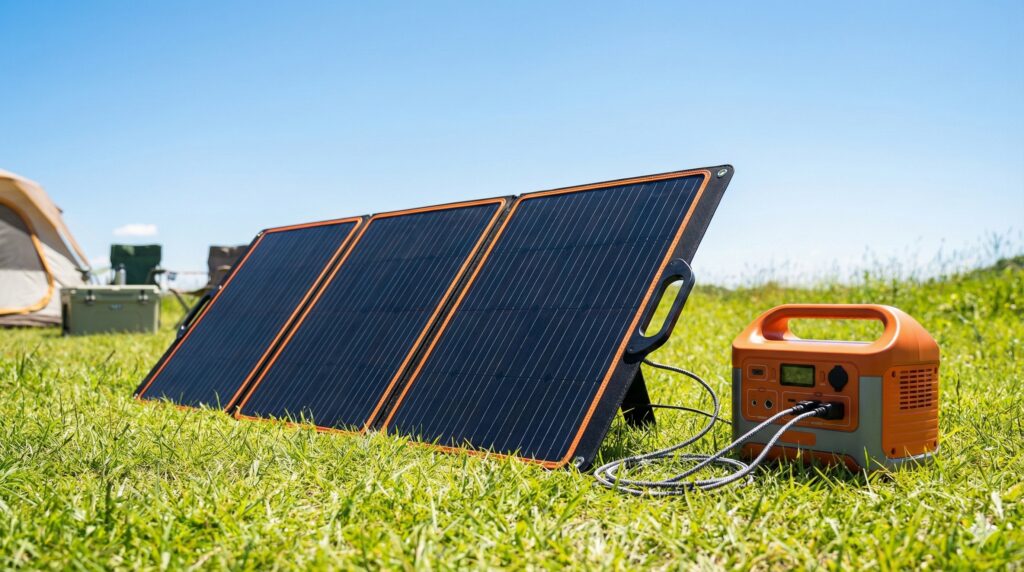
- Portable device-charging panels: These usually fold up, include USB outputs (and sometimes USB-C), and aim to charge power banks, phones, and small power stations. The key difference is regulated output and better cable/connectors.
The simplest way to think about it is a formula:
Useful solar charging = (panel watts you can actually harvest) + (electronics that regulate/charge safely) + (storage if you need steady power).
Why the emphasis on “actually harvest”? Panel watt ratings are typically measured under lab-like test conditions with strong sun and ideal angle. In real life, output drops quickly with clouds, shade, poor orientation, and hot panel temperatures. That’s why two people can buy “the same wattage” small panel and have totally different experiences.
If you’re trying to power or charge everyday electronics (phones, GPS units, cameras), stability matters: many devices expect a fairly steady 5V USB input. Solar output naturally fluctuates as the sun shifts or a cloud passes, which can cause charging to start/stop or reset. A battery or power bank in the middle can smooth that out.
For a reality check on how sun conditions change expected production, tools like the NREL PVWatts solar calculator help illustrate why “rated watts” and “real energy per day” aren’t the same thing. And for grounding in how PV works overall (modules, output basics, and system components), the DOE solar PV basics is a solid reference.
Who Small Solar Panels Fits Best
Small solar panels make sense when your expectations match their strengths: low power, daylight-dependent, and sometimes DIY-heavy. They’re a good fit if you’re in one of these scenarios:
- DIY projects and learning builds: Arduino/ESP projects, small motors, LED effects, classroom experiments, sensor nodes, and props where you can design around intermittent power.
- Trickle-charging a battery/power bank over time: If you’re okay with slow charging (hours to days depending on conditions), small panels can be practical.
- Daylight-only loads: Anything that doesn’t need to run overnight — like a daytime fan, a small fountain pump (with proper driver), or a decorative piece that only runs when the sun hits it.
- People who enjoy tinkering: If you’re comfortable adding a regulator, charge controller, diode, fuse, or weatherproofing, you’ll get better outcomes than someone expecting plug-and-play.
For example, with DIY mini panels like the Kanayu set, buyer reports commonly frame them as “project parts,” not turnkey charging gear. One owner put it simply: “Great for small projects.” — verified buyer, 5 stars.
If your plan involves charging lithium-ion batteries (power banks, phone batteries, LiPo packs for RC, etc.), keep the safety side in view: use the right charging electronics for the battery chemistry, don’t improvise connections, and avoid overheating/short circuits. If you’re building anything beyond a basic experiment, it’s worth reviewing NFPA lithium-ion battery safety and, for broader context, browsing NREL renewable energy research for how solar performance varies in real-world conditions.
Who Should Skip Small Solar Panels
Small solar panels are easy to overestimate. You should strongly consider skipping them (or sizing up, or adding storage/regulation) if any of the following describe you:
- You want reliable phone charging by plugging straight into a panel: Many small panels can’t keep a stable 5V output in typical conditions, so charging may stop and start.
- Your device must run overnight: A panel alone won’t do that. You’ll need a battery sized for your runtime and a charge controller suited to the battery type.
- Your panel location gets partial shade: Small panels don’t have much headroom. Shade can make the difference between “slow charge” and “nothing happens.”
- You’re expecting “rated watts” all day: Solar output is conditional — angle, season, clouds, heat, and cable losses all matter.
User feedback is especially blunt about the sunlight requirement. One critical review on these mini panels: “We bought these to use on our Halloween props and concept is great but only about 50% of our props had enough sunlight to make them work and I thought they would stay lit through the night but nope needs direct sunlight and doesn’t store for night” — verified buyer, 3 stars.
If your real goal is dependable emergency power (not just a daytime trickle), a small panel plus a power bank designed for solar input or a small power station is typically the more realistic setup. If you’re unsure about matching panel voltage/current to a battery system, an off-grid solar installer or licensed electrician can help you avoid unsafe wiring and mismatched charge settings.
Price and Value
“Small solar panels” span a huge price range because the category includes both bare mini panels and more complete, regulated portable chargers. For the DIY mini-panel end of the spectrum, pricing is often about how many panels you get in a multi-pack and whether the leads/solder tabs are usable.
The Kanayu Mini Solar Panels 3V 120mA (60 x 55 mm) typically land around $20–$30 for a multi-pack. Value is decent if you’re buying them as components—especially for prototyping, school projects, and low-stakes outdoor props.
What you generally don’t get at this price tier is:
- Regulated USB output
- Weatherproof junction boxes or robust strain relief
- Meaningful charging performance for modern phones without additional electronics/storage
So the value question to ask yourself is: Am I paying for a project part, or am I expecting a charging solution? If you need a charging solution, budgeting for a regulated panel (or a controller + battery/power bank) is usually money better spent than buying multiple cheap mini panels and trying to brute-force it.
Common Mistakes When Trying Small Solar Panels
Most “small solar panel disappointment” comes down to a few predictable mismatches between what the buyer expects and what the hardware can realistically do. Here are the mistakes we see most often (and how to avoid them):
- Expecting a mini panel to store energy: A panel is not a battery. If you want lights to stay on after sunset, you need storage (battery/power bank) and the right charge circuitry. As one buyer learned the hard way: “We bought these to use on our Halloween props and concept is great but only about 50% of our props had enough sunlight to make them work and I thought they would stay lit through the night but nope needs direct sunlight and doesn’t store for night” — verified buyer, 3 stars.
- Charging lithium batteries directly from the panel: Don’t connect a bare panel straight to a Li-ion/LiPo pack. Use a proper charger/charge controller designed for that chemistry and panel input range. This is both a performance and safety issue.
- Assuming the labeled voltage is what you’ll always get: Panel voltage varies with sunlight and load. A “3V” or “6V” panel can read higher open-circuit but sag hard under load. Design with regulation (buck/boost) if your device needs a steady input.
- Using long, thin cables: Cable resistance matters more when power is limited. Keep cables short, use decent gauge wire, and protect connections from flexing.
- Underestimating shade and indoor limitations: A panel behind glass or in shade may produce a tiny fraction of its rated output. If you need predictable energy, move the panel to direct sun and angle it toward the sky.
- Buying by “watts” alone: For DIY panels, build quality (lamination, solder tabs, leads, strain relief) can matter more than a marketing watt number — especially outdoors.
If you want a quick reality check before you buy, it helps to estimate how much sun you’ll actually get where you’ll use the panel. The NREL PVWatts solar calculator is meant for bigger systems, but it’s still useful for understanding the “sun hours” problem: your panel doesn’t make rated power all day, every day.
FAQ
How many watts do I need to charge a phone with a small solar panel?
Plan for more wattage than you think. Phones typically want a stable 5V supply, and real-world solar output often falls well below the label due to clouds, angle, and heat. As a practical approach, use a panel with regulated USB output and charge a power bank first, then charge the phone from the power bank for steadier results.
Can a small solar panel work in shade or through a window?
It might produce some power, but usually not much — especially for charging devices. Shade can cut output dramatically, and many window glass types reduce the light wavelengths solar cells use efficiently. For anything beyond a tiny trickle, put the panel in direct sun and aim it as squarely as you can toward the sky.
Do I need a charge controller, or can I connect the panel directly to my device?
For USB devices, you generally want regulated USB output (built-in regulation) or an external regulator. For batteries (especially lithium-ion), you should use a charger/charge controller designed for that battery chemistry — don’t connect a bare panel directly to a Li-ion/LiPo pack. For background on PV systems and components, the DOE solar PV basics is a helpful primer.
What’s the difference between a 5V USB solar panel and a 6V or 12V bare panel?
A 5V USB solar panel is intended to provide a regulated 5V output suitable for USB charging (within its limits). A 6V or 12V bare panel is usually just the PV module output; voltage and current will vary with sun and load, and you’re expected to add your own regulation and charging electronics. Bare panels can be great for DIY, but they’re not automatically “phone chargers.”
Why do small solar panels stop and start charging?
Solar output fluctuates constantly with passing clouds, wind movement, and even small changes in panel angle. If voltage dips below what a device or charging circuit expects, charging can pause; when sun returns, it resumes. Using a buffer (power bank/battery) often makes charging feel more continuous because the panel charges the buffer while the device charges from the buffer.
How can I estimate what a small solar panel will produce where I live?
You can approximate energy production using local “sun hours” as a starting point, then apply realistic losses for angle, heat, and shade. Tools like the NREL PVWatts solar calculator help illustrate how location, season, and shading affect output. Even if you’re using a tiny panel, the underlying lesson is the same: rated watts are not what you get all day.
Is it safe to use small solar panels with lithium-ion batteries?
It can be safe if you use the correct charging hardware and avoid DIY shortcuts. The bigger risks come from improper charging circuits, short circuits, damaged wiring, or overheating. If you’re building your own setup, review NFPA lithium-ion battery safety and consider having a qualified electrician or off-grid solar installer sanity-check anything you plan to leave unattended.
Looking for these on Amazon? Browse small solar panels on Amazon →
Bottom Line
Small solar panels are best when you treat them as daylight-dependent power sources for low-power loads or DIY projects — not as guaranteed phone chargers. If you’re charging electronics, prioritize regulated output and plan on using a battery/power bank to stabilize charging; if you’re building props or experiments, focus on correct voltage and sturdy leads over marketing claims.
Affiliate disclosure: Some of the links in this article are affiliate links. We may earn a commission if you purchase through them.