
TL;DR
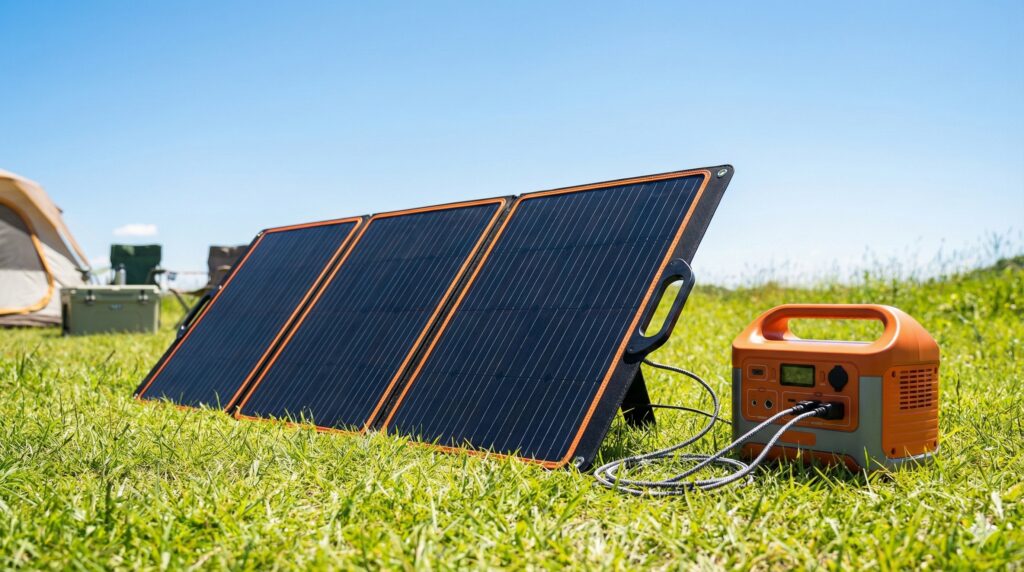
Portable solar panels almost never deliver their full rated wattage outside lab conditions, so picking the “best” one is mostly about choosing the right outputs (USB-C PD vs DC) and a design you’ll actually keep aimed at the sun. For steadier charging during a 2 – 3 day camping trip or a short power outage, plan to charge a power bank or power station first, then charge your devices from that battery.
Top Recommended Solar Power
| Product | Best For | Price | Pros/Cons | Visit |
|---|---|---|---|---|
| FlexSolar 40W Portable Foldable Solar Panel Charger | Mixed USB + DC device charging | $51.99as of Oct 17, 06:10 GMT+0000 | Multiple outputs for flexibility; 40W class is limiting for larger power stations | Visit Amazon |
| BigBlue SolarPowa 30 30W Solar Panel Charger | Simple phone/power bank top-ups | $54.89as of Oct 17, 04:00 GMT+0000 | Popular 30W-class folding charger; slower charging and more cloud-sensitive than 60–100W options | Visit Amazon |
| ECO-WORTHY 100W Portable Solar Panel for Outdoor Camping RV | Camping/RV use with a power station buffer | — | Higher-watt class for better solar harvest potential; pricing varies and depends on where you buy | Visit ECO-WORTHY |
Top Pick: Best Overall Solar Power
FlexSolar 40W Portable Foldable Solar Panel Charger
Best for: A weekend car-camping trip or emergency kit where you want flexible ports (USB-A, USB-C, and DC) to top up phones and power banks.
The Good
- Port flexibility is the big win — you’re not locked into USB-only charging when you’d rather feed a DC input on a small battery pack or compatible device.
- Solid fit for “small loads” in real life: phones, tablets, headlamps, handheld radios, and power banks.
- Budget-friendly for the 40W class, which makes it easier to justify as a backup panel for storm season or road trips.
- Folding form factor is generally easier to pack than rigid panels for trunk storage or a tote with other emergency supplies.
The Bad
- A 40W-rated panel can feel slow when you’re trying to meaningfully recharge larger batteries — especially with imperfect sun angle or heat.
- Like most portable panels, performance drops fast with partial shading (tree branches, tent lines, or even a backpack strap crossing a cell area).
- Direct-to-device charging can be finicky when clouds pass — using a battery buffer is usually more reliable.
4.5/5 across 33 Amazon reviews
“Helping a friend find a solution for daily charging of a phone where no electric is available. Purchased this panel set along with a 20000mAh power bank.The panel seems rugged and strong. With proper treatment, it seems like it will last a while.Plugged into the powerbank and used in a partially shaded window, the bank only charged from 40% to 60% over two…” — Verified Amazon buyer (5 stars)
“Multi-Output Solar Charging Panel, that is a Solar panel only, there is NO built in battery storage.Provides multiple power options, both USB-A & USB-C (18W max), and a 19V barrel jack, DC port (40W max). Enough energy to charge smartphones, tablets, and replenish power banks. While multiple outputs can be used at once, the limit is 40 Watts total. No power…” — Verified Amazon buyer (4 stars)
“Provides multiple power options, both USB-A & USB-C (18W max), and a 19V barrel jack, DC port (40W max). Enough energy to charge smartphones, tablets, and replenish power banks.” — verified buyer, 4 stars
Our Take: If you want one small folding panel that can handle a mix of USB gadgets and occasional DC needs during short trips, this FlexSolar is the most broadly practical pick in this shortlist — just set expectations that real-world watts will often land well below the rating unless you keep it perfectly aimed.
BigBlue SolarPowa 30 30W Solar Panel Charger
Best for: A lightweight “top-off” panel for day hikes, beach days, or a go-bag where you mainly want to keep a phone and power bank alive over a long afternoon.
The Good
- 30W-class panels are typically compact enough to stash in a vehicle kit and actually bring along, which matters more than peak watts you never deploy.
- Well-known in the portable solar charger category — and widely discussed — which can make troubleshooting and accessory shopping easier.
- Best use pattern is simple: park it in good sun, charge a power bank, then charge your phone from the bank for steadier power.
- Great fit for low-stakes loads (phones, earbuds, small USB lights) where “slow but steady” is fine.
The Bad
- 30W-rated output is inherently limited — it’s not the panel we’d pick when laptop charging is the main goal.
- More sensitive to sun angle than larger panels; you may need to re-aim it several times a day to keep charging speeds reasonable.
- If you try charging a phone directly, intermittent clouds can cause stop-start charging on some devices (another reason to use a power bank buffer).
4.3/5 across 343 Amazon reviews
“All the following items, used in this review, were purchased on Amazon: BigBlue SolarPowa 30 Folding Solar Charger (Smart IC Chip Charging Controller), JSAUX 100-watt USB-C to USB-C Cable (6-ft length), Portable Power Bank PB-08 PD22.5W (20Ah @ 3.7V) (74Wh), and a Toptes TS-710 Digital Light Meter.Local Weather Conditions on June 14, 2024 (3:15pm to…” — Verified Amazon buyer (5 stars)
“Amazing performance, Im getting almost 80w at 9AM.Giving it 4 stars because the legs are trash, it has 2 short legs but 3 panels. It needs one more leg for it to be stable..One werid thing is it tends to get stupid if you stand in front of it, the power drops to nill. Seems like the whole panel needs to have light for its internal computer to work?” — Verified Amazon buyer (4 stars)
Our Take: This is a sensible pick for simple USB charging during a day outdoors, but if you’re planning a 48-hour outage or multi-day off-grid trip, you’ll usually be happier moving up to a higher-watt panel and charging a battery first.
ECO-WORTHY 100W Portable Solar Panel for Outdoor Camping RV
Best for: Car camping, RV weekends, or tailgating where you’re pairing solar with a power station and want a more meaningful daily energy harvest than a 30–40W charger can provide.
The Good
- 100W-class portability is a sweet spot for many “solar generator” users because it can make a noticeable dent in a power station recharge in good sun (using the station as the buffer).
- More headroom for cloudy intervals and less-than-perfect aiming than smaller 30–40W panels.
- Owner feedback highlights easy handling and setup — a real advantage when you’re deploying it repeatedly across a 3-day camping trip.
- Often a better match for off-grid weekends where you’re running multiple USB devices plus a small DC load from a battery.
The Bad
- You still have to match connector type and voltage window to your specific power station input — otherwise you can leave watts on the table or end up needing adapters.
- Being “portable” at 100W usually means more bulk than a small USB-only folding charger, so it’s less backpack-friendly.
- Weather resistance is frequently misunderstood: the panel face may tolerate splashes, but the electronics, connectors, and your power station should be kept dry.
“Since the panels are easy to handle and I didn’t need any additional gear or cables I like this setup.” — Easy setup for solar generator on r/SolarDIY
Our Take: If your real goal is feeding a power station during camping or RV use, this is the most purpose-built direction in the group — just confirm your station’s solar input specs (voltage range and connector) before buying and keep your power station shaded while the panel sits in full sun.
Other Notable Alternatives Worth Considering
- Goal Zero Nomad 50 50W Foldable Solar Panel — Listed in this category based on retailer data; we haven’t independently verified specific performance for this exact listing, but it’s a common form factor for topping up small power stations and USB devices on car-camping trips.
FAQ
How many watts do I need in a portable solar panel?
For phones and power banks, 20–60W can work if you’re patient and get good sun; 60–100W is a more comfortable range for faster, more consistent daily top-ups. If you’re trying to recharge a power station for a multi-day trip (or want a better shot at keeping up during a 48-hour outage), 100–200W is usually where solar starts to feel meaningfully productive — as long as the connector and voltage range match your power station.
Why is my “100W” panel only making 50–70W?
Rated wattage is measured under standardized lab conditions, and real-world output commonly drops because of sun angle, heat on the cells, haze, and any partial shading. Basic PV fundamentals from the U.S. Department of Energy solar energy basics and performance work summarized by NREL photovoltaics research align with what most users see: keep the panel aimed directly at the sun, avoid even small shadows, and expect less output as the panel heats up.
Is it better to charge my phone directly from a solar panel or through a power bank?
Through a power bank (or power station) is usually more reliable. Solar input can dip quickly when clouds pass, and some phones respond by repeatedly starting and stopping the charge; a battery buffer smooths that variability so your devices see steady power.
Can a portable solar panel charge a laptop?
Sometimes, but you need the right kind of output. If you’re charging over USB-C, confirm the panel supports USB-C Power Delivery profiles that include 20V (common for many laptops) and that your cable is rated for the wattage; otherwise charging may be slow or may not negotiate at all. The more dependable approach is often: panel → power station (or large PD power bank) → laptop, because the battery handles solar fluctuations.
What connectors should I look for if I want to charge a power station?
Start with your power station’s solar input specs: connector type (often a DC barrel or Anderson-style connector), supported voltage window, and max input watts/amps. Then choose a panel that natively matches those specs or uses the manufacturer-recommended adapter cable — mismatched polarity or voltage is a real risk with generic DC adapters, and it’s worth double-checking with a licensed electrician or an off-grid solar installer if you’re unsure.
Are portable solar panels waterproof?
Many are “water-resistant” in the sense that the panel surface and fabric can handle light splashes, but the charging controller module, ports, and connectors often need to stay dry. Treat water ratings cautiously and assume you should protect the electronics in rain, especially if you’re using DC outputs to a power station.
What safety basics matter most with portable solar panels?
Don’t use damaged cables, and don’t run loose DC connections that can heat up; if a connector feels hot, stop and inspect it. Keep ports and controller modules dry, avoid covering panels while they’re connected under load (heat buildup is hard on materials), and use only manufacturer-recommended adapters when connecting to a power station. For deeper background on PV design and safety expectations, standards bodies like the International Electrotechnical Commission (IEC) outline how PV modules are evaluated — but portable “folding charger” setups still depend heavily on good user practices in the field.
Bottom Line
The best portable solar panel is the one with the outputs you actually need and a form factor you’ll consistently set up, aim, and re-aim throughout the day. From this shortlist, the FlexSolar 40W is our top overall pick because it offers the most practical mix of ports for typical charging needs — especially when paired with a power bank or small power station as a buffer.
Affiliate disclosure: Some of the links in this article are affiliate links. We may earn a commission if you purchase through them.
Product prices and availability are accurate as of the date/time indicated and are subject to change. Any price and availability information displayed on Amazon.com at the time of purchase will apply to the purchase of this product. Certain content that appears on this site comes from Amazon. This content is provided “as is” and is subject to change or removal at any time.