
Quick Hits
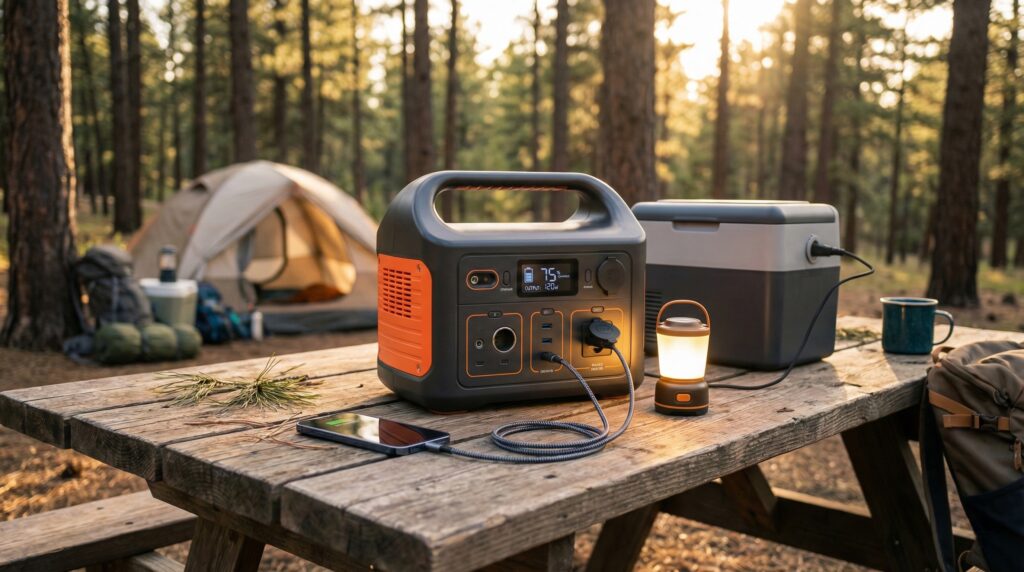
Modern camping has evolved away from the drone of gasoline generators and the frustration of bulky lead-acid batteries. Today, portable power stations offer a silent, fume-free way to run everything from CPAP machines and electric coolers to coffee makers in the middle of a primitive campsite. For most campers, the 1kWh capacity range is the sweet spot, providing enough energy for a multi-day trip without becoming too heavy to carry. The Anker Solix C1000 stands out for its incredibly fast recharge times, while the Jackery Explorer 2000 v2 is the powerhouse choice for those running heavy appliances like microwaves or portable AC units. If you are just starting out or heading to a festival, smaller units like the Jackery 300 provide plenty of juice for phones and fans in a footprint that fits in a backpack.
Introduction: Why the Right Power Station Changes Everything
Your camping experience shouldn’t be dictated by the length of an extension cord or the proximity of an RV hookup. For years, if you wanted electricity in the woods, you either had to listen to a noisy gas generator or build a complex DIY battery box. Neither was ideal. One ruined the peace of nature, and the other required a degree in electrical engineering to maintain.
The rise of portable power stations has fundamentally changed how we approach the outdoors. These “all-in-one” boxes combine a high-capacity battery, a pure sine wave inverter, and a charge controller into a single, luggable unit. You can charge them at home, in your car, or via solar panels, giving you a self-sustaining energy loop. Whether you are keeping a medical device running through the night or just making sure your morning coffee doesn’t require a propane torch, the right power station provides a level of comfort and safety that traditional camping gear simply can’t match. Choosing the best portable power station for camping means finding that perfect balance between capacity, weight, and the specific needs of your gear.
| Product Name | Best For | Price Range | Pros/Cons | Visit |
|---|---|---|---|---|
| Anker Solix C1000 | weekend warriors who need reliable, fast-charging power for appliances | $699 – $799 | ✅ Incredibly fast AC recharge time (under 1 hour).; High 1800W output can surge to 2400W for demanding ❌ The expansion battery port is proprietary, so you ; The app setup can be finicky on some Android devic |
|
| Jackery Explorer 2000 v2 | car campers and overlanders who stay out for long periods and run high-draw gear | $1099 – $1199 | ✅ Massive capacity allows for true off-grid independ; Runs high-wattage items like microwaves and kettle ❌ At nearly 40 pounds, it is not something you want ; It lacks the modular expandability found in EcoFlo |
|
| EcoFlow Delta 2 | content creators and tech enthusiasts who need smart monitoring and expandabi… | $799 – $899 | ✅ Extremely fast AC and solar charging rates.; The app control is genuinely useful for toggling p ❌ The cooling fans are quite loud when the unit is u; The top surface is not flat (due to the handles), |
|
| Jackery Explorer 300 | minimalist campers and festival-goers who just need to keep phones and fans r… | $279 – $329 | ✅ Extremely lightweight and easy to pack.; USB-C Power Delivery ports built right in. ❌ The display does not show “time remaining” for dis; The 293Wh capacity is too small for heaters, coffe |
|
| Bluetti EB55 | CPAP users and those who need a high variety of DC ports in a compact box | $449 – $499 | ✅ Compact form factor with a very high number of out; Wireless charging pad is convenient for overnight ❌ The external AC charging brick is large and gets q; The screen can be difficult to read in direct sunl |
Top 5 Portable Power Stations for Camping
1. Best Overall: Anker Solix C1000
If you are looking for the “Goldilocks” of power stations, the Anker Solix C1000 is it. With a 1056Wh capacity and an 1800W AC output, it handles almost anything you can throw at it—from a heavy-duty blender to a hair dryer. What really sets this unit apart is the HyperFlash technology. You can charge this from 0 to 80% in just 43 minutes when plugged into a wall outlet, which is a lifesaver if you realize you forgot to charge it the morning of your trip.
In practice, the unit’s 29lb frame makes it manageable for a single person to move from the trunk to the picnic table. Your camping setup will benefit from the Unibody design, which feels much more rugged than the plastic-heavy shells of older competitors. The built-in light bar is also surprisingly useful for illuminating a dark tent without needing to hunt for a flashlight.
What Works
- Incredibly fast AC recharge time (under 1 hour).
- High 1800W output can surge to 2400W for demanding appliances.
- The LiFePO4 batteries are rated for 3,000 cycles, meaning this will likely last you a decade of camping.
What Doesn’t
- The expansion battery port is proprietary, so you are locked into Anker’s ecosystem if you want more capacity.
- The app setup can be finicky on some Android devices during the initial pairing.
💰 Street Price: $699 – $799
Worth It? Best for weekend warriors who need reliable, fast-charging power for appliances. Skip if you need more than 2kWh of expandable storage for a permanent van setup.
2. Best for Multi-Day Off-Grid Use: Jackery Explorer 2000 v2
When you are heading into the backcountry for more than three days, capacity becomes the only metric that matters. The Jackery Explorer 2000 v2 offers a massive 2,042Wh of energy. This is enough to run a portable electric cooler for days on end while still having plenty left over for string lights, laptops, and speakers. Unlike some older Jackery models, this v2 version uses upgraded battery chemistry for better longevity.
You’ll appreciate the simplicity of the interface. Jackery has always excelled at making power stations that feel like consumer electronics rather than industrial equipment. The large, clear display tells you exactly how much power is going in and out, which is vital when you are trying to manage your consumption on day four of an off-grid trek.
What Works
- Massive capacity allows for true off-grid independence.
- Runs high-wattage items like microwaves and kettles without tripping the inverter.
- The build quality is top-tier with a focus on impact resistance.
What Doesn’t
- At nearly 40 pounds, it is not something you want to carry far from your vehicle.
- It lacks the modular expandability found in EcoFlow or Bluetti systems; what you buy is what you get.
💰 Street Price: $1099 – $1199
Worth It? Best for car campers and overlanders who stay out for long periods and run high-draw gear. Skip if portability is your top priority.
3. Best for Tech-Heavy Campers: EcoFlow Delta 2
For those who bring their entire digital life to the campsite—cameras, drones, laptops, and Starlink—the EcoFlow Delta 2 is the smartest choice. It uses a LiFePO4 battery that offers over 3,000 cycles before it hits 80% capacity. But the real draw is the ecosystem. The Delta 2 features one of the best smartphone apps in the industry, allowing you to monitor and control every port remotely from your hammock.
The charging speed is also impressive, hitting a full charge in about 80 minutes from an AC outlet. If you find your power needs growing, you can easily plug in a Delta 2 Extra Battery to double the capacity. This flexibility makes it a great “buy once, cry once” investment for anyone serious about solar generators.
What Works
- Extremely fast AC and solar charging rates.
- The app control is genuinely useful for toggling ports to save power.
- Expandable capacity allows the unit to grow with your needs.
What Doesn’t
- The cooling fans are quite loud when the unit is under heavy load or fast charging.
- The top surface is not flat (due to the handles), making it hard to stack other gear on top of it in a packed trunk.
💰 Street Price: $799 – $899
Worth It? Best for content creators and tech enthusiasts who need smart monitoring and expandability. Skip if you prefer a simple “plug and play” device without an app.
4. Best for Lightweight/Festival Camping: Jackery Explorer 300
Not every camping trip requires a 50-pound battery. If you are heading to a festival like Bonnaroo or a simple overnight at a state park, the Jackery Explorer 300 is a fantastic companion. It weighs only 7.1 pounds, which means you can carry it in one hand while lugging a cooler in the other. It’s primarily designed for charging phones (about 30 times), running a CPAP for a single night, or powering a small tent fan.
Your setup will benefit from the dual USB-C PD ports, which can charge a MacBook or modern smartphone at full speed without needing a bulky AC brick. It’s silent, reliable, and small enough to tuck into a corner of your tent without feeling cramped.
What Works
- Extremely lightweight and easy to pack.
- USB-C Power Delivery ports built right in.
- Perfect for keeping gadgets charged over a 3-4 day festival weekend.
What Doesn’t
- The display does not show “time remaining” for discharge, only percentages.
- The 293Wh capacity is too small for heaters, coffee makers, or electric grills.
💰 Street Price: $1099 – $1199
Worth It? Best for minimalist campers and festival-goers who just need to keep phones and fans running. Skip if you plan on using any kitchen appliances.
5. Best for Medical Needs (CPAP): Bluetti EB55
For campers who rely on a CPAP machine, the Bluetti EB55 is a purpose-built lifesaver. It offers 537Wh of capacity, which is typically enough to run most CPAP machines for two full nights (depending on humidity settings). What makes it better for medical users than most is the array of DC outputs. Using a DC converter for your CPAP instead of the AC plug can increase your runtime by up to 30%, and the EB55 has plenty of ports to support that.
The unit feels incredibly dense and well-made. The folding handle makes it easy to stack, and the wireless charging pad on top is a nice touch for keeping your phone topped off overnight without hunting for a cable in the dark.
What Works
- Compact form factor with a very high number of output ports (13 total).
- Wireless charging pad is convenient for overnight phone use.
- LiFePO4 battery ensures a long lifespan even with daily use.
What Doesn’t
- The external AC charging brick is large and gets quite hot during use.
- The screen can be difficult to read in direct sunlight.
💰 Street Price: $449 – $499
Worth It? Best for CPAP users and those who need a high variety of DC ports in a compact box. Skip if you want an internal power supply to minimize cable clutter.
What Real Users Are Saying (Reddit Insights)
General Sentiment: Convenience vs. The DIY Struggle
The general consensus among the camping community on Reddit is that while DIY LiFePO4 battery boxes (like a 12v 100Ah battery in a plastic crate) are cheaper per watt-hour, the convenience of a “ready-made” system from Anker or EcoFlow is almost always worth the premium for car campers. As u/Scoutmaster-Jedi noted, switching from a heavy lead-acid setup to a modern 1.3kWh system was a massive upgrade in terms of portability and ease of use.
“You can save some money by buying the components and making your own, but buying a ready-made system is better for most people. The decent ones all include the battery as well as a charge controller and inverter.” — r/camping
Top Complaints & Warnings: The Reality of Portable Power
The most common complaint involves “Solar Lag.” Many users report frustration when their 100W solar panels only produce 60W or 70W in real-world conditions. This is a crucial “Watch Out For” item: never expect 100% of the rated solar wattage unless you are in the desert at high noon. Another frequent gripe is weight. Users on r/camping frequently warn that units over 35lbs, like the larger Jackery or EcoFlow Pro models, become a chore for single-person handling and can actually discourage you from bringing them on shorter trips.
The ‘Primitive Site’ Advantage
One of the biggest reasons Reddit users recommend these units is the ability to book primitive sites. By bringing your own power, you can avoid the crowded, noisy, and often more expensive RV-focused “electric sites.” This allows for a much more peaceful experience while still having the luxury of an electric griddle or a charged camera battery. As user u/elbyl pointed out, a single EcoFlow unit was able to handle mattresses, coffee, and medical devices for three days in a primitive site and still had 53% battery left.
Key Technical Considerations for Campers
Pure Sine Wave vs. Modified Sine Wave
When you are shopping for a power station, you might see cheaper units advertised with “Modified Sine Wave” inverters. Avoid these. Your sensitive electronics—like laptops, CPAP machines, and even some modern LED lights—require a Pure Sine Wave to function correctly and safely. A modified wave can cause “electronic noise,” overheating, or even permanent damage to your gear. All the units we recommended above use Pure Sine Wave inverters.
LiFePO4 vs. Lithium-Ion (NCM)
The battery chemistry inside the box matters for how many years it will last. Traditional Lithium-Ion (NCM) batteries are lighter but usually only last about 500 charge cycles before their capacity drops. Lithium Iron Phosphate (LiFePO4) batteries, found in the Anker Solix and EcoFlow Delta 2, are slightly heavier but last for 3,000+ cycles. If you camp frequently, LiFePO4 is the significantly better value over time.
Long-Tail Camping Scenarios
Best for Car Camping & Van Life: EcoFlow Delta Pro
If you are living out of your vehicle or doing high-end “glamping,” the EcoFlow Delta Pro is the gold standard. It has a massive 3.6kWh capacity that can be expanded to 25kWh. It’s powerful enough to run a portable air conditioner or a full-sized microwave. Crucially for van lifers, it can be charged at EV charging stations, making it easy to top off while you are grabbing groceries in town.
Best for Festivals (Bonnaroo Picks)
For a 4-day weekend in the heat, your main needs are fans and phones. A 300W station combined with a small folding solar panel is the winning setup here. One Reddit user noted that a 300W unit ran a tower fan all night (drawing about 30W) and kept multiple phones charged for the entire duration of Bonnaroo. If you need something even smaller for just keeping a phone alive in your pocket, checking out the best solar power bank options might be a better fit than a full-sized station.
Solar Synergy: Choosing the Right Panels
While you can mix and match brands, using a brand’s own panels (like the Jackery SolarSaga 100W or 200W) usually ensures a plug-and-play experience without needing adapter cables. If you do go third-party to save money, ensure you have the correct MC4 to DC connector. Remember that solar is a “slow trickle” compared to wall charging; use it to maintain your battery rather than relying on it to charge a dead 2kWh unit from zero in a single afternoon.
Frequently Asked Questions
Is a 1kWh power station worth the investment for camping?
For most car campers, yes. A 1kWh unit like the Anker Solix C1000 or EcoFlow Delta 2 provides the perfect balance. It can run a 12V fridge for 2-3 days, charge phones dozens of times, and even run a coffee maker. It’s a significant upgrade over smaller units that might die after one night, and it’s much more portable than the massive 2kWh+ “home backup” style units. It essentially turns a primitive campsite into a fully functional basecamp.
Can a portable power station run a coffee maker or microwave?
Yes, but you must check the “AC Output” rating. Most standard home coffee makers and microwaves draw between 1000W and 1500W. To run these, you need a power station with an inverter rated for at least 1800W, such as the Anker Solix C1000 or the Jackery Explorer 2000 v2. Smaller units like the Jackery 300 will simply trip a safety breaker if you try to plug in a high-wattage kitchen appliance.
How long will a Bluetti EB55 run a CPAP machine?
The Bluetti EB55 has a 537Wh capacity. For a standard CPAP machine using a DC power cord (which is more efficient), you can expect about 15-20 hours of runtime. This usually translates to 2 to 3 nights of sleep. If you use the AC plug and have the humidifier heater turned on, that runtime could drop to a single night. For more consistent medical backup, many users look toward best solar generator kits to recharge during the day.
What is the difference between LiFePO4 and standard Lithium batteries?
LiFePO4 (Lithium Iron Phosphate) is the modern standard for high-quality power stations like the EcoFlow Delta 2. It offers significantly better longevity, lasting for 3,000+ charge cycles compared to the 500-800 cycles of standard NCM Lithium-Ion. While LiFePO4 is slightly heavier, the trade-off is a battery that remains healthy for 10 years or more of regular camping use, making it the better long-term investment.
Do I need a pure sine wave inverter for my camping gear?
Absolutely. Pure sine wave inverters produce electricity that is identical to (and often cleaner than) the power from your wall outlet at home. This is critical for protecting sensitive electronics like laptops, drones, and medical devices. All reputable brands, including Jackery, Anker, and Bluetti, use pure sine wave inverters in their camping-focused models to ensure your gear stays safe from electrical damage.
How fast can the Anker Solix C1000 recharge?
The Anker Solix C1000 is one of the fastest in the industry. It can recharge from 0% to 100% in roughly 58 minutes when using a standard AC wall outlet. This is a massive advantage for campers who might need a quick top-off before leaving or during a quick stop at a restaurant or visitor center. Even with solar, it can charge in under 2 hours under ideal conditions with enough panels.
Conclusion: Which Power Station is Right for You?
Choosing the best portable power station for camping ultimately depends on how you like to spend your time outdoors. If you are a weekend warrior who wants a “do-it-all” device that charges in the time it takes to pack your cooler, the Anker Solix C1000 is an unbeatable choice. For those who stay off the grid for a week at a time, the massive capacity of the Jackery Explorer 2000 v2 is worth the extra weight. If you’re looking for something to bridge the gap during emergencies at home, browsing our battery backup systems category can provide even more high-capacity options.
Regardless of which unit you pick, the peace of mind that comes with reliable, silent power is the real upgrade. No more worrying about a dead phone during an emergency, and no more cold coffee because you couldn’t get the fire started. With the right power setup, you can focus on what actually matters: enjoying the view and the company you’re with.
Disclosure: We earn a small commission on qualifying purchases through our Amazon links, at no extra cost to you. This helps support our hands-on testing and in-depth research.