
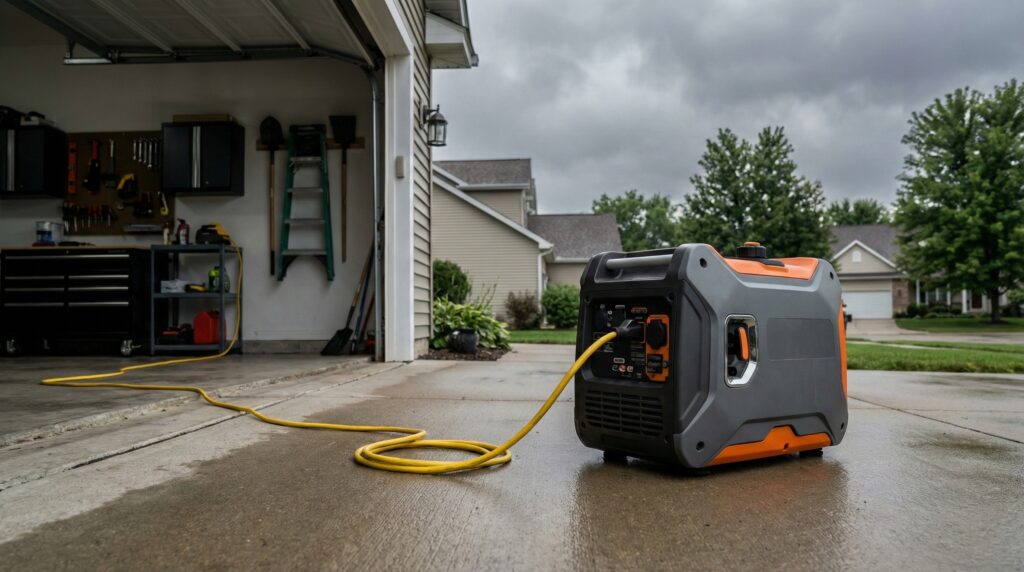
TL;DR
For most RVers, the “best” generator is the one that reliably starts your biggest load (usually the A/C) without being obnoxiously loud in a campground. Aim for an inverter generator, confirm your RV plug/outlet plan (TT-30 for 30A rigs, 14-50 strategy for 50A rigs), and size for starting surge — not just running watts.
Top Recommended Inverter Generators
| Product | Best For | Price | Pros/Cons | Visit |
|---|---|---|---|---|
| YAMAHA EF2200iS Inverter Generator, 2200 Watts, Blue | Light RV loads and quiet campsites | $1,322.18as of Oct 17, 04:00 GMT+0000 | Trusted inverter performance for essentials; may be undersized for many RV A/C starts without a soft-start | Visit Amazon |
| GENMAX GM4000iSAPC 4000 Watt Gasoline Inverter Generator with CO Detect | Higher-demand 30A RVs needing more surge headroom | $600 – $700 | More wattage in an inverter class; heavier/bulkier than small 2,000W units for loading and storage | Visit Genmax |
Top Pick: Best Overall Inverter Generators
YAMAHA EF2200iS Inverter Generator, 2200 Watts, Blue
Best for: RVers doing a long weekend of boondocking who want a quiet, dependable inverter generator for essentials (battery charging, lights, devices, small appliances), and who may be running an A/C only if they’ve added a soft-start and manage other loads.
The Good
- Inverter-style output is typically the more campground-friendly choice for noise and “cleaner” power for RV electronics.
- User feedback repeatedly points to it working well for camper/RV basics, which is what many RVers actually run most of the time.
- Easy-to-use operation is a real advantage when you’re setting up in the dark or in bad weather at a dispersed campsite.
- Yamaha’s reliability reputation is a big part of why people pay more for this class of machine — especially if you travel frequently.
The Bad
- At 2,200W-class output, it can be marginal for starting many RV roof A/C units unless you have a soft-start installed and avoid stacking loads (microwave + A/C start is a common “trip the breaker” moment).
- Premium pricing for the wattage — you’re paying for brand confidence and refinement, not max power per dollar.
4.3/5 across 179 Amazon reviews
“This was a good buy. I used this generator for my camper during hunting season and it worked great. It powered up my 110 volt electric water heater fairly quickly and gave enough hot water for a nice shower and dishes. After the water heater draw the generator turned down in idol and ran falsely. Enough power for my small tv and dvd player and my C-Pap…” — Verified Amazon buyer (5 stars)
“Great deal, I bought two. Added oil and gas, and after a few pulls they started up. It’s a Yamaha, quality built, it’s sturdy and built to last. I gave 4 stars because the description and the box describe an easy access panel, just twist the knobs and take the panel off. But neither unit has an easy access panel. It is not difficult to get the access panel…” — Verified Amazon buyer (4 stars)
“I used this generator for my camper during hunting season and it worked great. It powered up my 110 volt electric water heater fairly quickly” — verified buyer, 5 stars
Our Take: If your RV lifestyle is mostly charging batteries, running outlets, and keeping things quiet at a campground — and you’re realistic about A/C starting requirements — the EF2200iS is a solid, confidence-inspiring inverter generator.
GENMAX GM4000iSAPC 4000 Watt Gasoline Inverter Generator with CO Detect
Best for: A 30A RV owner planning a hot-weather off-grid trip where A/C starting is more likely, and you want more inverter-generator headroom than a 2,000W-class unit typically provides.
The Good
- Higher-watt inverter class is generally a better match for RV surge events (A/C compressor starts, microwave bursts, and converter/charger load at the same time).
- CO Detect feature adds a safety backstop (still not a substitute for proper placement and ventilation outdoors).
- Direct RV-intent positioning makes it more likely the outlet mix and ergonomics were designed with campers in mind.
- Good “power per dollar” on paper compared with some premium brands, for buyers prioritizing wattage in an inverter design.
The Bad
- More power usually means more weight and bulk — plan for a wheel kit/handle setup, and consider a loading ramp if you move it in and out of a truck bed.
- Even with inverter tech, higher loads can mean higher noise — expect it to be quietest in eco/partial-load operation, not at max output.
Our Take: If you’re trying to make A/C starts more realistic on a typical 30A rig (without moving to a parallel pair), a 4,000W-class inverter generator like this is the direction we’d look — just be honest about portability and storage.
FAQ
What size generator do I need to run my RV air conditioner (13.5k vs 15k BTU)?
It depends less on BTU rating and more on your A/C’s starting surge (the compressor “kick”). Many RVs can run a 13.5k BTU A/C on a mid-size inverter generator, but starting it is the hard part. If you don’t have a soft-start on the A/C, you’ll generally want more surge headroom (often pushing buyers toward the 3,000–4,500W inverter class); with a soft-start, some RVers can step down in generator size and still get reliable starts.
How do I figure out whether my RV is 30A or 50A service?
Check your shore-power cord and inlet: most 30A RVs use a TT-30 plug (three-prong, 120V), while 50A RVs typically use a 14-50 style plug (four-prong, two 120V “legs”). If you’re unsure, your RV manual should spell it out, and an RV tech or licensed electrician can confirm what your panel and inlet are wired for. The RV Industry Association (RVIA) has helpful basics on RV electrical service that can clarify what those plugs actually mean in practice.
Can a 30A generator run a 50A RV with an adapter?
Yes, but with big limitations. An adapter can make the connection physically fit, but it doesn’t magically create true 50A service — you’ll typically be feeding a single 120V source and a lot less total available power than a 50A RV can use when everything is running. Practically, it can work fine for battery charging, outlets, lights, and maybe one big load at a time, but you should not expect “whole RV” behavior (like running multiple A/Cs plus microwave plus water heater on electric).
Do I need an inverter generator for an RV?
For most RVers, an inverter generator is the safer bet for campground comfort and for sensitive electronics. Inverter generators are typically much quieter at partial load than traditional open-frame generators, and they generally provide more stable AC output for chargers, TVs, CPAP machines, and modern RV electronics. If you mainly camp where noise rules are strict, an inverter model is usually the right category choice.
Why does my generator trip when the RV A/C starts?
Common causes include insufficient starting surge capacity, too many loads running at once (microwave, water heater on electric, converter/charger pulling hard), or using an outlet/adapter that limits current (for example, stepping down to a 20A household outlet path). A soft-start on the A/C can reduce startup surge, and “load shedding” (turning off water heater electric mode, letting the converter settle, etc.) often solves the problem. If you’re repeatedly tripping breakers, consider having an RV tech or electrician check your adapter setup, cord gauge, and whether GFCI behavior is causing nuisance trips.
How far should I place a generator from my RV for noise and carbon monoxide safety?
Farther is generally better, as long as your cord is correctly sized to avoid voltage drop under load. Carbon monoxide is the bigger risk than noise: follow the Consumer Product Safety Commission (CPSC) generator CO safety guidance and never run a generator inside an RV, under the RV, or near open windows, doors, or vents. Use CO alarms as a backup, not a strategy.
Are there emissions rules I should care about when buying an RV generator?
Yes — especially if you travel to states or campgrounds with stricter emissions requirements. Look for models advertised as compliant with EPA and (when relevant) CARB requirements, since that can affect what’s legally sold or allowed in certain areas. For a starting point, see the U.S. Environmental Protection Agency (EPA) resources on small engines and emissions compliance.
Bottom Line
For many RV owners, the best generator is an inverter model that’s quiet enough for campgrounds and sized around your A/C starting surge — not just the “running watts” you see on a spec sheet. If your RV needs are mostly essentials and you value refined, dependable operation for frequent trips, the Yamaha EF2200iS is our top overall pick. If you’re trying to make hot-weather off-grid camping more realistic on a 30A rig, stepping up to a higher-watt inverter like the GENMAX GM4000iSAPC can give you the extra margin that prevents frustrating A/C start failures.
Affiliate disclosure: Some of the links in this article are affiliate links. We may earn a commission if you purchase through them.
Product prices and availability are accurate as of the date/time indicated and are subject to change. Any price and availability information displayed on Amazon.com at the time of purchase will apply to the purchase of this product. Certain content that appears on this site comes from Amazon. This content is provided “as is” and is subject to change or removal at any time.