
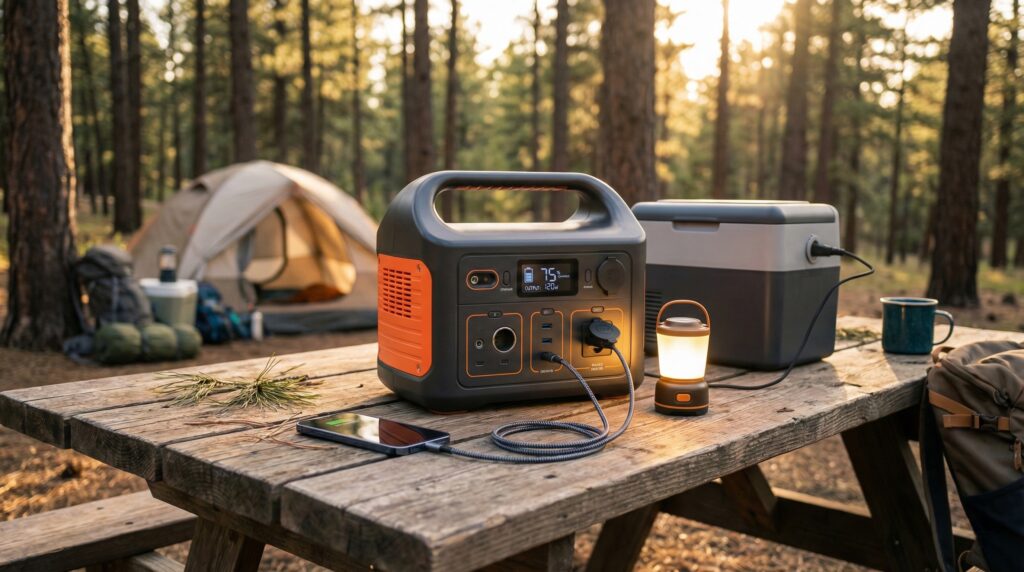
TL;DR
For most RVers, the “best” portable power station is the one that balances enough battery (watt-hours) for overnight essentials with enough inverter power (watts) to handle short bursts from kitchen appliances — plus fast recharging so you’re not stuck waiting all day. If you’re planning to connect through your RV’s shore-power inlet, think through converter/charger behavior and cord/adapter ratings, and consider a quick consult with a licensed electrician or off-grid solar installer if you’re unsure.
Top Recommended Portable Power Stations for Rv
| Product | Best For | Price | Pros/Cons | Visit |
|---|---|---|---|---|
| Jackery Explorer 2000 v2 Portable Power Station 2042Wh | Most RV weekend boondockers | $899.00as of Oct 17, 14:50 GMT+0000 | Easy ownership experience per buyer reports; some users note faster-than-expected drain | Visit Amazon |
| BLUETTI AC200L Portable Power Station 2048Wh LiFePO4 | Higher-demand appliance bursts | Check price on Amazon | Strong Amazon rating and “power” mentions in reviews; heavier, and RV integration still takes planning | Visit Amazon |
Top Pick: Best Overall Portable Power Stations for Rv
Jackery Explorer 2000 v2 Portable Power Station 2042Wh
Best for: Typical RV weekend boondocking (1–2 nights) where you want reliable power for essentials — lights, fans, device charging, TV/Starlink — and occasional short appliance use.
The Good
- Solid fit for the “RV essentials” load profile: keeping phones/laptops charged, running a 12V fridge (if you have one), and covering evening entertainment without needing hookups (2,042Wh capacity per brand spec).
- Buyer feedback leans strongly toward simple setup and straightforward charging — important if you’re using it on travel days and don’t want fiddly settings.
- Works well when you power selectively: plug key appliances directly into the unit with quality extension cords, rather than trying to energize every circuit in the RV.
- Good option for “quiet hours” campsites where you want to avoid running a generator at night (still keep the unit ventilated — don’t box it into a sealed compartment).
The Bad
- Some buyer reports suggest it can drain faster than expected depending on inverter loads and how you’re using AC outlets versus DC outputs.
- Like most ~2kWh-class stations, it’s not a “whole RV” replacement for shore power — high-draw loads like space heaters and many rooftop A/C setups will be limited or short-lived.
4.7/5 across 711 Amazon reviews
“Jackery Explorer 2000 V2 Review:I’m referring to the equipment as portable power station / PPS / battery.PERFORMANCE:It arrived well packaged and in perfect condition, with 30% charge. Charging was very simple. There is a quiet charging mode, which takes 3x duration to full charge, but is also quieter. I thought full charge speed was a nice, quiet, pleasant…” — Verified Amazon buyer (5 stars)
“The Jackery is super convenient and easy to use. It charges my devices quickly and is lightweight enough to take anywhere. I do notice that the battery drains a little faster than expected, but overall it’s reliable and gets the job done when I need portable power. Great backup option for trips and emergencies.” — Verified Amazon buyer (4 stars)
“It arrived well packaged and in perfect condition, with 30% charge. Charging was very simple.” — verified buyer, 5 stars
Our Take: If you want one portable power station that makes sense for real RV trips — not just emergency phone charging — this is the most balanced pick for capacity and everyday usability based on buyer feedback.
BLUETTI AC200L Portable Power Station 2048Wh LiFePO4
Best for: RVers who want a 2kWh-class station with strong user satisfaction and a LiFePO4-based approach for frequent trips — like a summer of weekend camping with regular recharge cycles.
The Good
- Strong buyer sentiment around “power” in Amazon review text, which usually maps to fewer inverter overload annoyances with common RV appliances (think microwave bursts or a coffee maker).
- High overall customer rating (4.7/5 across 459 Amazon reviews), which is meaningful when you’re trusting a big battery in a small RV space.
- LiFePO4 chemistry is generally chosen for durability and thermal stability in stationary storage categories (still follow safe charging/ventilation practices).
- A good match if your plan is “short, high-watt bursts” rather than trying to run one big load continuously.
The Bad
- It’s still a large, heavy class of device for many RV storage bays — plan how you’ll move it, where it will sit, and how you’ll route cords safely.
- Specs and RV outlet details vary by configuration and listing — don’t assume it will plug neatly into an RV 30A inlet without the right adapter and a plan for your converter/charger.
- Even at ~2kWh, you’ll likely need shore power, alternator charging, or meaningful solar to refill on multi-day trips.
4.7/5 across 459 Amazon reviews
“I conducted a considerable amount of research on solar power stations prior to selecting Bluetti. After reading dozens of glowing reviews, I chose Bluetti. I could not possibly be any happier with my purchase. I purchased the Bluetti AC200L along with two B300 expansion batteries, for a massive 8,192Wh of power. My set-up is primarily used for emergency…” — Verified Amazon buyer (5 stars)
“[EDIT: I was wrong about the box, Bluetti recommends keeping the original box but as long as you properly ship it they don’t care how its received for warranty service. Arin from Bluetti reached out to me to tell me that the warranty is actually 60 months regardless of who it is bought from, but the included warranty card attached is in direct opposition to…” — Verified Amazon buyer (4 stars)
Our Take: If you’re putting a portable station to work often (not just “just in case”), this is a compelling alternative with strong review volume — just be realistic about connection details and recharge planning.
FAQ
How many watt-hours do I need for an RV overnight?
Most RVers start feeling “comfortable” around 2,000Wh for an overnight when you’re powering essentials (lights, fans, device charging, maybe a TV/router) and not trying to run electric heat or A/C. A practical way to estimate: list each device, multiply watts × hours, then add a 20–30% buffer for inverter losses and real-world usage. Solar sizing concepts and energy budgeting are covered well in NREL renewable energy research resources.
Is a 2,000Wh portable power station enough to run an RV air conditioner?
Often, no — at least not for long. Many rooftop A/C units need high startup surge and then continue drawing significant power, which can drain a 2kWh battery quickly. If A/C is a priority, you’ll typically need a much larger battery capacity, a robust inverter with strong surge capability, and a realistic recharge plan (shore power or generator time), or you may be better served by a built-in RV lithium + inverter/charger setup.
Can I plug a power station into my RV’s 30A shore-power inlet?
Sometimes, but you need to be careful. The big gotcha is your RV converter/charger: if it’s on, the RV may try to charge its house battery from the power station — which is usually wasted energy and can create a “charging itself from itself” loop. Many RVers switch off the converter breaker when using a power station through the inlet, but if you’re not fully confident in your RV’s electrical layout, it’s worth asking a licensed electrician or experienced RV tech before making this your normal routine.
What’s the safest way to use a power station inside an RV?
Keep it ventilated, avoid direct sun through windows, and don’t run it in an enclosed compartment where heat can build up. Use appropriately rated cords and don’t overload outlets. For general battery safety practices (including charging/storage), review NFPA lithium-ion battery safety.
What’s the best way to recharge a portable power station while traveling?
Shore power (plugging into a campground pedestal or home outlet) is usually the fastest and most predictable. 12V “car charging” from an RV outlet is typically much slower and is best seen as a top-up. Solar can help a lot, but it’s weather-dependent — and you’ll want realistic expectations about how many sun-hours you’ll get and how much wattage you can deploy; tools like the NREL PVWatts solar calculator can help you sanity-check solar production in your region.
Do I need a TT-30 (30A RV) port on the power station?
It’s helpful, but not mandatory. A TT-30-style output can simplify plugging into an RV shore inlet (with the right cable/adapter), but it doesn’t magically increase how much power the station can provide — you’re still limited by the inverter’s continuous watt rating. If you’re mainly powering a few items (CPAP, laptops, router, small appliances), running extension cords directly to those loads is often the simplest and least error-prone approach.
Portable power station vs a built-in lithium battery bank — which is better for an RV?
Portable power stations are easy to deploy, transferable between vehicles, and great for occasional trips or emergency backup. A built-in LiFePO4 bank with an inverter/charger is usually more seamless for full-timers: it can integrate with your RV distribution, charging sources, and shore power more cleanly, and it often scales to higher capacity per dollar. If you’re on the fence, an off-grid solar installer can help you map loads to a system that won’t leave you short on runtime.
Bottom Line
The Jackery Explorer 2000 v2 is our best overall choice for most RVers because it hits the practical sweet spot: a ~2kWh capacity class that can cover real overnight essentials, plus buyer-reported ease of use that matters when you’re setting up at a campsite. If you want an alternative with strong customer satisfaction and a LiFePO4 angle, the BLUETTI AC200L is also worth a look — just plan your RV connection method and recharge strategy up front.
Affiliate disclosure: Some of the links in this article are affiliate links. We may earn a commission if you purchase through them.
Product prices and availability are accurate as of the date/time indicated and are subject to change. Any price and availability information displayed on Amazon.com at the time of purchase will apply to the purchase of this product. Certain content that appears on this site comes from Amazon. This content is provided “as is” and is subject to change or removal at any time.