
TL;DR
If you want the “best” portable inverter generator for real-world ownership, prioritize the basics that actually decide whether it works in an outage: the right surge watts for motor starts, the right voltage (120V-only vs 120/240V), and safe outdoor operation with CO protection. After that, service/parts support and day-to-day usability (noise, fuel handling, weight) tend to matter more than small spec differences on paper.
Top Recommended Inverter Generators
| Product | Best For | Price | Pros/Cons | Visit |
|---|---|---|---|---|
| GENMAX GM5500i 5500 Watt Gasoline Inverter Generator with CO Detect | Higher-output inverter power for home backup basics | $920 – $1080 | CO Detect called out and higher wattage than 2kW class; limited long-term reliability track record in user feedback | Visit GENMAX |
| Honda EU2200i 2200W Inverter Generator | Quiet, carryable camping/RV-friendly 120V power | $1,199.00as of Oct 17, 10:30 GMT+0000 | Excellent reputation and strong Amazon review volume; 120V-only and not sized for larger motor starts | Visit Amazon |
Top Pick: Best Overall Inverter Generators
GENMAX GM5500i 5500 Watt Gasoline Inverter Generator with CO Detect
Best for: People who want a higher-output inverter generator for a 24–72 hour power outage (fridge + lights + device charging), and who prefer a CO-shutoff feature over older open-frame designs.
The Good
- Higher wattage class than typical 2,000W “camping” inverters, which can make the difference when a fridge compressor or sump pump tries to start (manufacturer reports 5,500W class).
- CO Detect is called out by the brand, which can help reduce risk if the unit is accidentally placed too close to a structure (still outdoor-only).
- Inverter-style output is typically the right fit for sensitive electronics and modern chargers, versus conventional generators with rougher power quality (per product positioning as an inverter generator).
- Direct-from-brand product page makes it easier to confirm the exact model details and accessories instead of guessing from third-party listings.
The Bad
- Buyer evidence we’ve seen is thinner than the longest-established brands, so we have less confidence on long-term parts availability and support experience.
- Gasoline storage and carburetor varnish are real ownership headaches if you only run it a couple times per year — you’ll need a fuel plan (stabilizer, periodic exercise, and/or run-dry storage).
- Some shoppers report hesitating due to support responsiveness and shipping restrictions in certain situations, which is worth considering if you want maximum “set it and forget it” peace of mind.
“Genmax 10500 for inverter, trifuel, 50 and 40 amp, 240v, floating neutral.” — r/Generator discussion
“Did not go with them because despite stated CARB compliance Amazon will not send to CA, non-responsive customer support, and new model that has not been tested over time.” — r/Generator discussion
Price: $920 – $1080
Our Take: If you’re trying to cover the “most important” home essentials with an inverter generator and you value a CO shutoff feature, the GM5500i is a practical pick — just go in with eyes open about fuel storage and the thinner long-term track record in customer reviews compared with legacy brands.
Honda EU2200i 2200W Inverter Generator
Best for: A weekend camping trip, tailgating, or an RV setup where you mainly need quiet 120V power for battery charging, lights, and small appliances — not 240V loads.
The Good
- Very strong buyer sentiment on Amazon: 4.7/5 across 1,056 Amazon reviews, which is meaningful for day-to-day expectations like starting behavior, noise perception, and usability.
- Portable 2kW-class footprint is typically far easier to move, store, and deploy than “home backup” sized units — especially if you’re lifting it in and out of a vehicle solo.
- Inverter design is generally the right match for electronics (laptops, CPAP machines, battery chargers) because it aims for cleaner output than many conventional generators (inverter category positioning).
- Common choice for light emergency use — e.g., running a fridge intermittently plus chargers during a short outage — as long as you’re realistic about surge limits.
The Bad
- At this size, it’s easy to under-buy for motor-start loads (sump pumps, larger window AC units, some refrigerators on a bad day) — overload trips are common when a compressor kicks on.
- 120V-only units are not the answer for most transfer-switch/interlock setups feeding a home panel that expects 120/240V.
4.7/5 across 1,056 Amazon reviews
“I oscillated for quite a while before making this purchase. After all, I had a working 2500 watt generator with a Honda engine that worked just fine all summer long. I was off grid in my travel trailer from May 2 to the end of October. This one wasn’t cheap. But I bit the bullet and bought it.The first thing that impressed me was how quiet it was while…” — Verified Amazon buyer (5 stars)
“So this generator as everyone knows costs twice what the competition does. Just like them, it is carbureted and just like your dad’s 60s Ford, it must be adjusted for altitude, but in this case you have to physically replace the carburetor jet to regain some performance. I guess that for twice the price I thought I’d get something more. My 1998 Honda VFR…” — Verified Amazon buyer (4 stars)
Our Take: If your priority is a proven, highly portable inverter generator for quiet 120V use cases, the EU2200i is the safe bet — just don’t expect it to behave like a 120/240V home-backup generator when motors start.
FAQ
How many watts do I need in a portable inverter generator?
Start with your largest surge (starting) load — usually a fridge compressor, sump pump, well pump, or an AC — because that surge is what trips overload protection on an undersized inverter. Then add the running watts for everything you want on at the same time (lights, modem/router, chargers). If you can, use a plug-in watt meter for 120V appliances, and for any home-panel connection talk to a licensed electrician about safe sizing and transfer equipment.
Do I need a 120/240V inverter generator or is 120V-only fine?
120V-only is often fine for camping, RV 30A setups, tools, and running individual appliances with extension cords. You typically want 120/240V if you’re connecting to a home inlet with a transfer switch/interlock and you need both legs of the panel — or if you have true 240V loads (some well pumps, certain HVAC components). When in doubt, confirm what your transfer equipment expects and follow the generator manual and an electrician’s guidance.
Are inverter generators actually quieter than regular generators?
Often, yes — mainly because inverter generators can throttle down in “eco” mode when loads are light. But any generator will get noticeably louder as you approach high load, and placement matters: set it up outdoors, 20+ feet away when possible, aim exhaust away from the home, and avoid reflecting noise off hard walls.
Is a CO shutoff feature enough to run a generator in a garage or near an open door?
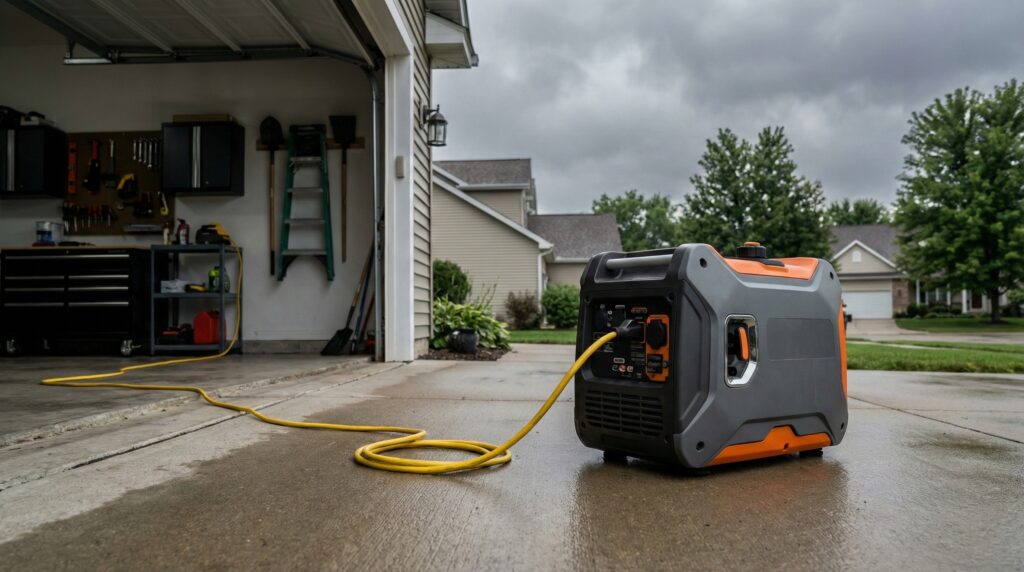
No. CO shutoff features can reduce risk, but they do not make indoor or attached-garage operation safe. Follow public safety guidance for outdoor placement well away from doors, windows, and vents; see CDC carbon monoxide safety guidance and CPSC generator safety guidance.
Gasoline vs propane: which is better for emergency storage?
Gasoline can go stale and gum up carburetors if it sits, which is a common “won’t start when I need it” failure point. Propane stores more reliably long term, but many generators make less peak power on propane, so you often need to size up for motor starts. Either way, run the generator under load periodically and keep spare oil and a spark plug on hand.
Can I plug a generator into a wall outlet to power my house?
No — that’s backfeeding and it can energize utility lines, risking electrocution and fire. If you want to power home circuits, use a properly installed transfer switch or interlock and follow code and local inspection requirements (often based on NFPA 70 / National Electrical Code). A licensed electrician is the right pro to consult for a safe setup.
What matters most for long-term ownership besides watts?
Parts and support, plus “boring” maintenance realities. Look for easy access to consumables (air filter, spark plug), clear warranty terms, and a service path you can actually use locally. Also plan for safe outdoor operation, appropriate cords, and CO alarms inside the home even when the generator is outside.
Bottom Line
For most shoppers who want one inverter generator that’s more capable than the small 2kW class, the GENMAX GM5500i is our top overall pick because it targets higher-output inverter use and includes CO Detect. If your priority is maximum portability and a proven track record for 120V camping/RV use, the Honda EU2200i is the cleaner fit — just be realistic about surge watts and 120/240V needs.
Affiliate disclosure: Some of the links in this article are affiliate links. We may earn a commission if you purchase through them.
Product prices and availability are accurate as of the date/time indicated and are subject to change. Any price and availability information displayed on Amazon.com at the time of purchase will apply to the purchase of this product. Certain content that appears on this site comes from Amazon. This content is provided “as is” and is subject to change or removal at any time.