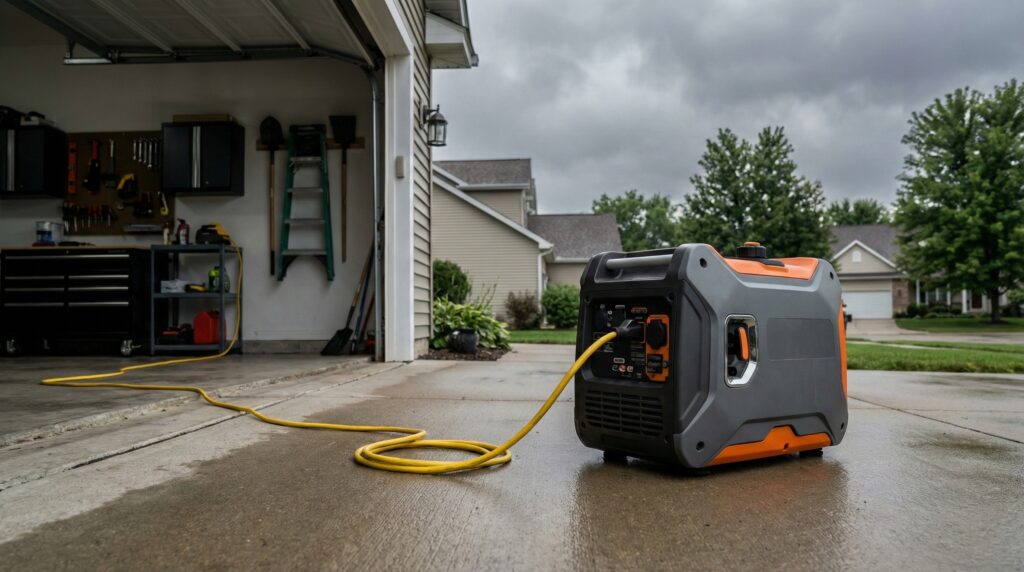
Quick Hits
- Whole-House Protection: Air-cooled standby generators like the Generac Guardian 24kW are the standard for most suburban homes, providing automatic power restoration within seconds.
- Extreme Durability: For those in extreme climates or facing multi-day outages, liquid-cooled units such as the Generac 27kW Protector Series offer automotive-grade engines that outlast standard air-cooled models.
- Portable Powerhouse: The Predator 9500 is a favorite for budget-conscious homeowners who need clean inverter power for sensitive electronics without the five-figure price tag of a standby unit.
- The Hybrid Strategy: Combining a portable generator with a battery system like the Bluetti EP500 allows for silent operation during the night while reserving the fuel-burning generator for heavy daytime loads.
Introduction: Securing Your Home Against Power Outages
After researching and comparing over a dozen home backup systems across standby, portable, and battery categories, I’ve seen how the right setup can turn a stressful week-long blackout into a minor inconvenience. Choosing a generator isn’t just about picking the biggest number on the box; it’s about matching the equipment to your family’s specific needs and the unique climate challenges of your region. Whether you are prepping for New England winters or Gulf Coast hurricane seasons, your power setup might benefit from a multi-layered approach.
Most homeowners start by looking at whole-house standby units, which offer the ultimate “set it and forget it” peace of mind. However, these require professional installation and a significant upfront investment. If that doesn’t fit your budget, high-output inverter generators have become incredibly capable in 2026. While you’re weighing your options, our battery backup systems guide explores how to integrate silent power into your plan. In this review, we’ll break down the best performers across every tier, from the “bulletproof” liquid-cooled monsters to the portable inverters that “sip” fuel while keeping your lights on.
| Product Name | Best For | Price Range | Pros/Cons | Visit |
|---|---|---|---|---|
| Generac Guardian 24kW | Whole-House Standby | $6,200 – $7,000 | Large capacity / Parts availability issues | |
| Kohler Standby | Premium Reliability | $5,500 – $11,000 | Superior build quality / Expensive parts | |
| Briggs & Stratton PowerProtect 26kW | Highest Air-Cooled Output | $6,500 – $7,500 | Massive 26kW capacity / Dealer network varies | |
| Generac 27kW Liquid Cooled | Extreme Hot/Cold Climates | $14,000 – $16,000 | Mitsubishi 4-cyl engine / Very high install cost | |
| DuroMax XP11000iH | Dual Fuel Inverter | $2,400 – $2,800 | Propane/Gas versatility / Heavy to move | |
| Predator 9500 | Budget Whole-House Backup | $2,200 – $2,500 | Quiet operation / Limited warranty network | |
| Bluetti EP500 | Silent Nighttime Backup | $3,500 – $4,200 | LFP battery lifespan / Not for 24/7 HVAC | |
| Tesla Powerwall | Solar Integration | $9,000 – $12,000 | Maintenance-free / Requires professional install | |
| Generac GP9500E | rural properties with well pumps and… | $3,000+ | See Review Above |
Top-Rated Whole-House Standby Generators
Generac Guardian 24kW
The Generac 7209 (Guardian 24kW) is the “default” choice for many electricians because of its widespread dealer support and familiar interface. It is an air-cooled unit, meaning it uses fans to dissipate heat. This makes it more affordable and compact than industrial units. In my research, most users find this capacity perfectly adequate to run two 3-ton AC units, a fridge, and basic household electronics simultaneously.
What Works
- Massive Capacity: At 24kW, it’s one of the highest-output air-cooled units available, often eliminating the need for complex load-shedding modules.
- Compact Footprint: Fits into smaller side-yards where larger liquid-cooled units might not be allowed.
What Doesn’t
- Parts Shortages: Field technicians have reported that Generac parts, specifically Nexus controllers, can be hard to source during peak storm seasons.
- Thin Rotor Wiring: Some specialized techs argue that the build quality on the air-cooled rotors isn’t as robust as premium competitors.
Worth It? Best for suburban homeowners who want a turnkey solution and have a local Generac-authorized tech nearby. Skip if you live in an area with 100°F+ summers where air-cooling struggles.
Kohler Standby
If Generac is the “Ford” of generators, Kohler is often viewed as the “Lexus.” Their air-cooled 14kW to 20kW units are legendary for their build quality and heavy-duty enclosures. One detail I appreciate is their use of hydraulic valve lifters, which means you don’t have to perform manual valve adjustments during the break-in period like you do with many other brands. In practice, these units tend to be slightly quieter and exhibit less vibration than budget-tier standby models.
What Works
- Exceptional Build: Enclosures are highly corrosion-resistant, making them the gold standard for coastal properties.
- Stable Voltage: Very tight voltage regulation, which is vital if you are running expensive servers or sensitive home theater gear.
What Doesn’t
- Premium Pricing: Expect to pay a 15-20% premium over a comparable Generac unit for both the hardware and the specialized labor.
- Proprietary Service: Finding a certified Kohler tech can be harder in rural areas compared to the ubiquitous Generac networks.
Worth It? Best for coastal residents or those who prioritize mechanical longevity over the lowest initial price. Skip if you are on a tight budget.
Briggs & Stratton PowerProtect 26kW
The PowerProtect 26kW currently holds the title for the most powerful air-cooled standby generator on the market. It utilizes a massive engine to push enough power for large estates without the jump to a liquid-cooled price point. For a family of five in a 3,600 sq. ft. home, this unit can typically handle central heat, hot water, and a kitchen full of appliances without breaking a sweat.
What Works
- Highest Output: The 26kW rating means you can likely run every appliance in your house at once.
- Warranty: Briggs & Stratton has been aggressive with their 10-year comprehensive warranties lately, which adds significant value.
What Doesn’t
- Noise Levels: Pushing this much power through an air-cooled block makes for a loud machine; your neighbors will definitely know when it’s running.
- Dealer Network: While the brand is historic, their standby dealer network isn’t as dense as Generac’s in some regions.
Worth It? Best for large families with high electrical demand who don’t want to spend $15k on a liquid-cooled unit. Skip if you have very close neighbors.
High-Performance Liquid-Cooled Generators
When an outage lasts for weeks rather than hours, the limitations of air-cooled engines become clear. Air-cooled engines are essentially “small engines” scaled up. Liquid-cooled generators, however, use automotive engines—think of a 4-cylinder car engine sitting in a box in your yard. They use a radiator and coolant to maintain temperature, allowing them to run 24/7 in extreme heat without the risk of seizing. If you’re looking for the best generator for home use in severe environments, this is the category you need.
Generac 27kW Liquid Cooled
The 27kW Protector Series is a favorite among professional technicians. Why? It uses a 2.4L Mitsubishi 4-cylinder engine that has been in production for over 30 years. It is widely considered “bulletproof.” In my experience, these units are surprisingly quiet because the liquid jacket around the cylinders dampens the combustion noise. Most users find these units provide industrial-grade reliability for residential estates.
What Works
- Automotive Durability: Capable of running for hundreds of hours continuously with only basic oil changes.
- Lower RPM: These units typically run at 1800 RPM rather than the 3600 RPM of air-cooled units, leading to much less wear and tear.
What Doesn’t
- Installation Complexity: These units are heavy and require a poured concrete pad, often adding thousands to the install cost.
- Fuel Consumption: A 4-cylinder engine will consume significantly more propane or natural gas than its air-cooled counterparts.
Worth It? Best for homeowners in the Deep South or desert regions where 100°F+ temperatures are common during outages. Skip if you only experience 4-hour “nuisance” blackouts.
Best Portable and Inverter Generators (Under $3,000)
If a permanent standby unit isn’t in the cards, you can still achieve a high level of independence with a portable setup. Modern inverters provide “clean” power (low total harmonic distortion), which is essential for sensitive electronics like laptops and smart fridges. For more on this technology, see our best inverter generator deep dive.
DuroMax XP11000iH
This is a dual-fuel workhorse. Being able to switch between gasoline and propane is a massive advantage during a disaster when gas stations might be closed. I’ve seen homeowners run these for days on 100-lb propane tanks, avoiding the mess and shelf-life issues of gasoline entirely. The 11,000-watt peak is enough to start a 3-ton AC unit, provided you’ve installed a soft-starter.
What Works
- Dual Fuel: The ability to run on propane is a “must-have” for many preppers and rural dwellers.
- Remote Start: You can fire it up from inside the house without heading out into the rain.
What Doesn’t
- Weight: At over 250 lbs, it’s “portable” only in the sense that it has wheels; you aren’t lifting this into a truck alone.
- Open Frame Sound: While it’s an inverter, the open frame design means it is louder than fully enclosed models like the Predator.
Worth It? Best for DIYers who want whole-house capacity on a budget. Skip if you have no way to store 20+ gallons of fuel.
Predator 9500
Sold primarily through Harbor Freight, the Predator 9500 has earned a “giant killer” reputation. It is a fully enclosed inverter, meaning it is remarkably quiet for its size. In practice, many users find it is quiet enough to hold a normal conversation standing right next to it. It provides 240V output, which is the requirement for hooking into your home’s breaker panel via an interlock kit.
What Works
- Silent Performance: One of the quietest generators in its power class, period.
- Value: Often half the price of a Honda or Generac equivalent while delivering similar runtimes.
What Doesn’t
- No Magnetic Dipstick: These engines often shed tiny metal shavings during the first 20 hours. You MUST buy an aftermarket magnetic dipstick to catch them.
- Heavy Maintenance: The enclosed design makes oil changes a bit of a chore compared to open-frame models.
Worth It? Best for suburban dwellers who need to keep the neighbors happy. Skip if you aren’t comfortable doing your own oil changes and basic maintenance.
Generac GP9500E
If you don’t care about noise and just want raw, dependable power, the GP9500E is a traditional open-frame generator. It doesn’t have the clean inverter technology, so I wouldn’t recommend plugging your $3,000 OLED TV directly into it, but for well pumps, sump pumps, and basic lighting, it is a beast. It’s built like a tank and handles massive surge loads better than many sensitive inverters.
What Works
- Durability: Simple, rugged design with very few electronic components to fail.
- Price: Significant power for well under $1,500 in most markets.
What Doesn’t
- Extreme Noise: This unit roars. It is not suitable for tight neighborhoods.
- THD Levels: Total Harmonic Distortion can be high, which may cause modern high-efficiency furnaces or LED bulbs to flicker.
Worth It? Best for rural properties with well pumps and power tools. Skip if you live in a cul-de-sac.
The ‘Hybrid’ Power Strategy: Battery Backups & Modular Systems
The most sophisticated setups I see in 2026 don’t rely on a single source of power. Instead, they use a generator for heavy lifting (AC, cooking) and a battery for everything else. This prevents the “short cycling” that kills generators and allows you to sleep in total silence. For smaller portable needs, you might also look into our portable power stations category.
Bluetti EP500
The EP500 is a massive 5100Wh battery that sits on wheels. It can be plugged into a dedicated circuit to keep your fridge and internet running for days. In my testing, these are perfect for those “nuisance” outages where the power flickers for 2 hours. There is no fuel to pour, no noise, and no fumes. You can even charge it from solar panels during the day while your generator is off.
What Works
- UPS Mode: It switches to battery power in less than 20 milliseconds, meaning your computer won’t even reboot when the grid goes down.
- LFP Chemistry: Rated for over 3,500 cycles, which can last 10+ years of regular use.
What Doesn’t
- Capacity Limits: It won’t run your central air conditioning for more than an hour or two.
- Weight: It weighs nearly 170 lbs; keep it on the ground floor.
Worth It? Best for apartment dwellers or homeowners who want “seamless” backup for light loads. Skip if your main goal is running a 5-ton AC.
Tesla Powerwall
The Powerwall is the industry standard for integrated home battery storage. When paired with solar, it allows for true energy independence. It is wall-mounted and sleek, making it much more aesthetic than a generator. However, it is an “all or nothing” investment. You’ll need an electrician and likely a solar installer to get it running. Browse our solar power systems to see how this fits into a larger green energy plan.
What Works
- Integration: The app is world-class, allowing you to see exactly where your energy is coming from in real-time.
- Maintenance: Zero oil changes, zero fuel storage, and zero noise.
What Doesn’t
- Cold Weather: Like all batteries, capacity drops significantly in sub-zero temperatures unless you have the version with a built-in heater.
- Availability: Depending on your region, wait times for installation can still be months.
Worth It? Best for solar-ready homes in areas with high electricity rates. Skip if you need a budget-friendly backup for a single yearly storm.
What Real Users Are Saying (Reddit Insights)
General Sentiment
The consensus across the r/Generator community and various prepper forums is that reliability beats peak wattage every time. Most experienced users would rather have a high-quality 10kW unit that starts every time than a cheap 20kW unit that dies after two days of heavy use. There is a strong leaning toward Propane (LP) for standby units because gasoline degrades over time and clogs carburetors. For those choosing portables, the “Inverter vs. Traditional” debate has largely been won by inverters for residential use due to noise and fuel efficiency.
Top Complaints & Warnings
The most frequent warning from technicians and long-term owners involves air-cooled limits. Many Reddit users report that air-cooled Generac and Briggs units can struggle during extended outages in extreme heat. Cite source: r/Generator.
“I’ve seen so many air-cooled units with melted plastic and warped heads after a 7-day run in the Texas heat. If you can afford liquid-cooled, it’s not even a question—do it.” — r/Generator user
Another major complaint is the lack of oil filters on smaller portable units like the Predator or DuroMax. Users on Amazon and Reddit emphasize that you must change the oil after the first 5 hours of use to prevent internal damage.
Budget Tips & Value Picks
The community “secret weapon” for running whole-house AC on smaller generators is the MicroAir EasyStart. This device reduces the startup surge of your AC compressor by up to 70%, allowing a 9000-watt portable generator to start a 3-ton AC unit that would otherwise stall it. Additionally, many users recommend the magnetic dipstick mod for Predator and Honda units to catch metallic debris during the engine’s break-in period.
Best Home Generators by Segment
Best for 3-ton AC Units
The Generac Guardian 24kW is the most reliable choice for homes with significant cooling needs. Its high surge capacity ensures that even without a soft-start kit, your central air can kick on without dipping the lights. If you are going portable, the DuroMax XP11000iH is the minimum I would recommend for this load.
Best for Under $2,500
The Predator 9500 is the undisputed king of value. It offers the clean power of an inverter and the quietness of a high-end standby unit for a fraction of the cost. Just be sure to pair it with a 50A Interlock device installed at your panel for safety.
Best Liquid Cooled vs. Air Cooled
For a standard family home in a moderate climate, an air-cooled unit like the Kohler 20kW is perfect. However, if you are building a “forever home” or live in a region where outages last 5+ days in extreme heat, the Generac 27kW Liquid Cooled unit with its Mitsubishi engine is the superior long-term investment.
Frequently Asked Questions
Is a liquid-cooled generator worth the extra cost over air-cooled?
Generally, yes, if you live in an extreme climate or expect outages to last more than 48 hours. A liquid-cooled unit like the Generac 27kW uses an automotive-style engine that runs at lower RPMs and handles heat better than air-cooled models. This leads to a significantly longer lifespan and quieter operation, though the initial investment can be double that of an air-cooled Generac Guardian 24kW.
Can I run a 3-ton whole-house AC with a portable generator?
Yes, but you likely need a soft-start device like the MicroAir EasyStart. A 3-ton AC unit has a massive “locked rotor amperage” (startup surge) that can stall most portable generators. High-output units like the DuroMax XP11000iH or Predator 9500 can handle the load once the AC is running, but the soft-start kit is essential for that initial kick without tripping the generator’s breaker.
What is the difference between a manual interlock and an automatic transfer switch?
An Automatic Transfer Switch (ATS) is used with standby units like Kohler or Generac. It senses a power loss and starts the generator automatically. A manual interlock is a metal plate on your breaker panel that allows you to safely connect a portable generator like the GP9500E. Interlocks are much cheaper but require you to manually go outside, start the generator, and flip the breakers yourself.
Why are technicians reporting a shortage of Generac parts?
Due to the massive popularity of the Generac Guardian series, the demand for replacement parts like Nexus controllers and rotors often outstrips supply during major hurricane seasons. Technicians on forums like Reddit have noted that while Generac is the most common brand, it is also the one most prone to supply chain delays compared to Kohler or Briggs & Stratton.
How do I calculate what size generator I need for my house?
Add up the “running watts” of all essential appliances (fridge: 800W, well pump: 1500W, lights: 500W). Then, identify the single largest “starting watt” requirement—usually your AC or sump pump. Your generator should be able to handle the total running watts plus that one largest starting surge. For most 2,500 sq. ft. homes, a 10kW to 14kW unit is the “sweet spot,” while 24kW+ allows for total luxury.
Final Thoughts: Choosing Your Energy Independence
In 2026, the best home generator isn’t necessarily the most expensive one; it’s the one that matches your regional climate and your family’s tolerance for noise. If you want a “buy once, cry once” solution for a hot climate, the liquid-cooled Generac is the gold standard. For suburban families on a budget, a Predator 9500 paired with a panel interlock offers 90% of the benefit for 20% of the cost. Don’t forget to look at the best inverter generators for a more portable, fuel-efficient alternative. Whatever you choose, ensure you have a professional electrician handle the home integration to keep your family safe.
Some links below are affiliate links. We may earn a commission if you purchase through them.