
Quick Hits
You do not need solar panels to benefit from a home battery backup. Modern AC-coupled systems allow you to charge directly from the grid during cheap off-peak hours and provide seamless power during outages. For whole-home integration, the FranklinWH aPB stands out for its intelligence, while the Anker Solix F3800 offers the best support for heavy 240V appliances like well pumps. If you want a modular system that grows with your needs, the Enphase IQ Battery 5P is a top contender, whereas the EcoFlow Delta Pro Ultra provides a simpler, semi-portable approach. For those in apartments or small homes needing to keep the essentials running, the Jackery Explorer series offers reliable, compact power without the need for complex electrical work. While batteries provide a cleaner, quieter alternative to gas generators, they act as a finite fuel tank—once the energy is gone during an outage, you cannot refill it until the grid returns.
Can You Use a Home Battery Without Solar?
It is a common misconception that home batteries and solar panels are a package deal. While they work beautifully together, you can absolutely install a battery system that relies solely on the utility grid for its “fuel.” These are known as AC-coupled systems. Instead of taking DC power from solar panels, they take AC power from your home’s electrical panel, convert it to DC to store in the battery, and then convert it back to AC when your lights go out or when electricity prices spike.
The transition from older Lead-Acid batteries to Lithium Iron Phosphate (LiFePO4 or LFP) has been the real catalyst for this shift. LFP batteries are safer, last for thousands of cycles, and can sit fully charged for long periods without the degradation issues seen in older technologies. If your goal is to avoid the noise and maintenance of a gas generator, or if you live in an area where solar isn’t feasible due to shading or roof constraints, a grid-charged battery is your best path toward energy independence. For a deeper look at the various hardware options, our battery backup systems guide explores the core technology in detail.
Top 5 Home Battery Backups Without Solar
1. Best Whole-Home Efficiency: FranklinWH aPB
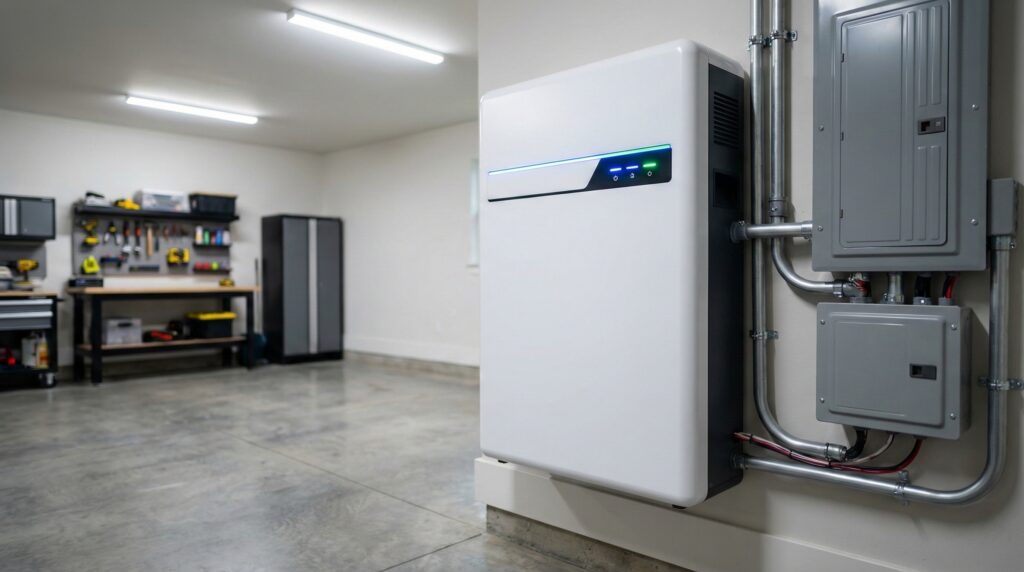
The FranklinWH aPB (all-in-one Power Base) is designed for people who want a “set it and forget it” experience. It isn’t just a battery; it’s an intelligent energy management system. It integrates directly with your main electrical panel and uses its built-in software to manage high-load appliances. If the grid goes down, the FranklinWH system can automatically shed non-essential loads to ensure your battery lasts as long as possible. You won’t have to worry about manually flipping breakers in the dark.
In practice, users appreciate the FranklinWH for its seamless transition. You often won’t even notice the power has flickered. It’s a sophisticated piece of hardware that handles 13.6kWh per unit, and you can stack up to 15 of them if you have the wall space and the budget. However, because it is a high-voltage, hardwired system, you will need a certified professional for the installation.
What Works
- Impressive 10kW peak power output allows it to start heavy AC units.
- The app is intuitive and provides granular control over which circuits get priority.
- Extremely robust build quality designed for indoor or outdoor installation.
What Doesn’t
- High entry cost compared to portable alternatives.
- Finding an installer who is familiar with FranklinWH can be harder than finding a Tesla or Enphase technician.
- The system is heavy and requires significant wall reinforcement.
Worth It? Best for homeowners who want a permanent, high-capacity solution that manages the whole house automatically. Skip if you are looking for a DIY or budget-friendly project.
Check FranklinWH Pricing & Availability
2. Best for High-Demand Appliances: Anker Solix F3800
If your home relies on a well pump, a clothes dryer, or a central HVAC system, you need 240V power. Most portable units only output 120V, leaving your most important appliances useless. The Anker Solix F3800 is a rare breed that provides native 240V output in a semi-portable form factor. You can roll it into your garage and plug it into a manual transfer switch, effectively powering your critical loads without a $15,000 permanent installation.
The F3800 is incredibly versatile. You can start with a single 3.84kWh unit and expand it up to 26.9kWh by stacking expansion batteries. This flexibility is perfect for people who aren’t sure exactly how much backup they need. You can start small and add more “fuel” to your tank later. We’ve looked at how this compares to other high-capacity units in our best solar generator roundup, though the F3800 shines specifically for its grid-charging speed.
What Works
- Dual-voltage support (120V/240V) is a lifesaver for suburban homes with well pumps.
- The wheels and “luggage-style” handle make it much easier to move than fixed batteries.
- It supports EV charging, meaning you can use your home backup to put a few miles into your car in an emergency.
What Doesn’t
- The unit is very heavy (over 130 lbs), so don’t plan on carrying it up stairs frequently.
- Some users on Reddit have reported the cooling fans can be quite loud during high-speed grid charging.
- The proprietary expansion cables are short, limiting where you can place the extra batteries.
Worth It? Best for suburban dwellers who need to run 240V appliances but don’t want a permanent wall-mounted system. Skip if you only need to power a laptop and a few lights.
Shop Anker Solix F3800 on Amazon
3. Best Scalable Option: Enphase IQ Battery 5P
Enphase is a darling of the smart home community, particularly among those who use Home Assistant for automation. The IQ Battery 5P is their latest modular offering. Instead of one massive battery, Enphase uses smaller 5kWh increments. This allows you to precisely size your system to your budget and space. Because Enphase uses microinverter technology within the battery itself, the system is exceptionally reliable; if one component fails, the rest of the battery bank keeps working.
For a grid-only user, the Enphase system is excellent for “Time-of-Use” (TOU) optimization. You can program the system to charge when your utility rates are lowest (usually middle of the night) and discharge during the expensive afternoon peaks. Over several years, this “grid arbitrage” can help the system pay for itself, even without a single solar panel on your roof.
What Works
- Industry-leading 15-year warranty provides massive peace of mind.
- Integrates perfectly with existing smart home ecosystems.
- The modular design means you can easily add more capacity five years down the road.
What Doesn’t
- Requires the Enphase System Controller to work in a “blackout” scenario, which adds to the installation cost.
- Installers often push hard for a solar add-on, as mentioned in many Reddit threads.
- The app can be overly complex for users who just want basic battery info.
Worth It? Best for tech-savvy homeowners who want a long-term, warranted system with deep smart-home integration. Skip if you want a simple “plug-and-play” solution.
4. Best for Ease of Installation: EcoFlow Delta Pro Ultra
The EcoFlow Delta Pro Ultra is perhaps the most ambitious battery released recently. It sits in the middle ground between a portable power station and a whole-home battery. It is modular, meaning you can stack the battery “bricks” like Legos. One inverter unit can handle up to five batteries, giving you 30kWh of storage. If you add more inverters, you can power an entire mansion.
What makes the Delta Pro Ultra stand out is the “Smart Home Panel 2.” This is a sub-panel that an electrician installs next to your main breaker box. Once it’s in, you simply plug the Delta Pro Ultra into the panel using a large cord. There is no permanent high-voltage wiring inside the battery units themselves, making it much faster (and cheaper) to install than a Tesla Powerwall or FranklinWH system. It’s a great companion to the gear we’ve highlighted in our portable power stations category.
What Works
- Can be charged via a standard wall outlet, an EV charging station, or the Smart Home Panel.
- Silent operation compared to any gas-powered alternative.
- The 6,000W output can handle an 3-ton central AC unit without tripping.
What Doesn’t
- The software ecosystem can be buggy; users occasionally report firmware updates that reset custom settings.
- It occupies a large footprint if you stack multiple batteries.
- The Smart Home Panel 2 is expensive and requires a specific type of electrical setup.
Worth It? Best for renters or homeowners who want high capacity without the “construction project” feel of permanent batteries. Skip if you have very limited floor space.
Check EcoFlow Delta Pro Ultra on Amazon
5. Best Value for Small Loads: Jackery Explorer 2000 Plus
Not everyone needs to power a central air conditioner. If your main concern is keeping your refrigerator running, charging your phones, and ensuring your Wi-Fi stays up during a storm, the Jackery Explorer 2000 Plus is the practical choice. It is a true “plug-and-play” device. You keep it plugged into a wall outlet in your living room or office, and it stays topped off at 100%.
The 2000 Plus uses LFP cells, which is a major upgrade for Jackery, ensuring the battery remains healthy for over 10 years of regular use. It’s quiet, portable enough to take on a camping trip, and requires zero installation. For those in NYC apartments or small suburban townhomes, this is often all the backup you really need. It’s essentially a giant version of the devices found in our best solar power bank guide, but with enough “oomph” to run a kitchen appliance.
What Works
- Zero installation required—just plug it into the wall.
- Very reputable customer service and a history of reliable hardware.
- Expandable capacity if you decide you need more runtime later.
What Doesn’t
- You have to manually plug your appliances into the unit during an outage (unless you use a portable transfer switch).
- It cannot power 240V appliances like dryers or large well pumps.
- The charging bricks can get quite warm during fast-recharge cycles.
Worth It? Best for apartment dwellers or those on a budget who only need to back up essential electronics. Skip if you need to power your whole house through your existing outlets.
Find Jackery Explorer 2000 Plus on Amazon
Home Battery Comparison: Top No-Solar Picks
| Product Name | Best For | Price Range | Pros/Cons | Visit |
|---|---|---|---|---|
| FranklinWH aPB | homeowners who want a permanent, high-capacity solution that manages the whol… | Check price on Amazon | ✅ Impressive 10kW peak power output allows it to sta; The app is intuitive and provides granular control ❌ High entry cost compared to portable alternatives.; Finding an installer who is familiar with Franklin |
|
| Anker Solix F3800 | suburban dwellers who need to run 240V appliances but don’t want a permanent … | Check price on Amazon | ✅ Dual-voltage support (120V/240V) is a lifesaver fo; The wheels and “luggage-style” handle make it much ❌ The unit is very heavy (over 130 lbs), so don’t pl; Some users on Reddit have reported the cooling fan |
|
| Enphase IQ Battery 5P | tech-savvy homeowners who want a long-term, warranted system with deep smart-… | Check price on Amazon | ✅ Industry-leading 15-year warranty provides massive; Integrates perfectly with existing smart home ecos ❌ Requires the Enphase System Controller to work in ; Installers often push hard for a solar add-on, as |
|
| EcoFlow Delta Pro Ultra | renters or homeowners who want high capacity without the “construction projec… | Check price on Amazon | ✅ Can be charged via a standard wall outlet, an EV c; Silent operation compared to any gas-powered alter ❌ The software ecosystem can be buggy; users occasio; It occupies a large footprint if you stack multipl |
|
| Jackery Explorer 2000 Plus | apartment dwellers or those on a budget who only need to back up essential el… | Check price on Amazon | ✅ Zero installation required—just plug it into the w; Very reputable customer service and a history of r ❌ You have to manually plug your appliances into the; It cannot power 240V appliances like dryers or lar |
What Real Users Are Saying (Reddit Insights)
General Sentiment
The general consensus on Reddit, particularly in communities like r/preppers and r/homeenergy, is that battery-only backups are a superior, quieter alternative to gas generators for short-term outages (1-3 days). Users in suburban areas like NYC and Chicago, where gas generators can be a nuisance to neighbors, find that systems like the Anker Solix or EcoFlow are much more “socially acceptable.” Many users also highlight the secondary benefit of using these batteries for “Free Nights” plans, where they charge the battery at 0 cents per kWh at 2 AM and run their house for free during the day.
Top Complaints & Warnings
While the hardware is generally praised, the “real world” of installation can be frustrating. Here are the most common warnings from the community:
- The Installer ‘Solar Push’: Multiple users report that finding an electrician to install a battery-only system is difficult. “I had to tell him 3 times I don’t want solar,” one Reddit user noted, explaining that installers often get higher commissions on solar panels and will bash battery-only setups as “too expensive.”
- Regulatory Red Tape: Even without solar, many utility companies require a “Permission to Operate” (PTO) if the battery is tied to your electrical panel. This can take weeks or months of paperwork.
- The “Finite Tank” Issue: In a multi-day outage, a battery can run dry. One user mentioned,
“Without solar, a battery is a finite fuel tank—once it’s empty during an outage, it’s empty until the grid returns.” — r/enphase
This is why many users still keep a small solar generator or a backup panel for long-term emergencies.
Budget Tips & Value Picks
For those on a budget, the community often recommends avoiding the “Big Three” (Tesla, Enphase, Franklin) and looking toward the portable ecosystem.
“You got Anker and EcoFlow as DIY options with simple smart panels and low installs.” — r/enphase
Buying a portable unit and a manual transfer switch (roughly $300-$500 for the switch) is the most cost-effective way to get backup power without the “installer tax.”
How to Maximize Your ROI: Grid Arbitrage and Time-of-Use
If you’re paying for a home battery, you want it to do more than just sit there waiting for a storm. The most effective way to see a return on investment is through Time-of-Use (TOU) shifting. Most modern utility plans charge you significantly more for power between 4 PM and 9 PM. By setting your battery to discharge during these hours, you avoid those high rates. Then, the battery recharges at 2 AM when demand is low and rates are cheap.
In some regions, you can even join “Virtual Power Plants” (VPPs). Your utility company might pay you to discharge your battery back into the grid during peak demand events. Over a year, these small credits and savings on your daily bill can add up to hundreds of dollars, making the battery a financial tool as well as a safety one.
Portable Power Stations vs. Fixed Battery Systems
When you’re shopping, you’ll see a massive price gap between portable units ($3,000–$5,000) and fixed systems ($10,000–$15,000+). The difference usually comes down to two things: Power and Permitting.
Fixed systems like the FranklinWH or Tesla Powerwall are hardwired into your home. They can back up your entire house automatically. You don’t have to lift a finger; the lights don’t even flicker. Portable units like the Jackery or EcoFlow usually require you to manually plug in your fridge or flip a manual transfer switch. However, portable units don’t always require a utility permit, and you can take them with you if you move. If you’re looking for something purely for off-grid trips that can double as a home backup, check out our guide to the best solar power bank for smaller devices.
Technical Buying Guide: Capacity, Inverters, and Chemistry
To avoid buyer’s remorse, you need to understand three technical specs:
- LiFePO4 (LFP) Chemistry: Only buy batteries using LFP. They are rated for 3,000+ cycles, meaning they will last 10 years even if you use them every single day. Older NCM (Lithium-ion) batteries degrade faster and have a higher risk of thermal runaway.
- Continuous vs. Peak Output: A battery might say it has 5,000W of power, but can it handle the 10,000W “surge” your AC unit needs to start? Look for the peak or “starting” wattage if you plan on running motors.
- Calculating Daily Load: On average, a US home uses about 30kWh per day. If you have a 10kWh battery, it will only last about 8 hours if you don’t change your habits. To stretch a battery for 2 days, you must turn off the HVAC and only run the essentials (fridge, lights, Wi-Fi).
Frequently Asked Questions
Can I charge a home battery backup from the grid instead of solar?
Yes, all modern home batteries like the FranklinWH aPB and Anker Solix F3800 can be charged directly from a standard AC outlet or a dedicated circuit. This is actually a popular strategy for those with Time-of-Use (TOU) electricity plans, allowing them to charge at night when rates are lowest and use the power during the day.
Do I need utility company permission (PTO) for a battery-only system?
If the battery is permanently hardwired into your home’s electrical panel, your utility company usually requires Permission to Operate (PTO). However, if you use a portable unit like the Jackery Explorer 2000 Plus or an EcoFlow Delta Pro plugged into a manual transfer switch, you typically do not need utility approval, as the system is not “grid-tied” in a way that feeds power back to the street.
Is a battery backup cheaper than a natural gas generator?
Upfront, a battery is usually more expensive. A high-end natural gas generator might cost $10,000 installed, while a whole-home battery could be $15,000. However, batteries have zero fuel costs and require no annual maintenance. Over 10 years, especially if you use grid arbitrage to lower your monthly bills, the battery can often become the cheaper long-term investment.
Can I add solar panels to my battery backup later if I change my mind?
Absolutely. Most systems, including the EcoFlow Delta Pro Ultra and the Enphase IQ Battery, are designed to be “solar-ready.” You can add panels at any time. For a look at which panels might suit your future needs, browse our solar generators section for compatible folding or rigid panel options.
How long will a 15kWh battery power a typical home during an outage?
A 15kWh battery will typically run a refrigerator, LED lights, and home networking for about 24 to 36 hours. If you try to run your central air conditioning, it may only last 2 to 4 hours. Managing your “load” is critical when you don’t have solar panels to recharge the system during the day. For smaller, more targeted backup needs, consider the devices in our best solar power bank review.
Will a home battery backup work with a slate or tile roof?
Yes. This is one of the biggest reasons people choose battery-only systems. If you have a slate, tile, or historic roof where solar panel installation is prohibited or too expensive, a grid-charged battery gives you all the benefits of backup power without risking damage to your specialized roofing materials.
Final Thoughts
Choosing a home battery without solar is a smart, pragmatic move for homeowners who prioritize reliability and quiet operation over total off-grid living. Whether you go for a permanent, intelligent system like the FranklinWH or a versatile, high-output unit like the Anker Solix F3800, you are buying peace of mind. Just remember that without the sun to refill your tank, energy management becomes your primary job during an outage. Stick to the essentials, watch your capacity, and enjoy the silence of a generator-free home.
Some links below are affiliate links. We may earn a commission if you purchase through them.
Affiliate disclosure: Some of the links in this article are affiliate links. We may earn a commission if you purchase through them.